The server security audit script answers the questions you ask in the first ten minutes on a server you have never seen: who can log in and how, is there a firewall, is anything protecting SSH, is it patched, is anything listening where it should not. It is a baseline, not a scanner.
Version 2.3.0 (7 October 2026): An external review found that the firewall check could say PASS when the only DROP rules were fail2ban bans or a single blocked port and everything else was accepted. PASS now needs a catch-all deny on the INPUT path; specific drops on an ACCEPT policy, or a DROP that an earlier conditional ACCEPT may bypass, are now warnings.
Table of Contents
Version 2 fixes the thing that matters most in a security report: a check that could not run no longer looks like a check that passed. When /etc/shadow cannot be read, the empty-password check says SKIP. When dnf check-update fails because a mirror is down, the updates check says SKIP instead of “no pending updates”. Skipped checks are counted in the summary and set exit code 1.
What it checks
- Accounts: extra UID 0 users, accounts with empty passwords,
NOPASSWDsudo rules. - SSH: effective values from
sshd -T, or fromsshd_configand itsIncludefiles whensshd -Tfails: port,PermitRootLogin,PasswordAuthentication, X11 forwarding,authorized_keysentries. - Firewall: the INPUT rules from
nft list rulesetandiptables -Sare evaluated in order, following jumps into CSF, ufw, firewalld and Docker chains. PASS (“INPUT filtering verified”) needs a catch-all deny that traffic actually reaches: a DROP/REJECT policy, or a DROP/REJECT rule with no conditions, for example after ESTABLISHED, lo or SSH ACCEPT rules. If the only DROP/REJECT rules match specific traffic, such as fail2ban or sshguard bans or single ports, and everything else is accepted, the result is a WARN “No catch-all DROP”. A DROP that comes after a conditional ACCEPT (for example-p tcp -j ACCEPTfollowed by-p tcp --dport 22 -j DROP) is a WARN “INPUT filtering UNVERIFIED”; the line names the rules so you can check the order by hand. An ACCEPT-everything rule before any DROP, accept-only rule sets and drops in unrelated chains are a WARN. For nftables, every base chain on the input hook is checked, including fail2ban and sshguard tables. If one backend passes, a weaker result from the other is shown as INFO only. An active CSF, firewalld or ufw is shown for context but is not a PASS on its own; CSF in TESTING mode or disabled is a WARN. - Listening services: open TCP ports, and a warning if MySQL, PostgreSQL, Redis, Memcached or MongoDB listen on all interfaces.
- Brute-force protection: fail2ban with at least one jail, CSF with LFD running, cPHulk, or Imunify360 with its service running (an installed but stopped agent is a WARN), plus failed SSH logins in the auth log.
- Updates: pending
dnf/yumoraptupdates (with the age of the apt lists) and whether a reboot is required. - Kernel / MAC: SELinux or AppArmor,
tcp_syncookies,rp_filter. - Filesystem: world-writable files under
/homeand/var/www, SUID binaries newer than/etc/passwd,noexecon/tmp, filesystems over 90% full.
Usage
curl -fsSL https://srvscripts.com/get/server-security-audit/ -o server-security-audit.sh
bash server-security-audit.sh                   # full report, run as root
bash server-security-audit.sh --brief           # only WARN and SKIP lines plus the summary
bash server-security-audit.sh --allow-skipped   # skipped checks do not set exit 1
bash server-security-audit.sh --no-color > audit.txt
No arguments are required.
Sample output
  INFO  Not running as root: checks that need root are reported as SKIP and make the exit code 1 (use --allow-skipped to accept that).

== Accounts ==
  PASS  Only root has UID 0
  SKIP  Empty-password check: /etc/shadow not readable (needs root)
  SKIP  NOPASSWD sudo check: sudoers files not readable (needs root)

== SSH ==
  INFO  Settings from: config files (sshd -T failed)
  INFO  SSH port: 22
  PASS  PermitRootLogin = prohibit-password
  WARN  PasswordAuthentication = yes (default) — use keys
  SKIP  authorized_keys count: needs root

== Firewall ==
  SKIP  Firewall state unknown: nft list ruleset needs root; iptables -S needs root

== Updates ==
  WARN  201 packages have updates pending (apt-get -s upgrade, lists 0d old)

== Filesystem ==
  SKIP  World-writable file scan: needs root
  SKIP  SUID binary scan: needs root

== Summary ==
4 warning(s), 6 check(s) could not run.
Not running as root: re-run as root for a complete audit.
This is a shortened run as an unprivileged user on a test Ubuntu 24.04 machine. On the same machine as the same user, version 1 printed PASS for “No accounts with an empty password” and “No NOPASSWD sudo rules” without being able to read /etc/shadow or the sudoers files, and reported “No active firewall” from rules it could not read. Now those lines are SKIP and the summary says six checks did not run.
Tested on a real server
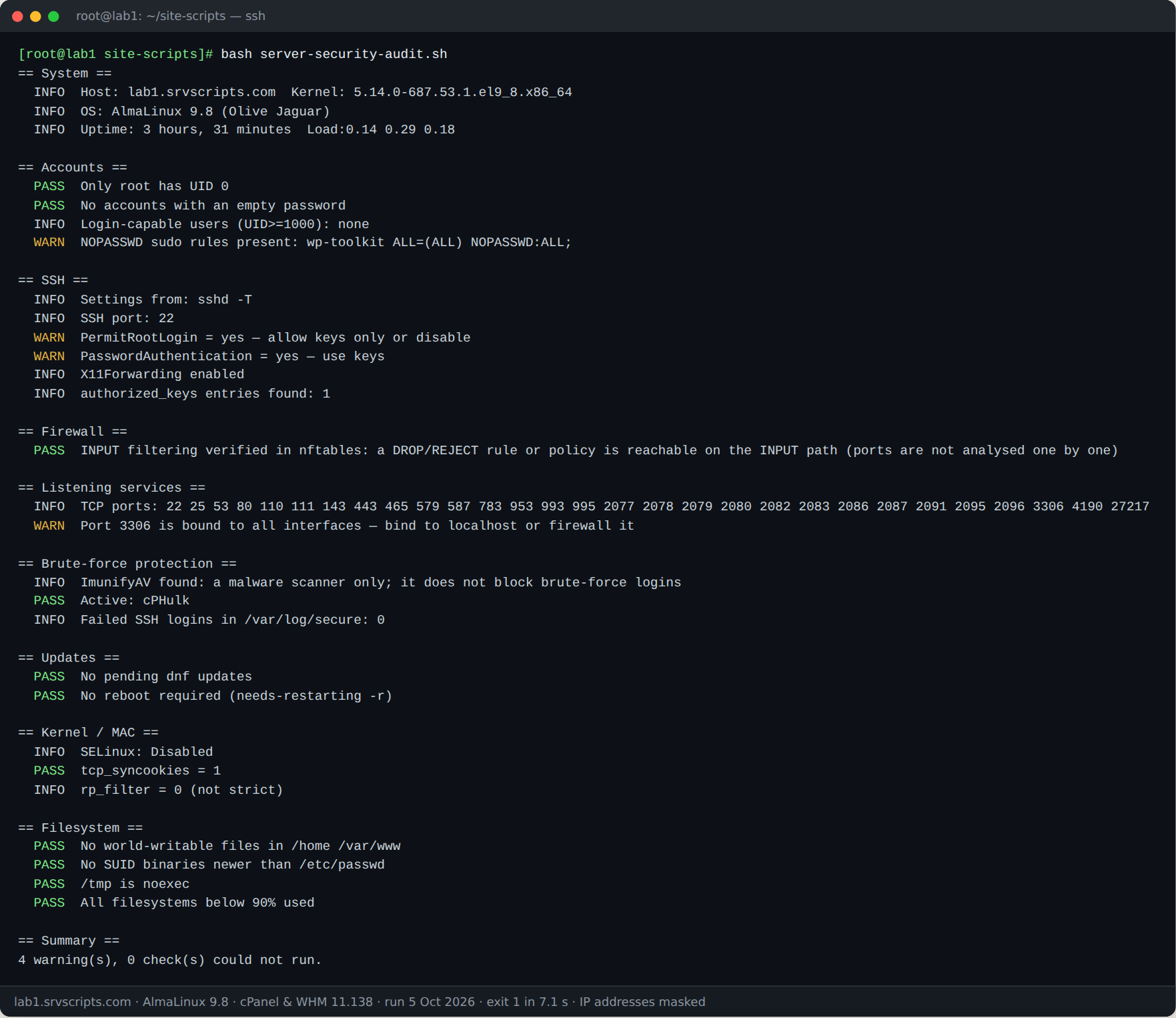
We ran this script on our lab server on 5 October 2026: AlmaLinux 9.8 with cPanel & WHM 11.138, MariaDB 10.11 and three WordPress test accounts. The screenshot is the real terminal output; only IP addresses are masked.
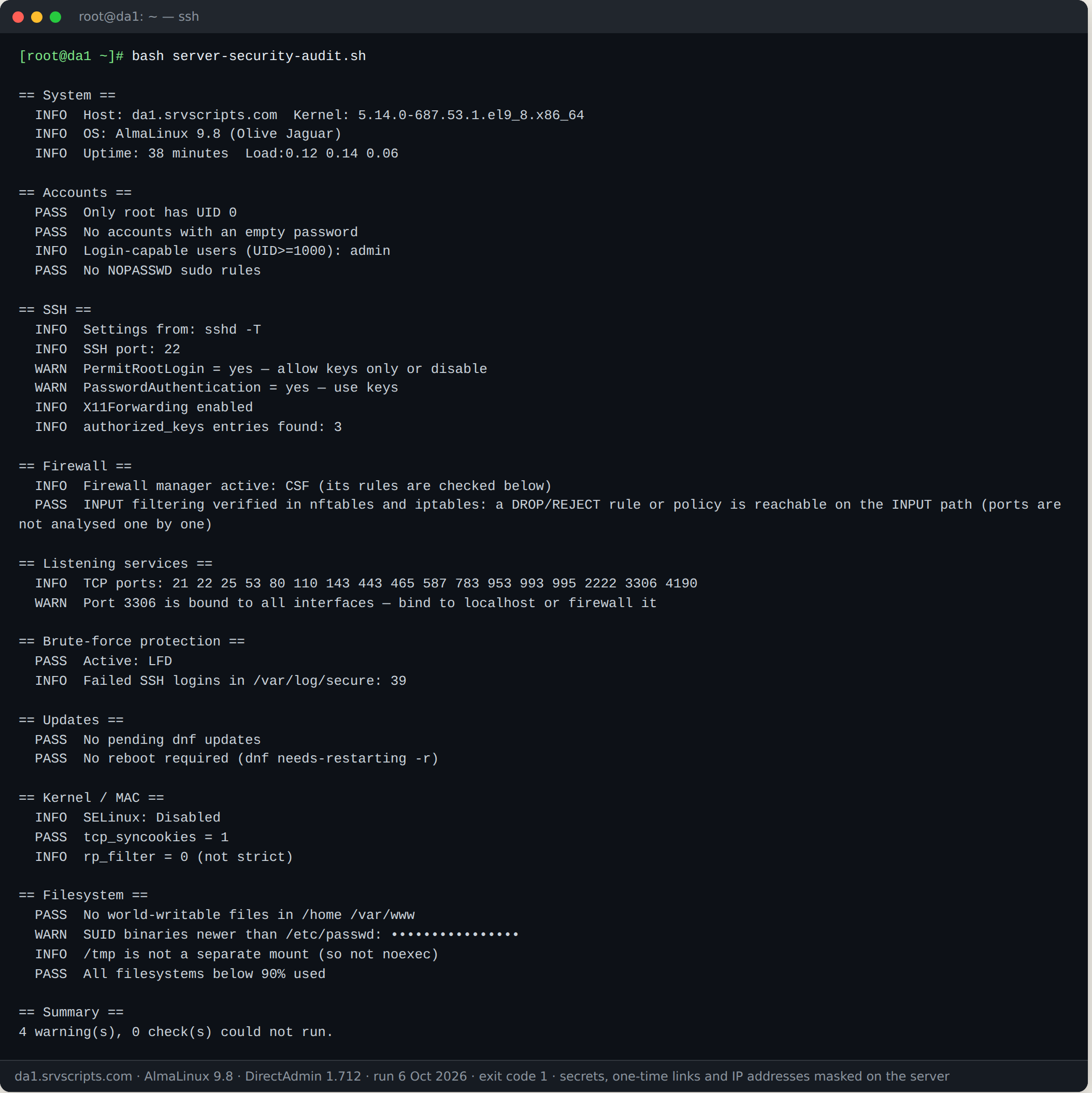
Second run, on our DirectAdmin test server (DirectAdmin 1.712, AlmaLinux 9.8, CSF/LFD, 6 October 2026). It found four warnings on a default install, including MariaDB listening on all interfaces (port 3306) and SSH password logins still enabled.
What the test changed: Our lab test found a false warning in version 2.2.0: the free ImunifyAV scanner that cPanel installs by default was mistaken for Imunify360 and reported as "installed but not running". Fixed in 2.2.1, shown above.
Version 2.3.0 lab results (7 October 2026): On a Debian 12 server with FreePBX 17, where the INPUT policy is ACCEPT and the only drops come from fail2ban chains, 2.3.0 reports WARN No catch-all DROP on the INPUT path (... 7 specific drop/reject rule(s) ...; then INPUT policy ACCEPT): only specific DROP/REJECT rules such as fail2ban bans or single ports; traffic not explicitly blocked is allowed. Version 2.2.1 said PASS on the same host.
On the same host we added two test rules, -I INPUT 1 -p tcp -j ACCEPT and -A INPUT -p tcp --dport 2999 -j DROP. Version 2.3.0 reported WARN INPUT filtering UNVERIFIED ... a DROP rule exists, but an earlier ACCEPT rule may let the same traffic through first; check the rule order manually, where 2.2.1 had said PASS INPUT filtering verified. We removed the test rules afterwards.
On the DirectAdmin server (AlmaLinux 9.8, DirectAdmin 1.712, CSF) the check still passes: PASS INPUT filtering verified in nftables and iptables: the INPUT path ends in a catch-all DROP/REJECT rule or policy (ports are not analysed one by one). On the cPanel lab (AlmaLinux 9.8, cPanel & WHM 11.138), which uses cPanel’s own nftables rules and no CSF, the firewall result is now WARN UNVERIFIED. The screenshots above were taken before 2.3.0.
Options
--brief: print only WARN and SKIP lines and the summary.--allow-skipped: exit 0 when the only issues are skipped checks, for example a deliberate non-root run.--no-color: plain output (colour is only used on a terminal anyway).-h,--help,--version.
Running the server security audit script from cron
Exit code 0 means every check ran and passed, 1 means a warning or a skipped check, 2 is a usage error. After an upgrade to 2.3.0, a server whose only drops are fail2ban bans or single ports on an ACCEPT policy gets the new firewall WARN, so the cron job below will start to mail you about it. Run it as root:
0 7 * * 1 /root/bin/server-security-audit.sh --brief --no-color || mail -s "Security audit: $(hostname)" you@example.comNotes
Nothing is changed; every check is a read. The script creates one temporary file for find error output and removes it on exit. On cPanel it asks whmapi1 for the cPHulk status. A failed call is reported as unknown, not as “no protection”. For SSH settings, sshd -T needs root and readable host keys; without it the script parses the config files, and if one of those is unreadable the SSH checks are skipped. Directives are documented in the OpenSSH manual.
Limitations
- The config-file fallback for SSH stops at the first
Matchblock and does not evaluateMatchrules. - apt results are only as current as the last
apt-get update, which is why the list age is printed. - The world-writable scan covers
/homeand/var/www; the SUID scan covers the root filesystem only (-xdev). - A firewall PASS means the INPUT path ends in a default deny, not that every port or service is covered: compare the listening services with what should be public. The script does not compare what rules match. A catch-all DROP or a DROP policy counts as verified even when an earlier ACCEPT is broad enough to let almost everything through, such as
-i eth0 -j ACCEPTon a host with only one interface. A DROP after any conditional ACCEPT is reported as UNVERIFIED, even when it really is reachable. Legacyip6tablesrules are not evaluated (nftablesinettables are). Brute-force results show that protection is running; Imunify360’s own protection settings are not inspected. - If
systemctlcannot be queried (no D-Bus access, for example inside some containers), service-based checks are reported as SKIP rather than as inactive.
Changelog
- 2.3.0 — The firewall check passes only when the INPUT path ends in a catch-all deny (a DROP/REJECT policy, or an unconditional DROP/REJECT rule that traffic reaches). Specific DROP/REJECT rules such as fail2ban bans or single ports on an ACCEPT policy are now a WARN “No catch-all DROP”, and a DROP after a conditional ACCEPT is a WARN “INPUT filtering UNVERIFIED”, for iptables and nftables. Every nftables base chain on the input hook is checked. Found in an external review.
- 2.2.0 — Firewall rules are evaluated in order: an ACCEPT-everything rule before the DROP is now a WARN, not a PASS. An active CSF, firewalld or ufw no longer passes without a reachable DROP/REJECT in its rules, and unreadable rules with an active manager are SKIP.
- 2.1.0 — Imunify360 counts as brute-force protection only when its service is running; an installed but stopped agent is a WARN.
- 2.1.0 — iptables and nftables checks follow the INPUT path (and the chains it jumps to) and require a drop or reject there; accept-only rules or a drop in an unrelated chain no longer count as an active firewall. A disabled CSF is reported.
- 2.1.0 — A failed
systemctlquery is SKIP instead of “not active”; fail2ban without jails and CSF without a running LFD are reported. - 2.0.0 — Checks whose data cannot be read (shadow, sudoers, firewall rules, sshd config, auth log) report SKIP instead of PASS; skipped checks are counted and set exit 1 unless
--allow-skipped. - 2.0.0 —
dnf/yum check-updateexit codes handled (0 none, 100 updates, other = unknown); failedapt-get -s upgradeor empty apt lists are unknown;needs-restarting -rexit 1 means reboot, other codes mean unknown. - 2.0.0 — Disk usage warnings now count towards the total and the exit code.
- 2.0.0 — Every command that can fail for reasons other than a negative finding (
sshd -T,whmapi1,systemctl,ss,find,ufw,nft,iptables,sysctl,df) is handled explicitly. - 2.0.0 —
sshd -Tfallback readsIncludefiles and uses the correct OpenSSH default forPermitRootLogin;--no-color,-h/--help,--version; colour only on a terminal; SKIP lines in--brief. - 1.0.0 — Initial release: accounts, SSH, firewall, ports, brute-force, updates, sysctl, filesystem.
Server security audit script at a glance
Official documentation: cPanel & WHM documentation, AlmaLinux wiki, Linux man pages.
Related guides: cPanel Root Escalation Incident Response: Critical First 24 Hours · CSF Fork 2026: Which Reliable Replacement After ConfigServer? · Hardening CSF safely: disabling Messenger, remote lists and other risky options.
The script
#!/usr/bin/env bash
# Server Security Audit Script (v2.3.0) - from srvScripts.com
# Source, docs and updates: https://srvscripts.com/scripts/server-security-audit/
# Copyright (c) 2026 srvScripts.com. MIT licence: if you copy, share or adapt this script, keep this notice and credit srvScripts.com.
# server-security-audit.sh — read-only security baseline check for Linux servers
# https://srvscripts.com/scripts/server-security-audit/   License: MIT
# Version: 2.3.0  (2.3.0: firewall PASS now needs a catch-all deny; shadowed or ban-only DROPs are WARN)
#
# Prints PASS / WARN / SKIP / INFO lines. Changes nothing. Run as root for full coverage:
#   bash server-security-audit.sh                  # full report
#   bash server-security-audit.sh --brief          # only WARN and SKIP lines (cron + mail)
#   bash server-security-audit.sh --allow-skipped  # checks that cannot run do not set exit 1
# A check whose data cannot be read is reported as SKIP, never as PASS. The firewall PASS means
# the INPUT path ends in a catch-all deny (DROP/REJECT policy, or an unconditional DROP/REJECT that
# is reached). An ACCEPT-everything rule before it is a WARN; only specific DROPs (e.g. fail2ban
# bans) with an ACCEPT policy is a WARN; a DROP that only follows a conditional ACCEPT is a WARN
# (unverified), because overlapping matches are not analysed. A PASS does not prove that every
# port or service is covered. Brute-force checks are heuristics.
# Exit: 0 = all checks ran and passed, 1 = warnings or skipped checks, 2 = usage error.
set -uo pipefail
export LC_ALL=C
PATH=$PATH:/usr/sbin:/sbin:/usr/local/sbin      # sshd, sysctl, iptables live here
SCRIPT_VERSION=2.3.0

usage() {
  cat <<'EOF'
Usage: server-security-audit.sh [--brief] [--allow-skipped] [--no-color]
  --brief          print only WARN and SKIP lines plus the summary
  --allow-skipped  exit 0 even if some checks could not run (e.g. not root)
  --no-color       no colours (colour is only used on a terminal anyway)
  -h, --help       this help;  --version  print the version
EOF
}
BRIEF=0; ALLOW_SKIPPED=0; COLOR=1
while [[ $# -gt 0 ]]; do
  case "$1" in
    --brief) BRIEF=1 ;;
    --allow-skipped) ALLOW_SKIPPED=1 ;;
    --no-color) COLOR=0 ;;
    -h|--help) usage; exit 0 ;;
    --version) echo "server-security-audit $SCRIPT_VERSION"; exit 0 ;;
    *) echo "Unknown option $1" >&2; usage >&2; exit 2 ;;
  esac
  shift
done

if (( COLOR )) && [[ -t 1 ]]; then GR=$'\e[32m'; YE=$'\e[33m'; CY=$'\e[36m'; NC=$'\e[0m'; else GR=""; YE=""; CY=""; NC=""; fi
WARNS=0; SKIPS=0
pass()  { (( BRIEF )) || printf '  %sPASS%s  %s\n' "$GR" "$NC" "$*"; }
warn()  { WARNS=$((WARNS+1)); printf '  %sWARN%s  %s\n' "$YE" "$NC" "$*"; }
skip()  { SKIPS=$((SKIPS+1)); printf '  %sSKIP%s  %s\n' "$CY" "$NC" "$*"; }
info()  { (( BRIEF )) || printf '  INFO  %s\n' "$*"; }
head_() { (( BRIEF )) || printf '\n== %s ==\n' "$*"; }
have()  { command -v "$1" >/dev/null 2>&1; }
ROOT=0; [[ $EUID -eq 0 ]] && ROOT=1
SYSTEMD=0; have systemctl && [[ -d /run/systemd/system ]] && SYSTEMD=1
TMPD=$(mktemp -d) || { echo "mktemp failed" >&2; exit 2; }
trap 'rm -rf "$TMPD"' EXIT

# find wrapper: prints matches; returns 1 only for real errors (a file vanishing mid-scan is not one)
safe_find() {
  find "$@" 2>"$TMPD/find.err"; local rc=$?
  (( rc == 0 )) && return 0
  grep -qv 'No such file or directory' "$TMPD/find.err" && return 1
  return 0
}
# systemd unit state: 0 active, 1 not active (inactive/failed/missing), 2 no systemd,
# 3 the query itself failed (no state printed, e.g. no D-Bus access). UNIT_STATE holds the word.
unit_active() {
  UNIT_STATE=""
  (( SYSTEMD )) || return 2
  UNIT_STATE=$(systemctl is-active "$1" 2>/dev/null | head -n 1)
  case $UNIT_STATE in
    active|reloading) return 0 ;;
    inactive|failed|activating|deactivating|maintenance|unknown) return 1 ;;
    *) UNIT_STATE="query failed"; return 3 ;;
  esac
}

(( ROOT )) || info "Not running as root: checks that need root are reported as SKIP and make the exit code 1 (use --allow-skipped to accept that)."

head_ "System"
info "Host: $(hostname -f 2>/dev/null || hostname)  Kernel: $(uname -r)"
# shellcheck source=/dev/null
[[ -r /etc/os-release ]] && info "OS: $(. /etc/os-release && echo "${PRETTY_NAME:-unknown}")"
info "Uptime:$(uptime -p 2>/dev/null | sed 's/^up//')  Load:$(cut -d' ' -f1-3 /proc/loadavg 2>/dev/null)"

head_ "Accounts"
if uid0=$(awk -F: '$3==0 && $1!="root"{printf "%s ", $1}' /etc/passwd 2>/dev/null); then
  if [[ -z $uid0 ]]; then pass "Only root has UID 0"; else warn "Extra UID 0 accounts: $uid0"; fi
else skip "UID 0 check: /etc/passwd not readable"; fi
if [[ -r /etc/shadow ]] && nopass=$(awk -F: '$2==""{printf "%s ", $1}' /etc/shadow 2>/dev/null); then
  if [[ -z $nopass ]]; then pass "No accounts with an empty password"; else warn "Accounts with empty password: $nopass"; fi
else skip "Empty-password check: /etc/shadow not readable (needs root)"; fi
shells=$(awk -F: '$7 ~ /(bash|sh|zsh)$/ && $3>=1000 {printf "%s ", $1}' /etc/passwd 2>/dev/null)
info "Login-capable users (UID>=1000): ${shells:-none}"
if [[ -e /etc/sudoers ]]; then
  # grep: 0 = match, 1 = no match, 2 = a file could not be read
  nopw=$(grep -rhs 'NOPASSWD' /etc/sudoers /etc/sudoers.d 2>/dev/null); rc=$?
  nopw=$(printf '%s\n' "$nopw" | grep -v '^[[:space:]]*#' | grep -v '^$' | head -5)
  if (( rc > 1 )); then
    [[ -n $nopw ]] && warn "NOPASSWD sudo rules present: $(echo "$nopw" | tr '\n' ';')"
    skip "NOPASSWD sudo check: sudoers files not readable (needs root)"
  elif [[ -z $nopw ]]; then pass "No NOPASSWD sudo rules"
  else warn "NOPASSWD sudo rules present: $(echo "$nopw" | tr '\n' ';')"; fi
else info "sudo is not installed (/etc/sudoers absent)"; fi

head_ "SSH"
SSHD_CFG=/etc/ssh/sshd_config; SSH_SRC=""; SSH_T=""
# Fallback when sshd -T fails: emit "key value" from sshd_config and its Include files in
# the order sshd reads them, stopping at Match blocks. Returns 1 if any file is unreadable.
ssh_cfg_dump() {
  local f=$1 k v g inc rc=0
  [[ -r $f ]] || return 1
  while read -r k v || [[ -n $k ]]; do
    [[ -z $k || $k == \#* ]] && continue
    k=${k,,}
    [[ $k == match ]] && break
    if [[ $k == include ]]; then
      for g in $v; do                       # unquoted on purpose: Include takes globs
        [[ $g == /* ]] || g=/etc/ssh/$g
        for inc in $g; do [[ -e $inc ]] || continue; ssh_cfg_dump "$inc" || rc=1; done
      done
      continue
    fi
    echo "$k ${v%%#*}"
  done <"$f"
  return $rc
}
if ! have sshd && [[ ! -e $SSHD_CFG ]]; then
  info "OpenSSH server is not installed"
else
  if have sshd && SSH_T=$(sshd -T 2>/dev/null) && [[ -n $SSH_T ]]; then SSH_SRC="sshd -T"
  elif SSH_T=$(ssh_cfg_dump "$SSHD_CFG"); then SSH_SRC="config files (sshd -T failed)"
  else SSH_T=""; fi
  eff() { awk -v k="$1" '$1==k{print $2; exit}' <<<"$SSH_T"; }
  if [[ -z $SSH_SRC ]]; then
    skip "SSH settings: sshd -T failed and $SSHD_CFG or an Include file is not readable (needs root)"
  else
    info "Settings from: $SSH_SRC"
    port=$(eff port); info "SSH port: ${port:-22}"
    prl=$(eff permitrootlogin); prl=${prl:-prohibit-password}
    case "$prl" in
      no|prohibit-password|without-password) pass "PermitRootLogin = $prl" ;;
      *) warn "PermitRootLogin = $prl — allow keys only or disable" ;;
    esac
    pwa=$(eff passwordauthentication)
    if [[ ${pwa:-yes} == no ]]; then pass "PasswordAuthentication = no"; else warn "PasswordAuthentication = ${pwa:-yes (default)} — use keys"; fi
    x11=$(eff x11forwarding)
    if [[ ${x11:-no} == no ]]; then pass "X11Forwarding off"; else info "X11Forwarding enabled"; fi
  fi
  if (( ROOT )); then
    if files=$(safe_find /root/.ssh /home/*/.ssh -maxdepth 1 -name authorized_keys -type f); then
      keys=0; while IFS= read -r f; do [[ -n $f ]] && keys=$(( keys + $(grep -cEv '^[[:space:]]*(#|$)' "$f") )); done <<<"$files"
      info "authorized_keys entries found: $keys"
    else skip "authorized_keys count: find reported errors"; fi
  else skip "authorized_keys count: needs root"; fi
fi

# Does the INPUT path end in a catch-all deny? Reads `iptables -S` (or ip6tables -S) and evaluates
# rules in order: an unconditional ACCEPT ends the chain, so anything after it is unreachable; jumps
# into user chains (CSF, ufw, firewalld, fail2ban, Docker) are followed; RETURN ends a user chain.
# Only a catch-all deny counts as filtering: the DROP/REJECT policy (if traffic reaches the end of
# INPUT) or an unconditional DROP/REJECT reached without a conditional jump. Conditional DROPs
# (fail2ban bans, single ports) only block what they match. Matches are NOT compared, so a DROP
# after a conditional ACCEPT (or after a conditional jump into a chain that ACCEPTs) may never be
# reached: that is unverified, never yes.
# Prints: yes (catch-all deny), acceptall:<rule> (unconditional ACCEPT before any drop),
# unverified:<rule> (<reason>) (a drop exists, but only after an ACCEPT),
# partial:<detail> (only specific DROP/REJECT rules, then ACCEPT), no.
ipt_input_filters() {
  awk '
    function uncond(s) { gsub(/-m comment --comment ("[^"]*"|[^ ]+)/, "", s); gsub(/-c [0-9]+ [0-9]+/, "", s); sub(/(^| )-[jg] .*$/, "", s); gsub(/[[:space:]]+/, "", s); return (s == "") }
    # walk(chain, depth, pc): 1 = catch-all DROP/REJECT reached; 2 = traffic stopped by an unconditional
    # ACCEPT; 0 = fell through. pc = 1 if this chain was entered by a conditional jump.
    # ca = first conditional ACCEPT on the path, sh = first DROP/REJECT after it (may be unreachable),
    # np/pt = number and first of the specific (conditional) DROP/REJECT rules reached before any ACCEPT.
    function walk(c, depth, pc,   i, t, r, u) {
      if (depth > 30 || (c in busy)) return 0
      busy[c]=1
      for (i=1; i<=n[c]; i++) {
        t=tgt[c,i]; u=unc[c,i]
        if (t=="DROP" || t=="REJECT") { if (u && !pc) { delete busy[c]; return 1 }
                                        if (ca != "") { if (sh=="") sh=c " rule " i } else { np++; if (pt=="") pt=c " rule " i }
                                        continue }
        if (t=="ACCEPT") { if (u) { if (c=="INPUT") firstacc=i; delete busy[c]; return 2 } if (ca=="") ca=c " rule " i; continue }
        if (t=="RETURN") { if (u) { delete busy[c]; return 0 } continue }
        if (t in known) { r=walk(t, depth+1, (pc || !u)); if (r==1) { delete busy[c]; return 1 }
                          if (r==2 && u) { if (c=="INPUT" && !firstacc) firstacc=i; delete busy[c]; return 2 }
                          if (r==2 && ca=="") ca=c " rule " i " (jump to " t ")" }
      }
      delete busy[c]; return 0
    }
    $1=="-P" { pol[$2]=$3; known[$2]=1; next }
    $1=="-N" { known[$2]=1; next }
    $1=="-A" { c=$2; known[c]=1; k=++n[c]; t=""; for (i=3;i<NF;i++) if ($i=="-j" || $i=="-g") t=$(i+1)
               tgt[c,k]=t; line=$0; sub(/^-A [^ ]+ ?/, "", line); unc[c,k]=uncond(line) }
    END {
      np=0; r=walk("INPUT", 0, 0)
      if (r==1) { print "yes"; exit }
      if (r==0 && (pol["INPUT"]=="DROP" || pol["INPUT"]=="REJECT")) { print "yes"; exit }
      if (sh != "") { print "unverified:" sh " (DROP/REJECT after a conditional ACCEPT at " ca ")"; exit }
      if (np) { print "partial:" np " specific DROP/REJECT rule(s), first " pt "; then " (r==2 ? "ACCEPT-all at INPUT rule " firstacc : "INPUT policy " (pol["INPUT"]=="" ? "ACCEPT" : pol["INPUT"])); exit }
      if (r==2) { print "acceptall:INPUT rule " firstacc; exit }
      print "no"
    }'
}
# Same question for `nft list ruleset`: every base chain with hook input is evaluated in order
# (a drop in any of them is final, an accept only ends that chain). jump/goto targets in the same
# table are followed. Same rules as above: only a catch-all drop or policy drop is yes, a drop after a
# conditional accept is unverified, and specific drops (e.g. fail2ban/sshguard set bans) are partial.
# Prints yes / acceptall:<table/chain> / unverified:<table/chain rule N> (<reason>) / partial:<detail> / no.
nft_input_filters() {
  awk '
    function opens(s) { return gsub(/\{/, "{", s) }
    function closes(s) { return gsub(/\}/, "}", s) }
    # the rule without counter/log statements, so "counter drop" counts as an unconditional drop
    function bare(s) { gsub(/(^| )counter( packets [0-9]+ bytes [0-9]+)?( |$)/, " ", s); gsub(/(^| )log( prefix "[^"]*"| level [a-z]+)*( |$)/, " ", s)
                       gsub(/ +/, " ", s); sub(/^ /, "", s); sub(/ $/, "", s); return s }
    function walk(c, depth, pc,   i, l, b, r, t, u) {
      if (depth > 30 || (c in busy)) return 0
      busy[c]=1
      for (i=1; i<=n[c]; i++) {
        l=rl[c,i]; b=bare(l)
        if (l ~ /(^|[[:space:]])(drop|reject)([[:space:]]|$)/ || l ~ /reject with /) {
          if (!pc && b ~ /^(drop|reject( with .*)?)$/) { delete busy[c]; return 1 }
          if (ca != "") { if (sh=="") sh=c " rule " i } else { np++; if (pt=="") pt=c " rule " i }
          continue }
        if (b=="accept") { delete busy[c]; return 2 }
        if (l ~ /(^|[[:space:]])accept([[:space:],}]|$)/) { if (ca=="") ca=c " rule " i; continue }
        if (b=="return") { delete busy[c]; return 0 }
        if (match(l, /(jump|goto) [^ ;}]+/)) { t=substr(l, RSTART, RLENGTH); sub(/^(jump|goto) /, "", t); t=tb[c] "/" t
          u=(b ~ /^(jump|goto) [^ ]+$/)
          r=walk(t, depth+1, (pc || !u)); if (r==1) { delete busy[c]; return 1 }
          if (r==2 && u) { delete busy[c]; return 2 }
          if (r==2 && ca=="") ca=c " rule " i " (jump to " t ")" }
      }
      delete busy[c]; return 0
    }
    {
      line=$0; sub(/[[:space:]]*#.*/, "", line); gsub(/comment "[^"]*"/, "", line)
      if (depth==0 && match(line, /^[[:space:]]*table[[:space:]]+[^[:space:]]+[[:space:]]+[^[:space:]{]+/)) {
        s1=substr(line, RSTART, RLENGTH); sub(/^[[:space:]]+/, "", s1); split(s1, w, /[[:space:]]+/); tbl=w[2] " " w[3] }
      if (depth==1 && match(line, /^[[:space:]]*chain[[:space:]]+[^[:space:]{]+/)) {
        s2=substr(line, RSTART, RLENGTH); sub(/^[[:space:]]*chain[[:space:]]+/, "", s2); ch=tbl "/" s2; inch=1; tb[ch]=tbl; n[ch]+=0 }
      else if (inch && depth==2) {
        l=line; gsub(/[[:space:]]+/, " ", l); sub(/^ /, "", l); sub(/ ?;? ?$/, "", l)
        if (l ~ /hook input/) { hook[ch]=1; if (l ~ /policy drop/) pd[ch]=1 }
        else if (l != "" && l != "}" && l !~ /^(type|policy|comment|devices?) /) rl[ch, ++n[ch]]=l
      }
      depth += opens(line) - closes(line)
      if (depth<=1) inch=0
    }
    END {
      acc=""; unv=""; part=""; tot=0
      for (c in hook) { ca=""; sh=""; pt=""; np=0; r=walk(c, 0, 0)
        if (r==1 || (r==0 && pd[c])) { print "yes"; exit }
        if (sh != "") { if (unv=="") unv=sh " (DROP/REJECT after a conditional ACCEPT at " ca ")" }
        else if (np) { tot+=np; if (part=="") part=pt "; then " (r==2 ? "accept-all" : "policy accept") " in " c }
        else if (r==2 && acc=="") acc=c }
      if (unv != "") { print "unverified:" unv; exit }
      if (tot) { print "partial:" tot " specific drop/reject rule(s), first " part; exit }
      if (acc != "") { print "acceptall:" acc; exit }
      print "no"
    }'
}

head_ "Firewall"
# Which manager is in charge is reported for context only: an active service does not prove that
# its rules filter anything, so the PASS below depends on the ordered rule check alone.
mgr=(); notes=()
if have csf && [[ -f /etc/csf/csf.conf ]]; then
  if [[ -e /etc/csf/csf.disable ]]; then warn "CSF is installed but disabled (/etc/csf/csf.disable exists; csf -e enables it)"
  elif grep -q '^TESTING = "0"' /etc/csf/csf.conf 2>/dev/null; then mgr+=("CSF")
  elif [[ -r /etc/csf/csf.conf ]]; then warn "CSF is installed but TESTING mode is on (rules are flushed every 5 minutes)"
  else notes+=("csf.conf not readable"); fi
fi
if have firewall-cmd; then unit_active firewalld; case $? in 0) mgr+=("firewalld") ;; 3) notes+=("firewalld state query failed") ;; esac; fi
if have ufw; then if out=$(ufw status 2>/dev/null); then [[ $out == *"Status: active"* ]] && mgr+=("ufw"); else notes+=("ufw status needs root"); fi; fi
(( ${#mgr[@]} )) && info "Firewall manager active: ${mgr[*]} (its rules are checked below)"

fwres=(); fwread=0
if have nft; then
  if out=$(nft list ruleset 2>/dev/null) && [[ -n $out || $ROOT -eq 1 ]]; then fwread=1; fwres+=("nftables:$(nft_input_filters <<<"$out")")
  else notes+=("nft list ruleset needs root"); fi
fi
if have iptables; then
  if out=$(iptables -S 2>/dev/null); then fwread=1; fwres+=("iptables:$(ipt_input_filters <<<"$out")")
  else notes+=("iptables -S needs root"); fi
fi
fwyes=""; fwacc=""; fwunv=""; fwpart=""
for r in "${fwres[@]}"; do
  case ${r#*:} in
    yes) fwyes+="${fwyes:+ and }${r%%:*}" ;;
    acceptall:*) fwacc+="${fwacc:+; }${r%%:*} ${r#*:acceptall:}" ;;
    unverified:*) fwunv+="${fwunv:+; }${r%%:*} ${r#*:unverified:}" ;;
    partial:*) fwpart+="${fwpart:+; }${r%%:*}: ${r#*:partial:}" ;;
  esac
done
if [[ -n $fwyes ]]; then
  pass "INPUT filtering verified in ${fwyes}: the INPUT path ends in a catch-all DROP/REJECT rule or policy (ports are not analysed one by one)"
  [[ -n $fwacc ]] && info "Not filtering on its own: ${fwacc} (accepts everything first)"
  [[ -n $fwunv ]] && info "Not verified on its own: ${fwunv}"
  [[ -n $fwpart ]] && info "No catch-all DROP on its own: ${fwpart}"
elif [[ -n $fwacc || -n $fwunv || -n $fwpart ]]; then
  [[ -n $fwacc ]] && warn "Firewall does not filter: ${fwacc} accepts all traffic before any DROP/REJECT is reached${mgr:+ (manager active: ${mgr[*]})}"
  [[ -n $fwunv ]] && warn "INPUT filtering UNVERIFIED in ${fwunv}: a DROP rule exists, but an earlier ACCEPT rule may let the same traffic through first; check the rule order manually"
  [[ -n $fwpart ]] && warn "No catch-all DROP on the INPUT path (${fwpart}): only specific DROP/REJECT rules such as fail2ban bans or single ports; traffic not explicitly blocked is allowed"
elif (( fwread )); then
  warn "No reachable DROP/REJECT rule or DROP policy on the INPUT path${mgr:+, although ${mgr[*]} is active}"
elif (( ${#mgr[@]} )); then
  skip "Firewall: ${mgr[*]} active, but its rules could not be read ($(printf '%s; ' "${notes[@]}" | sed 's/; $//')), so filtering is unverified"
elif (( ${#notes[@]} )); then
  skip "Firewall state unknown: $(printf '%s; ' "${notes[@]}" | sed 's/; $//')"
else warn "No firewall found (no nft, iptables, CSF, firewalld or ufw)"; fi

head_ "Listening services"
if ! have ss; then skip "Listening services: ss not installed (iproute2)"
elif ! lst=$(ss -Hltn 2>/dev/null); then skip "Listening services: ss -ltn failed"
else
  info "TCP ports: $(awk '{print $4}' <<<"$lst" | sed 's/.*://' | sort -un | tr '\n' ' ')"
  exposed=0
  for p in 3306 6379 27017 11211 5432; do
    if awk '{print $4}' <<<"$lst" | grep -Eq "^(0\.0\.0\.0|\*|\[::\]):$p\$"; then
      warn "Port $p is bound to all interfaces — bind to localhost or firewall it"; exposed=1
    fi
  done
  (( exposed )) || pass "No database/cache port (3306, 5432, 6379, 11211, 27017) bound to all interfaces"
fi

head_ "Brute-force protection"
prot=""; unknown=()
if have fail2ban-client || have fail2ban-server; then
  unit_active fail2ban
  case $? in
    0) if have fail2ban-client && st=$(fail2ban-client status 2>/dev/null); then
         jails=$(sed -n 's/.*Number of jail:[[:space:]]*\([0-9]*\).*/\1/p' <<<"$st")
         if [[ ${jails:-0} -gt 0 ]]; then prot="fail2ban ($jails jail(s))"
         else warn "fail2ban is running but has no jails enabled"; fi
       else unknown+=("fail2ban is running but fail2ban-client status failed (needs root)"); fi ;;
    1) info "fail2ban is installed but not running (${UNIT_STATE})" ;;
    2) unknown+=("fail2ban installed but systemd not available") ;;
    3) unknown+=("fail2ban state query failed") ;;
  esac
fi
if [[ -f /usr/local/cpanel/cpanel ]]; then
  if ! have whmapi1; then unknown+=("whmapi1 not found")
  elif out=$(whmapi1 cphulk_status 2>/dev/null); then [[ $out == *"is_enabled: 1"* ]] && prot="${prot:+$prot, }cPHulk"
  else unknown+=("whmapi1 cphulk_status failed"); fi
fi
if [[ " ${mgr[*]} " == *" CSF "* ]]; then
  unit_active lfd
  case $? in 0) prot="${prot:+$prot, }LFD" ;; 1) warn "CSF is active but LFD is not running (${UNIT_STATE})" ;; 2) unknown+=("systemd not available to check lfd") ;; 3) unknown+=("lfd state query failed") ;; esac
fi
# Imunify360: an installed agent is not enough; its service must be running.
# The free ImunifyAV (default on cPanel) ships the same imunify360-agent command but is only a malware
# scanner with no imunify360 service, so Imunify360 is recognised by its service unit or firewall package.
im360=0
if have imunify360-agent; then
  if (( SYSTEMD )) && systemctl list-unit-files imunify360.service 2>/dev/null | grep -q '^imunify360\.service'; then im360=1
  elif { have rpm && rpm -q imunify360-firewall >/dev/null 2>&1; } || { have dpkg-query && dpkg-query -W imunify360-firewall >/dev/null 2>&1; }; then im360=1; fi
fi
if (( ! im360 )) && { have imunify-antivirus || { have rpm && rpm -q imunify-antivirus >/dev/null 2>&1; }; }; then
  info "ImunifyAV found: a malware scanner only; it does not block brute-force logins"
fi
if (( im360 )); then
  unit_active imunify360
  case $? in
    0) prot="${prot:+$prot, }Imunify360 (service running; protection settings not inspected)" ;;
    1) warn "Imunify360 is installed but its service is not running (${UNIT_STATE})" ;;
    2) unknown+=("Imunify360 installed but systemd not available") ;;
    3) unknown+=("Imunify360 service state query failed") ;;
  esac
fi
if [[ -n $prot ]]; then pass "Active: $prot"
elif (( ${#unknown[@]} )); then skip "Brute-force protection unknown: $(printf "%s; " "${unknown[@]}" | sed "s/; $//")"
else warn "No brute-force protection detected (fail2ban / CSF+LFD / cPHulk / Imunify)"; fi
log=""; for l in /var/log/secure /var/log/auth.log; do [[ -e $l ]] && { log=$l; break; }; done
if [[ -z $log ]]; then info "No /var/log/secure or /var/log/auth.log (journald only): failed logins not counted"
elif f=$(grep -c 'Failed password' "$log" 2>/dev/null) || [[ $? -eq 1 ]]; then info "Failed SSH logins in $log: ${f:-0}"
else skip "Failed SSH logins: $log not readable (needs root)"; fi

head_ "Updates"
PM=""; have dnf && PM=dnf; [[ -z $PM ]] && have yum && PM=yum
if [[ -n $PM ]]; then
  # check-update exit codes: 0 = no updates, 100 = updates available, anything else = error
  out=$("$PM" -q check-update 2>/dev/null); rc=$?
  case $rc in
    0) pass "No pending $PM updates" ;;
    100) n=$(grep -cE '^[[:alnum:]][^[:space:]]*\.[[:alnum:]_]+[[:space:]]' <<<"$out")
         warn "${n} package(s) have updates pending ($PM check-update)" ;;
    *) skip "Pending updates unknown: $PM check-update failed (exit $rc; repo or network problem?)" ;;
  esac
elif have apt-get; then
  lists=$(find /var/lib/apt/lists -maxdepth 1 -name '*_Packages*' -printf '%T@\n' 2>/dev/null | sort -n | tail -1)
  if [[ -z $lists ]]; then skip "Pending updates unknown: apt package lists are empty (run apt-get update)"
  elif out=$(apt-get -s upgrade 2>/dev/null); then
    n=$(grep -c '^Inst' <<<"$out"); days=$(( ($(date +%s) - ${lists%.*}) / 86400 ))
    if (( n == 0 )); then pass "No pending apt updates (package lists ${days}d old)"
    else warn "$n packages have updates pending (apt-get -s upgrade, lists ${days}d old)"; fi
  else skip "Pending updates unknown: apt-get -s upgrade failed (exit $?; dpkg lock or broken packages?)"; fi
else skip "Pending updates: no dnf, yum or apt-get found"; fi
[[ -f /var/run/reboot-required ]] && warn "Reboot required (/var/run/reboot-required)"
if [[ -n $PM ]]; then
  # needs-restarting -r: 0 = no reboot needed, 1 = reboot needed, anything else = error
  if have needs-restarting; then nr=(needs-restarting -r); else nr=("$PM" needs-restarting -r); fi
  out=$("${nr[@]}" 2>&1); rc=$?
  if (( rc == 0 )); then pass "No reboot required (${nr[*]})"
  elif (( rc == 1 )) && [[ $out == *"Reboot is required"* ]]; then warn "Reboot required (${nr[*]})"
  else skip "Reboot status unknown: ${nr[*]} failed (exit $rc)$(have needs-restarting || echo '; is dnf-utils/yum-utils installed?')"; fi
fi

head_ "Kernel / MAC"
if have getenforce; then
  m=$(getenforce 2>/dev/null)
  if [[ $m == Enforcing ]]; then pass "SELinux enforcing"; else info "SELinux: ${m:-unknown}"; fi
fi
if have aa-status; then
  if aa-status --enabled 2>/dev/null; then pass "AppArmor enabled"; else info "AppArmor not enabled (or not readable)"; fi
fi
v=$(sysctl -n net.ipv4.tcp_syncookies 2>/dev/null)
case $v in 1|2) pass "tcp_syncookies = $v" ;; 0) warn "tcp_syncookies is off" ;; *) skip "tcp_syncookies: sysctl could not read it" ;; esac
v=$(sysctl -n net.ipv4.conf.all.rp_filter 2>/dev/null)
case $v in 1) pass "rp_filter = 1" ;; 0|2) info "rp_filter = $v (not strict)" ;; *) skip "rp_filter: sysctl could not read it" ;; esac

head_ "Filesystem"
if (( ROOT )); then
  dirs=(); for d in /home /var/www; do [[ -d $d ]] && dirs+=("$d"); done
  if (( ${#dirs[@]} == 0 )); then info "No /home or /var/www to scan"
  else
    # report what was found even if the scan hit errors; an error means SKIP, never PASS
    ww=$(safe_find "${dirs[@]}" -xdev -type f -perm -0002); rc=$?
    [[ -n $ww ]] && warn "World-writable files ($(grep -c . <<<"$ww")), first 5: $(head -5 <<<"$ww" | tr '\n' ' ')"
    if (( rc )); then skip "World-writable scan incomplete: $(head -1 "$TMPD/find.err")"
    elif [[ -z $ww ]]; then pass "No world-writable files in ${dirs[*]}"; fi
  fi
  suid=$(safe_find / -xdev -type f -perm -4000 -newer /etc/passwd); rc=$?
  [[ -n $suid ]] && warn "SUID binaries newer than /etc/passwd: $(head -5 <<<"$suid" | tr '\n' ' ')"
  if (( rc )); then skip "SUID scan incomplete: $(head -1 "$TMPD/find.err")"
  elif [[ -z $suid ]]; then pass "No SUID binaries newer than /etc/passwd"; fi
else
  skip "World-writable file scan: needs root"
  skip "SUID binary scan: needs root"
fi
if have findmnt; then
  tmp=$(findmnt -no OPTIONS /tmp 2>/dev/null)
  if [[ $tmp == *noexec* ]]; then pass "/tmp is noexec"
  elif [[ -n $tmp ]]; then info "/tmp is not mounted noexec"
  else info "/tmp is not a separate mount (so not noexec)"; fi
fi
dfo=$(df -hP -x tmpfs -x devtmpfs -x squashfs -x overlay 2>/dev/null); rc=$?
full=0
while read -r fs _ _ _ pct mnt; do
  [[ $pct =~ ^([0-9]+)%$ ]] || continue
  (( BASH_REMATCH[1] >= 90 )) && { warn "$mnt is $pct full ($fs)"; full=1; }
done < <(tail -n +2 <<<"$dfo")
if (( rc != 0 )); then skip "Disk usage: df could not read every filesystem (exit $rc)"
elif (( ! full )); then pass "All filesystems below 90% used"; fi

head_ "Summary"
printf '%d warning(s), %d check(s) could not run.\n' "$WARNS" "$SKIPS"
if (( SKIPS )); then
  (( ROOT )) || echo "Not running as root: re-run as root for a complete audit."
  (( ALLOW_SKIPPED )) && echo "Skipped checks do not affect the exit code (--allow-skipped)."
fi
(( WARNS > 0 )) && exit 1
(( SKIPS > 0 && ! ALLOW_SKIPPED )) && exit 1
exit 0
4a98c6881189b6171d184b91862b6ed320766445b1204022798cab22d0761efacurl -fsSL -o server-security-audit.sh https://scr.srvscripts.com/server-security-audit/server-security-audit.sh && curl -fsSL https://scr.srvscripts.com/server-security-audit/server-security-audit.sh.sha256 | sha256sum -cInvoke-WebRequest -Uri 'https://scr.srvscripts.com/server-security-audit/server-security-audit.sh' -OutFile 'server-security-audit.sh'; if ((Get-FileHash 'server-security-audit.sh' -Algorithm SHA256).Hash -eq '4A98C6881189B6171D184B91862B6ED320766445B1204022798CAB22D0761EFA') { 'OK: the file is intact' } else { 'MISMATCH: do not run this file' }curl and sha256sum are not the Linux tools, so use the PowerShell line there.Also on GitHub: github.com/srvscripts/scripts
Frequently asked questions
Why does it exit 1 when I run it without root and there are no warnings?
Because some checks did not run, and a clean exit would tell cron that the server passed them. Run it as root, or add --allow-skipped if a partial audit is what you want.
What does SKIP mean exactly?
The check could not get its data: a file was unreadable, a command was missing or returned an error. The line says which, so you know what to fix or where to look by hand.
Does it change anything on the server?
No. It reads files and runs query commands such as sshd -T, ss, dnf check-update and apt-get -s upgrade. The only write is a temporary file that is removed on exit.
Why does PermitRootLogin show prohibit-password when my config does not set it?
That is the OpenSSH default since version 7.0. Version 1 wrongly assumed yes when the setting was absent.
Why does the firewall check warn although fail2ban is running?
fail2ban only blocks the addresses it has banned. If the INPUT policy is ACCEPT and there is no catch-all DROP, everything else is still allowed, so since version 2.3.0 the script reports No catch-all DROP. Add a catch-all DROP rule or a DROP policy after your ACCEPT rules.