Users describe bad calls as robotic, choppy or delayed; networks describe them as latency, jitter and packet loss. This VoIP MOS calculator connects the two. Enter the latency, jitter and packet loss you measured and the codec you use, and it estimates the Mean Opinion Score (MOS) and R-factor with the ITU-T G.107 E-model, shows how many points delay and loss cost, and how the score changes as the network gets worse.
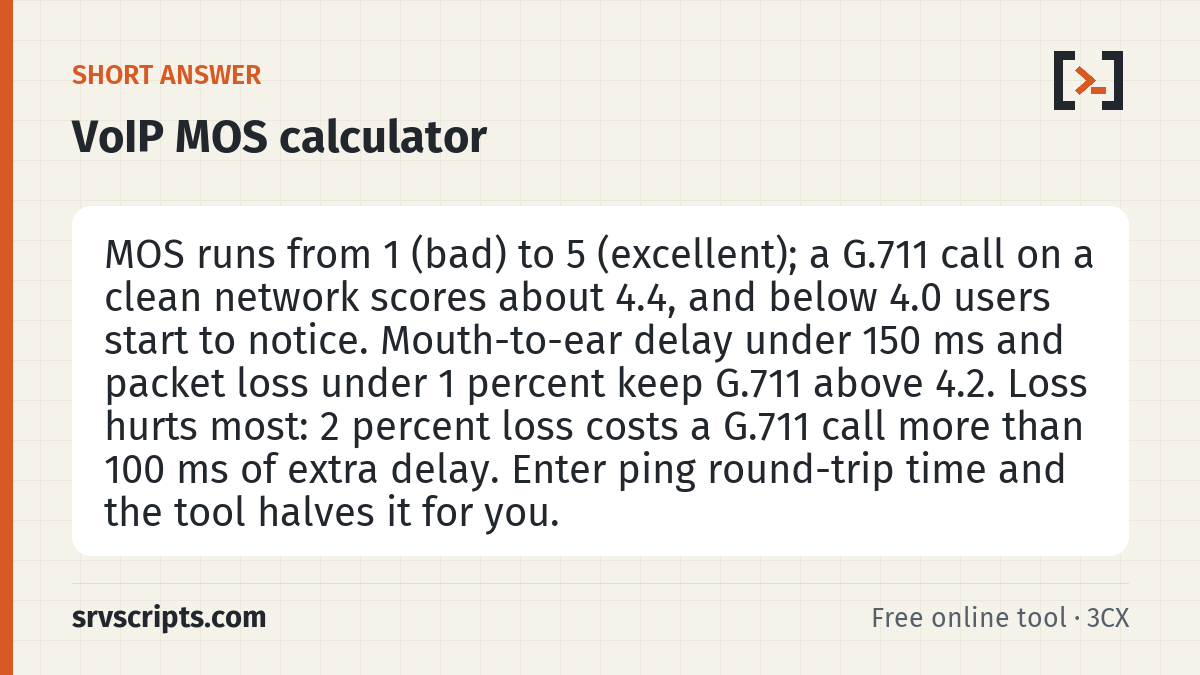
Short answer: MOS runs from 1 (bad) to 5 (excellent); a G.711 call on a clean network scores about 4.4, and below 4.0 users start to notice. Mouth-to-ear delay under 150 ms and packet loss under 1 percent keep G.711 above 4.2. Loss hurts most: 2 percent loss costs a G.711 call more than 100 ms of extra delay. Enter ping round-trip time and the tool halves it for you.
Table of Contents
What MOS and the R-factor mean
| R-factor | MOS | User satisfaction (ITU-T G.107) |
|---|---|---|
| 90 – 100 | 4.34 – 4.5 | Very satisfied |
| 80 – 90 | 4.03 – 4.34 | Satisfied |
| 70 – 80 | 3.60 – 4.03 | Some users dissatisfied |
| 60 – 70 | 3.10 – 3.60 | Many users dissatisfied |
| 50 – 60 | 2.58 – 3.10 | Nearly all users dissatisfied |
MOS was originally a listening test score (ITU-T P.800): people rated calls from 1 to 5 and the average is the MOS. The E-model predicts that score from network figures instead, through the R-factor, a 0 to 100 scale that starts at 93.2 for a perfect narrowband call and loses points for each impairment.
How the score is calculated
The calculator uses the simplified E-model with default values for echo, noise and loudness. The delay impairment (Id) depends on mouth-to-ear delay, which is the one-way network latency plus the jitter buffer (twice the jitter, at least 20 ms) plus packetisation and codec look-ahead. The equipment impairment (Ie-eff) combines the codec’s built-in loss of quality with packet loss, using the codec’s robustness to loss from ITU-T G.113. R = 93.2 − Id − Ie-eff, and MOS follows from R.
The estimate assumes random packet loss. Bursty loss, where several packets in a row disappear, sounds worse than the same average spread out, so a Wi-Fi network or a congested uplink can score lower in practice than here.
What hurts call quality most
- Packet loss is the biggest factor. G.711 with packet loss concealment drops from about 4.4 to 4.3 at 1 percent, 4.1 at 3 percent and below 4.0 at around 4 percent; compressed codecs such as G.729 start lower and fall faster, and bursty loss is worse than these figures.
- Delay costs little until about 150 ms mouth to ear and a lot after 200 ms, when people start talking over each other.
- Jitter matters through the jitter buffer it forces: 30 ms of jitter adds about 60 ms of delay, or packets arrive too late and count as lost.
- Codec: G.711 is the reference; G.729 starts 11 points down. Wideband codecs such as G.722 and Opus sound better than this narrowband scale can show.
How to measure latency, jitter and loss
# latency, jitter (mdev) and loss over 100 pings to your SIP provider
ping -c 100 -i 0.2 sip.provider.example

# per-hop loss and latency, 200 cycles
mtr -rwc 200 sip.provider.example

# from a live call on Asterisk: RTCP jitter, loss and round-trip time
asterisk -rx "pjsip show channelstats"
Measure at the busiest time of day and from the same network the phones use. A clean ping to the provider and bad calls usually means the problem is local: Wi-Fi, a saturated uplink without QoS, or a SIP ALG on the router.
VoIP MOS calculator at a glance
Official documentation: ITU-T G.107: the E-model, ITU-T G.113: transmission impairments, ITU-T P.800: MOS.
Related: VoIP call quality and MOS · Fix one-way audio · VoIP bandwidth calculator · TCP ping.
Frequently asked questions
What is a good MOS for VoIP?
4.0 or higher. A G.711 call on a clean network scores about 4.3 to 4.4, the practical maximum for narrowband calls. Between 3.6 and 4.0 some users notice problems, and below 3.6 many complain.
Should I enter ping time or one-way latency?
Either: choose “Ping round trip” and the calculator halves it, because the E-model needs one-way delay. If your monitoring already reports one-way delay, choose “One way”.
How much packet loss is acceptable for VoIP?
Under 1 percent keeps G.711 calls good. Between 1 and 3 percent users notice clipped words, and above 5 percent calls become hard to follow. Compressed codecs tolerate less.
Why is my MOS low when bandwidth is fine?
MOS depends on loss, delay and jitter, not on spare bandwidth. A link with plenty of capacity can still drop packets on Wi-Fi, during bursts from large downloads, or on a congested ISP path. QoS (DSCP EF) protects voice from the bursts.