This VoIP bandwidth calculator works out how much bandwidth your calls really need once packet headers, encryption and VPN tunnels are included. Codec data sheets quote only the voice payload, which understates the real figure by a third or more. Pick the codec, packet interval and number of concurrent calls, and the calculator shows the per-call rate, the total for each direction and the capacity to plan for with headroom.
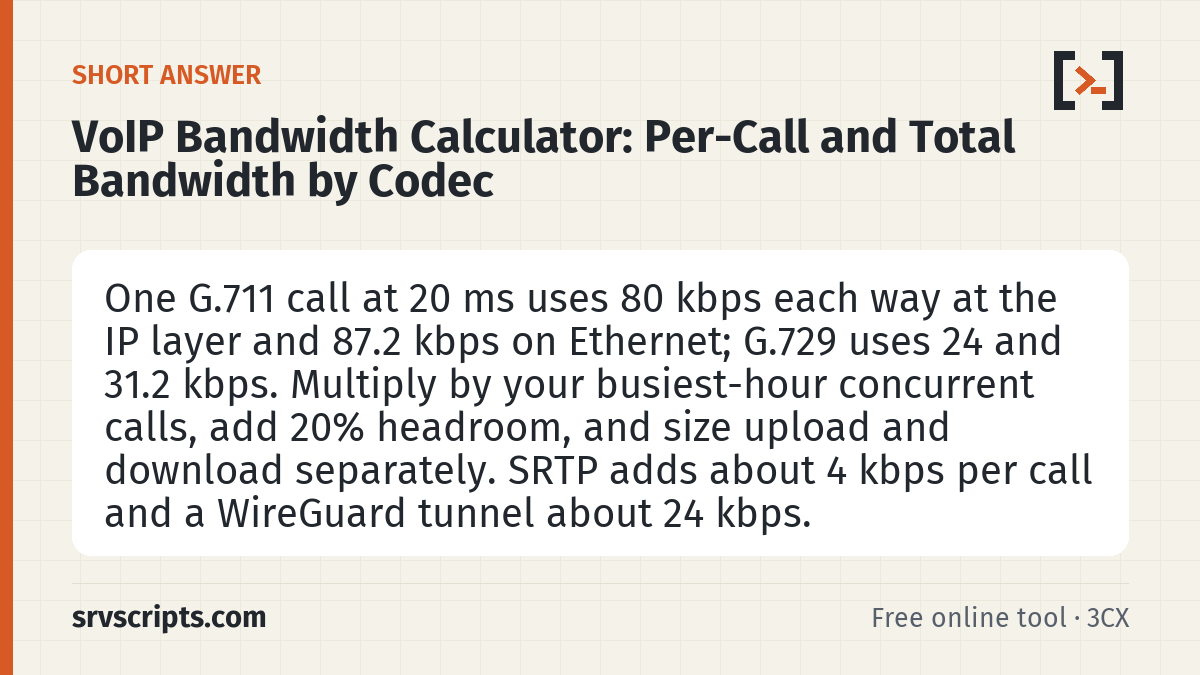
Short answer: One G.711 call at 20 ms uses 80 kbps each way at the IP layer and 87.2 kbps on Ethernet; G.729 uses 24 and 31.2 kbps. Multiply by your busiest-hour concurrent calls, add 20% headroom, and size upload and download separately. SRTP adds about 4 kbps per call and a WireGuard tunnel about 24 kbps.
Table of Contents
How the figure is calculated
Each voice packet carries the codec payload plus 40 bytes of IPv4, UDP and RTP headers (60 on IPv6). At 20 ms packetisation there are 50 packets per second in each direction, so headers alone add 16 kbps. The calculator adds optional SRTP (10 bytes), a tunnel (WireGuard 60 bytes, IPsec with NAT traversal about 73, OpenVPN about 69) and 18 bytes of Ethernet framing, then converts bytes per packet into kilobits per second.
kbps per direction = (payload + headers) bytes × 8 × packets per second ÷ 1000
G.711, 20 ms:  (160 + 40) × 8 × 50 ÷ 1000 = 80 kbps
Planning tips
- Use the busiest hour’s concurrent calls, not the number of users; most offices peak at 20 to 30% of users on the phone at once.
- Keep voice under about half the upload capacity unless QoS marks RTP as DSCP EF on the edge router.
- Choose 30 ms packets only where bandwidth is tight; they save header overhead but add delay.
- Cloud phone apps usually use Opus and adapt their rate, so treat the Opus figure as a planning maximum.
For the background on codecs and overhead, read the VoIP codec bandwidth guide, and for quality targets see the VoIP call quality guide.
VoIP bandwidth calculator at a glance
Official documentation: RFC 3550: RTP, ITU-T G.711.
Related: VoIP codec bandwidth guide · VoIP call quality guide · Subnet calculator.
Frequently asked questions
How many concurrent calls does a 10 Mbps connection support?
On paper more than 100 G.711 calls each way, but for good quality keep voice within about half the upload capacity unless QoS is configured, so plan on roughly 50 to 55 calls.
Does the calculator include both directions?
The totals are per direction. A normal call sends the same amount each way, so you need that figure on upload and again on download.
Why is Opus shown at a fixed rate?
Opus adapts its bit rate to network conditions. The calculator uses a typical voice setting as a planning figure; real usage is usually at or below it.