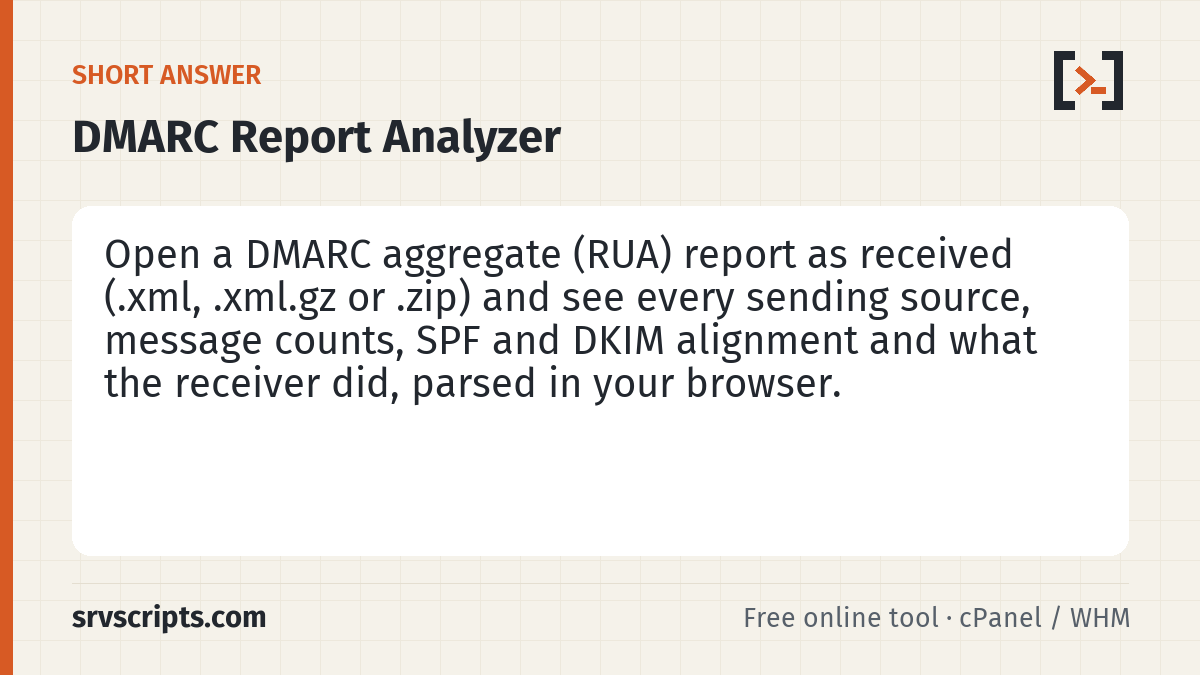
Receivers such as Google, Microsoft and Yahoo send daily XML reports to the rua= address in your DMARC record. They are hard to read by hand; drop one here to get a table of who sent mail as your domain and whether it passed. The file is decompressed and parsed locally; nothing is uploaded.
Table of Contents
What to look for
Sort by volume and identify every source IP: your own server, your mail relay (MailBaby, Microsoft 365, Google Workspace) and any marketing or CRM platform. Legitimate sources that fail need an SPF include or DKIM signing with your domain before you move DMARC to p=quarantine or p=reject. Unknown IPs with small volumes that fail are usually spoofing attempts, which is exactly what DMARC enforcement will block.
DMARC passes if either SPF or DKIM passes and aligns with the From domain. A message can show SPF pass in the auth results but still fail DMARC when the envelope sender belongs to a different domain, which is common with third-party senders.
Receiving fewer reports
Use a dedicated mailbox or a subaddress for rua= reports, because a busy domain can receive dozens a day. Reports to an address on a different domain require an authorization record at that domain (example.com._report._dmarc.otherdomain.com).
DMARC report analyzer at a glance
Official documentation: RFC 7489 (DMARC), cPanel & WHM documentation, RFC 5321 (SMTP).
Related guides: Warm up a new mail server IP or sending domain without landing in spam · Setting up MailBaby with cPanel/WHM Exim: router, transport, SRS and DKIM · Whitelisting MailBaby in cPanel greylisting, CSF and SpamAssassin.
Frequently asked questions
Which report formats are supported?
Aggregate reports as defined in RFC 7489: plain XML, gzip (.xml.gz) and zip files containing one XML file, exactly as they arrive by e-mail.
What about forensic (ruf) reports?
Forensic reports are individual message samples in a different format, and most large providers no longer send them.
Is my report data uploaded?
No. The file is read, decompressed and parsed by JavaScript in your browser.