SIPp is the standard tool for load testing SIP, but on its own it answers only one question: did something reply 200 OK? On an Asterisk or FreePBX server the PBX itself often answers: an extension that hit its concurrency limit hears an announcement, a misrouted call lands in an IVR or voicemail. SIPp counts all of those as successful calls. This SIPp call load test script places a controlled burst of calls as one of your extensions and then checks the call records to see how many calls really left on a trunk.
It is the script behind our guide A SIP 200 OK is not proof your carrier got the call, where a “30 of 30 successful” test turned out to have delivered only 9 calls.
Table of Contents
What the SIPp call load test does
- Writes a SIPp scenario that registers with digest authentication, places the call (answering the 401/407 challenge), holds it for
--holdseconds and hangs up. - Passes the extension password to SIPp in a private injection file (mode 600), never on the command line, so it does not show up in
ps. - Runs the burst with your call count, call rate and concurrency limit, and samples the live call count in Asterisk once a second.
- Reads the FreePBX CDR afterwards: a call counts as delivered only if it was ANSWERED on one of your trunks, taken from the FreePBX trunk list or given with
--carrier, between the start and the end of the test. Calls SIPp counted as successful but the PBX or another phone answered are reported, with the dialplan application that answered them (for example Playback). - Says OK only when every count adds up: all requested calls started, all answered, none failed, SIPp finished normally and the same number answered on a trunk. A run that was stopped early or left no counters is reported as INCOMPLETE (exit 1), never as OK.
- Warns before it starts when the extension has a FreePBX Outbound Concurrency Limit lower than your test, and asks for
yesbecause every call is a real call.
Before you run it: cost and safety
- Every call is a real outbound call. Through a paid SIP trunk it is billed, and a burst of calls to international numbers looks exactly like toll fraud to your provider. Dial a test number your provider gives you, a free destination, or your own test carrier.
- Carriers limit calls per second (CPS). A test above that limit measures the carrier, not your PBX; ask for the limit first.
- Use a dedicated test extension with a simple random password, and remove or disable it after testing.
- The script changes nothing on the PBX. It only registers, calls and reads the CDR, so there is nothing to back up or revert.
Install and first run
apt install sip-tester            # Debian/Ubuntu package name for SIPp
curl -fsSLO https://scr.srvscripts.com/sipp-call-load-test/sipp-call-load-test.sh
printf '%s' 'TestExtensionPassword' > /root/1002.secret && chmod 600 /root/1002.secret
bash sipp-call-load-test.sh --ext 1002 --secret-file /root/1002.secret --number 15550100 --calls 30 --rate 3 --max 10 --hold 5
Run it on the PBX itself (the default target is 127.0.0.1:5060), so it can read the CDR and the live call count. Against another PBX use --pbx HOST and --no-cdr; delivery to the carrier is then not verified. Exit codes: 0 every requested call was started, answered and answered on a trunk; 1 failed calls, false successes or an incomplete run; 2 the test could not run (for example the registration was refused); 3 bad option, missing tool or no trunk list.
Tested on a real server
| Test | Result |
|---|---|
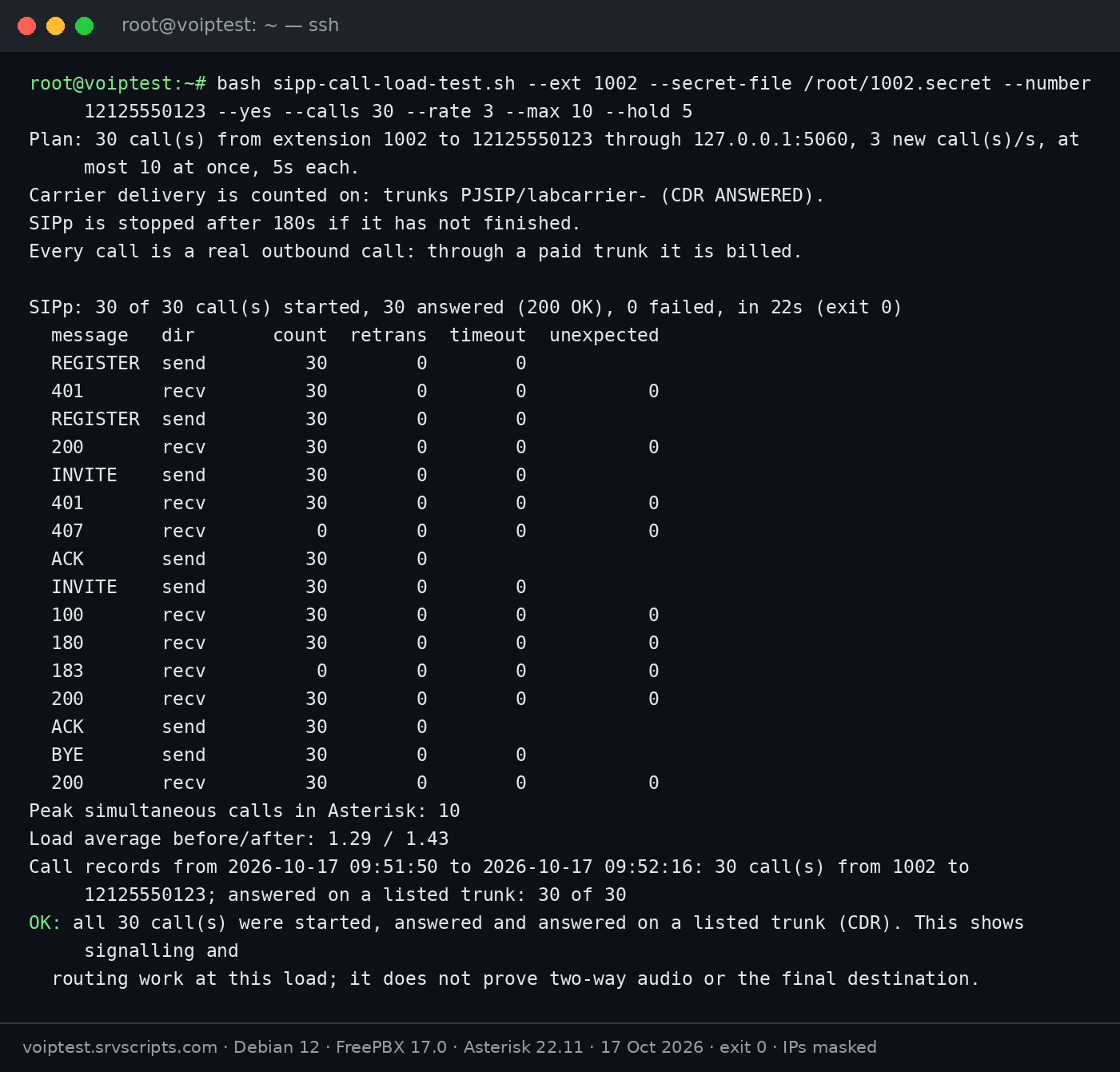
| 30 calls, 3 per second, 10 at once, 5 s each | OK: 30 answered, 30 of 30 answered on the trunk, peak 10 calls |
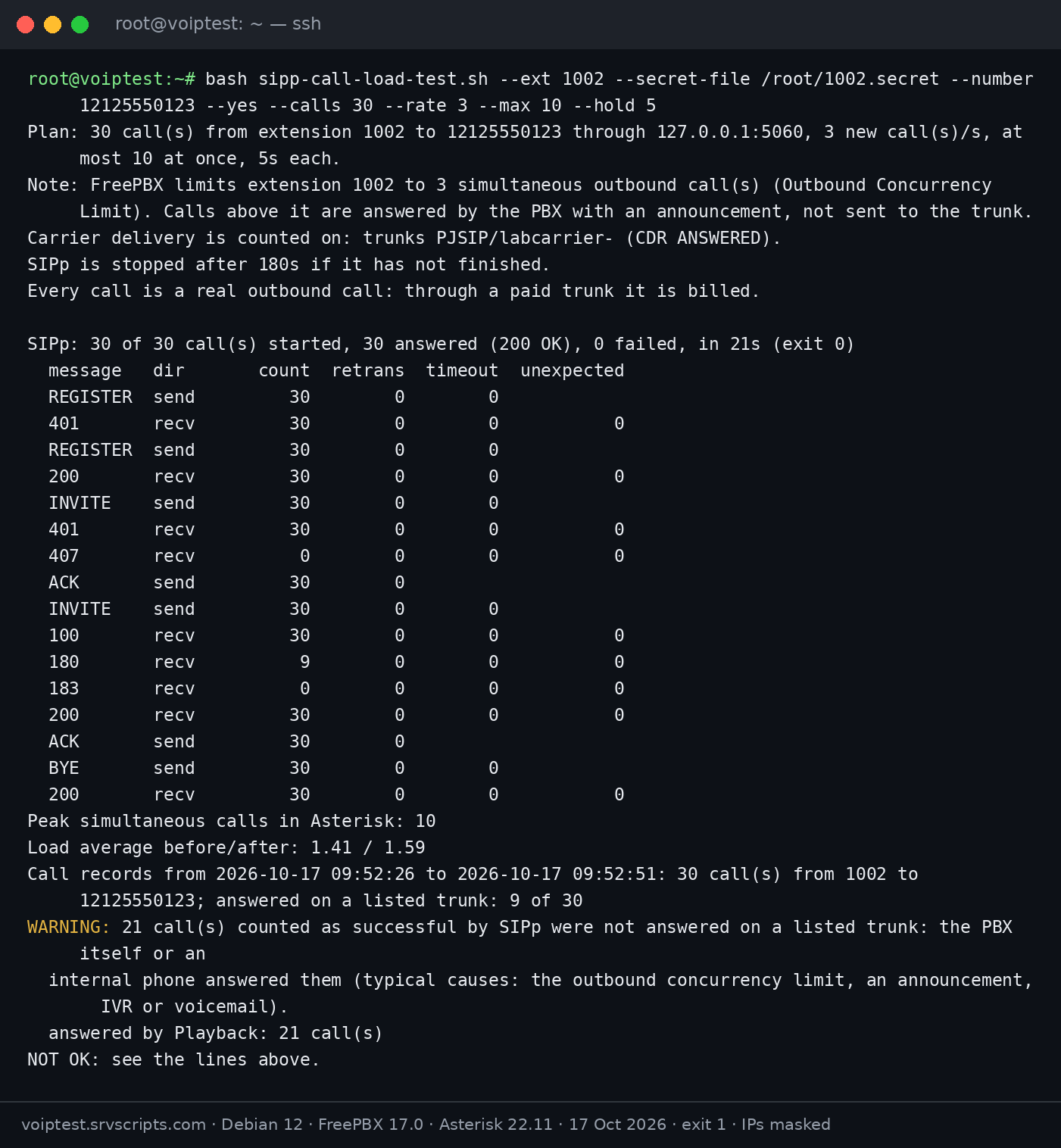
| Same test with the extension’s Outbound Concurrency Limit at 3 | SIPp: 30 of 30 “successful”. CDR: 9 delivered, 21 answered by Playback (the limit announcement). WARNING, exit 1 |
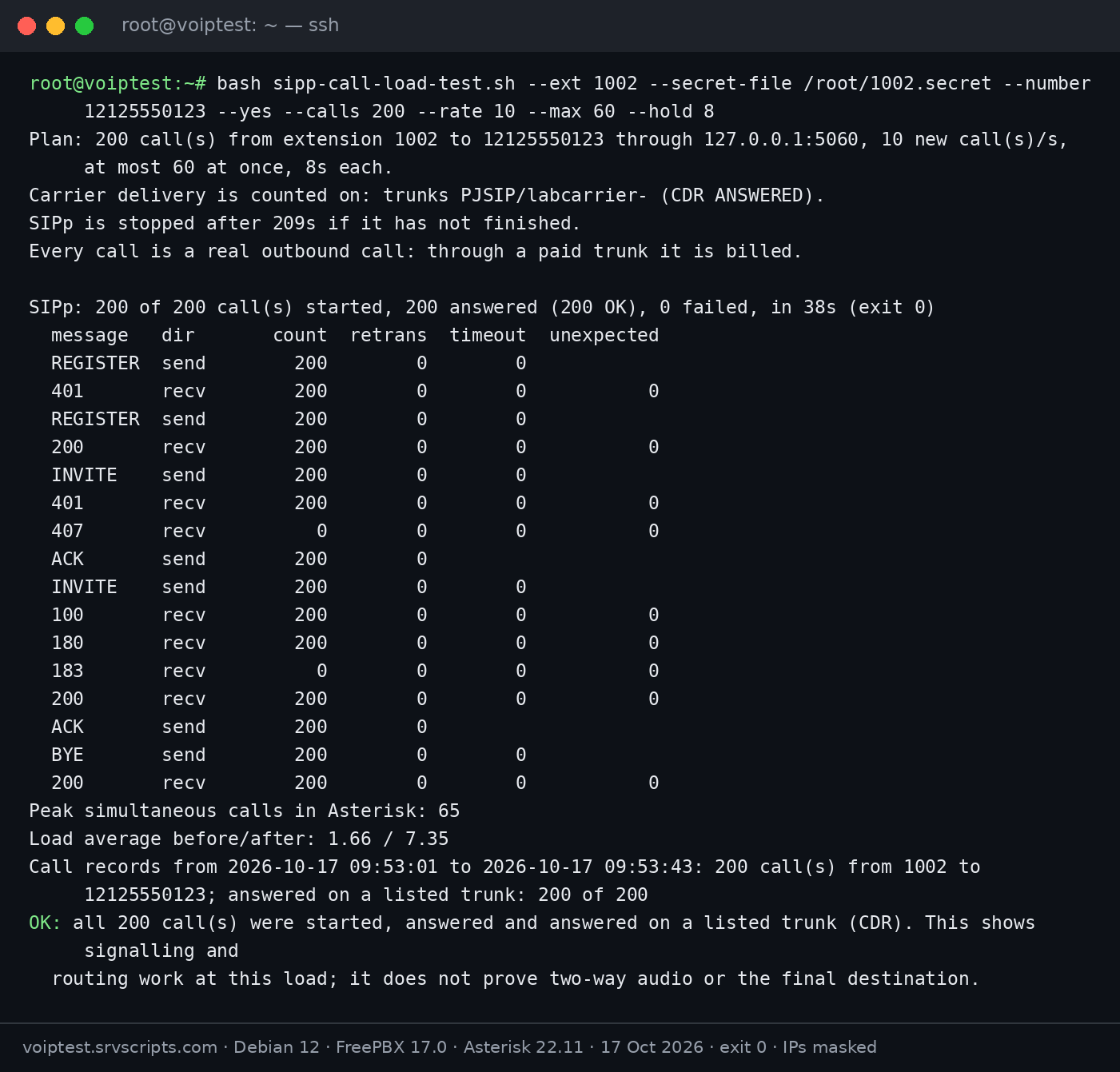
| 200 calls, 10 per second, 60 at once, 8 s each | OK: 200 of 200 on the trunk; load average 0.54 → 3.55 on 4 vCPU (signalling only, no audio) |
| Wrong extension password | “Registration was refused”, exit 2 |
--no-cdr | OK with “delivery not verified” |
No terminal and no --yes | Stops before any call, exit 3 |
| Version 1.0.1: 30 calls, 3 per second, 10 at once | OK: 30 started, 30 answered, 30 of 30 on the listed trunk, exit 0 |
| 1.0.1 with the Outbound Concurrency Limit at 3 | 9 of 30 on the trunk, 21 answered by Playback: WARNING, NOT OK, exit 1 |
| 1.0.1: 200 calls, 10 per second, 60 at once | OK: 200 of 200 on the trunk, exit 0 |
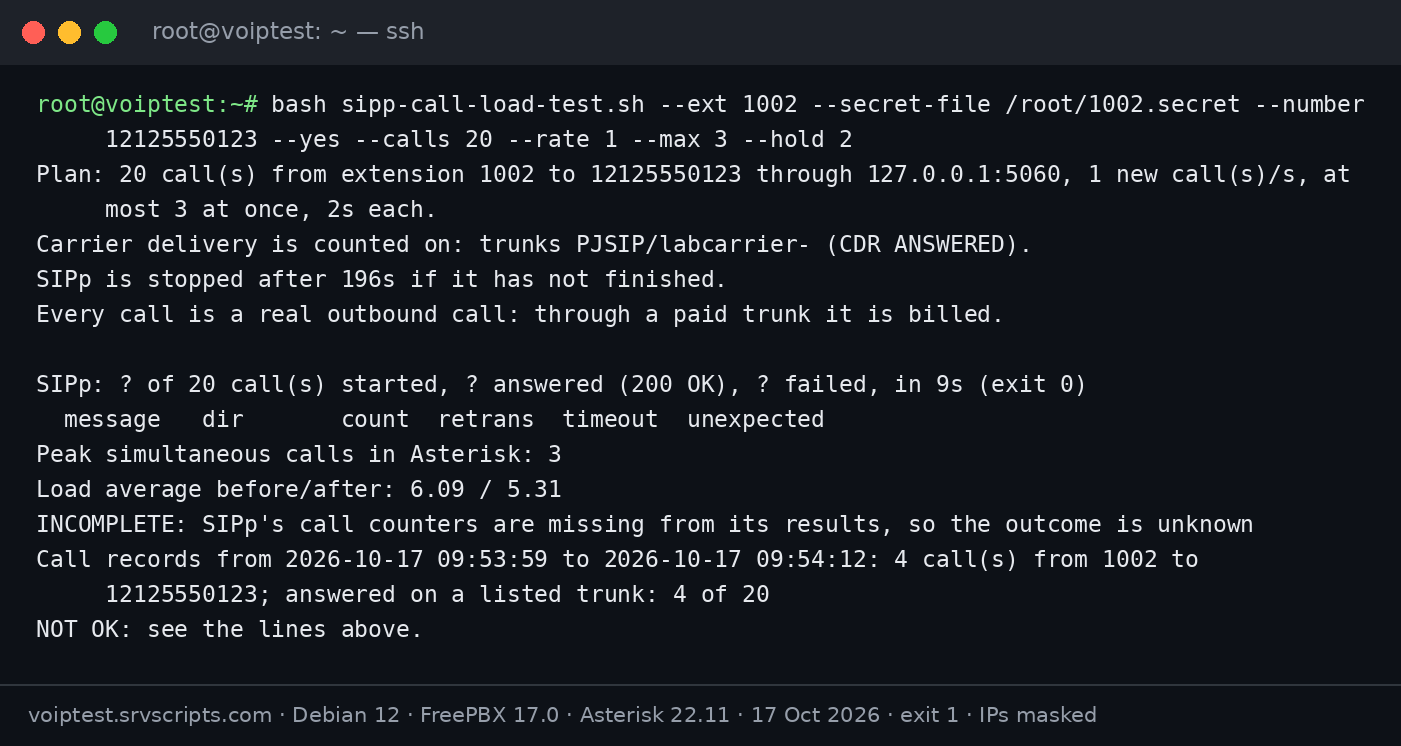
| 1.0.1: 20 calls, SIPp stopped from another shell after 9 s | SIPp itself exited 0 and left no counters; the script reports INCOMPLETE, exit 1 (1.0.0 could not tell) |
| 1.0.1: 6 calls at 0.5 per second | OK: 6 of 6 on the trunk (1.0.0 stopped with a division by zero below 1 call per second) |
We ran these tests on our FreePBX 17 lab server (Debian 12, Asterisk 22.11, 4 vCPU) on 17 October 2026 with SIPp 3.6.1. The calls went through real FreePBX outbound routes to a test carrier (a second SIPp answering every call on the same server), so no real number was dialled. The peak of 68 in the 200-call run is Asterisk’s own count, which includes calls still hanging up while new ones start.
An independent review of version 1.0.0 found two ways it could report success that it had not checked: after an incomplete run (SIPp stopped by the time limit) it still printed OK for all calls, and its default test for carrier delivery, any answered channel that is not a Local channel, also counted calls answered by another extension. Version 1.0.1 fixes both, and we re-ran the tests above on the same lab (rebuilt from a backup) on 17 October 2026. The load average of the 1.0.1 200-call run (1.7 to 7.4) is higher than the first run because another service on the rebuilt lab kept restarting in the background, so read both as rough figures. 27 automated tests with a stand-in SIPp and CDR cover the cases above plus a time-out after one call, no call started, counters missing, call records arriving late or not at all, an extra call in the test window and call rates from 0.01 to 1000. The screenshots are the real terminal output of 1.0.1; only IP addresses are masked.
Options
| Option | Meaning |
|---|---|
--ext EXT | Extension SIPp registers as (password from SIPP_SECRET or --secret-file) |
--number NUMBER | Number to dial |
--calls N | Total calls (default 20, maximum 5000) |
--rate R | New calls per second, 0.01 to 1000, for example 0.5 (default 2) |
--max M | Calls at the same time (default 10) |
--hold SEC | How long each answered call stays up (default 5) |
--pbx HOST[:PORT] | PBX to call through (default 127.0.0.1:5060) |
--local-ip IP | Source address for SIPp (default: worked out from the route) |
--carrier REGEX | Count a call as delivered only if its CDR dstchannel matches, for example '^PJSIP/mytrunk-'. Default: the trunks in the FreePBX trunk list; on plain Asterisk this option is required |
--no-cdr | Skip the CDR check (remote PBX) |
--yes | Do not ask for confirmation (for repeat runs) |
Notes and limits
- This is a signalling test. SIPp sends no audio here, so it does not measure transcoding, recording or RTP capacity; those need RTP traffic (SIPp can replay a pcap) and are a separate test.
- Each call registers before it dials, which also exercises the registrar. Expect registrations in the PBX log during the test.
- FreePBX Outbound Concurrency Limit is on the extension’s Advanced tab. 0 means no limit; set it back after testing if you rely on it against fraud.
- Large tests trip fail2ban or the FreePBX firewall if they come from an outside address; run them from the PBX or add the test host to the allow list for the test.
- Call records are matched by extension, dialled number and the time of the test, not by a marker on each call. If something else calls the same number from the same extension during the test, the script says the counts cannot be trusted. Use a test extension nothing else uses.
- ANSWERED in the CDR means the trunk answered the call signalling. It does not prove two-way audio, or that the call reached the final destination behind the carrier.
- SIPp gets a time limit worked out from the plan (call rate,
--maxand--hold, plus 50% and 2 minutes); the script shows it before the test and refuses plans that would run for more than 24 hours.
Related: the 200 OK guide, Erlang calculator, PJSIP health check, toll fraud watch.
SIPp scenario syntax, injection files and the [authentication] keyword: SIPp documentation.
The script
#!/usr/bin/env bash
# SIPp Call Load Test for Asterisk and FreePBX, Checked Against the CDR (v1.0.1) - from srvScripts.com
# Source, docs and updates: https://srvscripts.com/scripts/sipp-call-load-test/
# Copyright (c) 2026 srvScripts.com. MIT licence: if you copy, share or adapt this script, keep this notice and credit srvScripts.com.
#
# Places a controlled burst of real SIP calls through your PBX as one of its extensions (SIPp registers with the
# extension's password and dials a number you choose), then checks the call records to see how many calls really
# left on a trunk. SIPp alone counts a call as "successful" whenever something answers it with 200 OK, and an
# Asterisk PBX often answers calls itself: a concurrency-limit announcement, an IVR, voicemail or a "number not
# in service" message. This script reports those as false successes.
#
#   SIPP_SECRET='extension password' bash sipp-call-load-test.sh --ext 1002 --number 12125550123 --calls 30 --rate 3 --max 10 --hold 5
#   bash sipp-call-load-test.sh --ext 1002 --secret-file /root/1002.secret --number 12125550123 --calls 200 --rate 10 --max 60 --hold 8 --yes
#
# Run it ON the PBX (default target 127.0.0.1:5060): it then also reads the CDR (FreePBX asteriskcdrdb) and the
# live channel count. A call counts as delivered only when its CDR shows it ANSWERED on one of your trunks: the
# FreePBX trunk list, or the channels you give with --carrier. Call records are matched by extension, number and
# the test's start and end time, so use a test extension that nothing else uses during the test. ANSWERED proves
# signalling and routing, not two-way audio or the final destination.
# Against another PBX use --pbx HOST and --no-cdr; carrier delivery is then NOT verified.
# COST WARNING: every call is a real outbound call. Through a paid SIP trunk it costs money, and bursts to
# international numbers look exactly like toll fraud. Use a test number, a free destination or your own test
# carrier. The script shows the plan and asks for "yes" unless --yes is given.
# The extension password is passed to SIPp in a private injection file (mode 600), never on the command line.
# Exit codes: 0 every requested call was started, answered and (with the CDR) answered on a trunk; 1 failed calls,
# false successes, or an incomplete run (SIPp stopped early, counters missing or not adding up, call records
# missing or mixed with other calls); 2 the test could not run (registration refused, SIPp error, CDR query
# failed); 3 bad option, missing tool or no trunk list.
# Version 1.0.0 (2026-10-17): first release. Tested on FreePBX 17.0.33 / Asterisk 22.11 (Debian 12) with SIPp 3.6
#   and a test carrier: 30 and 200 calls (60 at once), and the false-success case (extension concurrency limit 3).
# Version 1.0.1 (2026-10-17): fixes from an independent review. An incomplete run (SIPp stopped by the time limit,
#   fewer calls started than requested, counters missing) is no longer reported as OK; every count must add up.
#   Carrier delivery is counted only on known trunks (FreePBX trunk list or --carrier), not on any non-Local
#   channel, which also matched extensions. Call records are limited to the test's start and end time and are
#   re-read for up to CDR_WAIT seconds. Fractional rates (--rate 0.5) work; --rate 0 and absurd plans are refused
#   before any call is placed.
set -uo pipefail
export LC_ALL=C
PBX=127.0.0.1:5060; EXT=""; NUM=""; CALLS=20; RATE=2; MAXC=10; HOLD=5; SECRET_FILE=""; CARRIER=""; NOCDR=0; YES=0
LOCAL_IP=""; DB=asteriskcdrdb; AST=${ASTERISK_BIN:-asterisk}
usage() {
  cat <<'EOF'
Usage: sipp-call-load-test.sh --ext EXT --number NUMBER [options]
  --ext EXT            extension SIPp registers as (its password: env SIPP_SECRET or --secret-file)
  --secret-file FILE   file holding only the extension password (keep it mode 600)
  --number NUMBER      number to dial (a test number or test carrier; see the cost warning)
  --calls N            total calls (default 20, max 5000)
  --rate R             new calls per second, 0.01-1000, e.g. 0.5 (default 2)
  --max M              at most M calls at the same time (default 10)
  --hold SEC           seconds each answered call stays up (default 5)
  --pbx HOST[:PORT]    PBX to call through (default 127.0.0.1:5060, i.e. run this on the PBX)
  --local-ip IP        source address for SIPp (default: the address used to reach the PBX)
  --carrier REGEX      count a call as delivered only if its CDR dstchannel matches REGEX (e.g. '^PJSIP/mytrunk-');
                       default: the trunks in the FreePBX trunk list (needed on plain Asterisk)
  --no-cdr             skip the CDR check (remote PBX); delivery to the carrier is then not verified
  --yes                do not ask for confirmation
  -h, --help           this help
Environment: SIPP_SECRET (extension password), MYSQL_ARGS (extra mysql arguments), ASTERISK_BIN,
  CDR_WAIT (seconds to wait for late call records, default 20)
Needs: sipp (Debian/Ubuntu: apt install sip-tester), plus mysql and asterisk on the PBX for the checks.
EOF
}
die() { echo "ERROR: $*" >&2; exit 3; }
num() { [[ "${2:-}" =~ ^[0-9]+$ ]] || die "$1 needs a whole number"; }
while [ $# -gt 0 ]; do
  case "$1" in
    --ext) EXT="${2:-}"; [[ "$EXT" =~ ^[A-Za-z0-9_.+-]+$ ]] || die "--ext: letters, digits, _ . + - only"; shift 2 ;;
    --secret-file) SECRET_FILE="${2:-}"; [ -r "$SECRET_FILE" ] || die "--secret-file: cannot read $SECRET_FILE"; shift 2 ;;
    --number) NUM="${2:-}"; [[ "$NUM" =~ ^[0-9*#+]+$ ]] || die "--number: digits, *, # and + only"; shift 2 ;;
    --calls) num "$1" "${2:-}"; CALLS=$2; shift 2 ;;
    --rate) [[ "${2:-}" =~ ^[0-9]{1,6}(\.[0-9]{1,3})?$ ]] || die "--rate needs a number such as 2 or 0.5"; RATE=$2; shift 2 ;;
    --max) num "$1" "${2:-}"; MAXC=$2; shift 2 ;;
    --hold) num "$1" "${2:-}"; HOLD=$2; shift 2 ;;
    --pbx) PBX="${2:-}"; [[ "$PBX" =~ ^[A-Za-z0-9.:\[\]-]+$ ]] || die "--pbx: invalid host"; shift 2 ;;
    --local-ip) LOCAL_IP="${2:-}"; shift 2 ;;
    --carrier) CARRIER="${2:-}"; [ -n "$CARRIER" ] || die "--carrier needs a pattern"; case "$CARRIER" in *"'"*|*'\'*) die "--carrier: no quotes or backslashes" ;; esac; shift 2 ;;
    --no-cdr) NOCDR=1; shift ;;
    --yes) YES=1; shift ;;
    -h|--help) usage; exit 0 ;;
    *) usage >&2; die "unknown option: $1" ;;
  esac
done
[ -n "$EXT" ] && [ -n "$NUM" ] || { usage >&2; die "--ext and --number are required"; }
[ "$CALLS" -ge 1 ] && [ "$CALLS" -le 5000 ] || die "--calls must be 1-5000"
[ "$MAXC" -ge 1 ] && [ "$HOLD" -ge 1 ] || die "--max and --hold must be at least 1"
[ "$HOLD" -le 3600 ] || die "--hold must be at most 3600"
awk -v r="$RATE" 'BEGIN{exit !(r >= 0.01 && r <= 1000)}' || die "--rate must be between 0.01 and 1000 calls per second"
# time limit for SIPp: the slower of the call rate and the --max/--hold rhythm, plus 50%, plus fixed slack
budget=$(awk -v c="$CALLS" -v r="$RATE" -v m="$MAXC" -v h="$HOLD" 'BEGIN{t=c/r; w=(c/m)*(h+5); if(w>t)t=w; b=t*1.5+h*3+120; printf "%d", (b==int(b))?b:int(b)+1}')
[[ "$budget" =~ ^[0-9]+$ ]] || die "cannot work out the time limit"
[ "$budget" -le 86400 ] || die "this plan would run for more than 24 hours (time limit ${budget}s); raise --rate or --max, or lower --calls"
CDR_WAIT=${CDR_WAIT:-20}; [[ "$CDR_WAIT" =~ ^[0-9]{1,3}$ ]] || die "CDR_WAIT must be 0-999 seconds"
command -v sipp >/dev/null 2>&1 || die "sipp not found (Debian/Ubuntu: apt install sip-tester; RHEL: build from github.com/SIPp/sipp)"
SECRET=${SIPP_SECRET:-}; [ -n "$SECRET_FILE" ] && SECRET=$(head -1 "$SECRET_FILE" | tr -d '\r\n')
[ -n "$SECRET" ] || die "no extension password: set SIPP_SECRET or use --secret-file"
case "$SECRET" in *';'*|*'['*|*']'*|*[[:space:]]*) die "the password contains ';', '[', ']' or a space, which SIPp cannot pass safely; set a simpler test password" ;; esac
host=${PBX%:*}; port=${PBX##*:}; [ "$host" = "$PBX" ] && port=5060
if [ -z "$LOCAL_IP" ]; then
  case "$host" in 127.*|localhost) LOCAL_IP=127.0.0.1 ;;
    *) LOCAL_IP=$(ip route get "$(getent ahostsv4 "$host" | awk 'NR==1{print $1}')" 2>/dev/null | awk '{for(i=1;i<NF;i++) if($i=="src"){print $(i+1); exit}}') ;; esac
fi
[ -n "$LOCAL_IP" ] || die "cannot work out the local address; use --local-ip"
read -ra MA <<<"${MYSQL_ARGS:-}"
CDR=0
if [ "$NOCDR" = 0 ]; then
  command -v mysql >/dev/null 2>&1 && mysql "${MA[@]}" -N -B "$DB" -e "SELECT 1 FROM cdr LIMIT 1" >/dev/null 2>&1 && CDR=1
  [ "$CDR" = 1 ] || die "cannot read the CDR ($DB.cdr) on this machine; run on the PBX, set MYSQL_ARGS, or use --no-cdr"
  if [ -n "$CARRIER" ]; then
    oncarrier="dstchannel REGEXP '$CARRIER'"; trunks="channels matching --carrier '$CARRIER'"
  else
    # FreePBX trunk list -> dstchannel prefixes (PJSIP/name-, SIP/name-, IAX2/name-, DAHDI/; custom: PJSIP/x@name)
    likes=(); names=()
    while IFS=$'\t' read -r tech chan; do
      pre=""
      case "$tech" in
        pjsip) pre="PJSIP/$chan-" ;; sip) pre="SIP/$chan-" ;; iax|iax2) pre="IAX2/$chan-" ;; dahdi) pre="DAHDI/" ;;
        custom) if [[ "$chan" =~ ^(PJSIP|SIP|IAX2)/[^@]*@([A-Za-z0-9_.-]+) ]]; then pre="${BASH_REMATCH[1]}/${BASH_REMATCH[2]}-"
                elif [[ "$chan" =~ ^(PJSIP|SIP|IAX2)/([A-Za-z0-9_.-]+)(/|$) ]]; then pre="${BASH_REMATCH[1]}/${BASH_REMATCH[2]}-"; fi ;;
      esac
      [[ "$pre" =~ ^[A-Za-z0-9]+/[A-Za-z0-9_.-]*$ ]] || continue
      names+=("$pre"); e=${pre//_/\\_}; likes+=("dstchannel LIKE '$e%'")
    done < <(mysql "${MA[@]}" -N -B asterisk -e "SELECT tech, channelid FROM trunks WHERE disabled <> 'on'" 2>/dev/null)
    [ "${#likes[@]}" -gt 0 ] || die "cannot read the FreePBX trunk list (asterisk.trunks); give your trunk with --carrier '^PJSIP/mytrunk-', or use --no-cdr"
    oncarrier="($(IFS='|'; printf '%s' "${likes[*]}" | sed 's/|/ OR /g'))"; trunks="trunks ${names[*]}"
  fi
fi
HAVE_AST=0; command -v "$AST" >/dev/null 2>&1 && "$AST" -rx "core show version" >/dev/null 2>&1 && HAVE_AST=1

limit=""
[ "$HAVE_AST" = 1 ] && limit=$("$AST" -rx "database get AMPUSER/$EXT concurrency_limit" 2>/dev/null | awk '/^Value:/{print $2}')
echo "Plan: $CALLS call(s) from extension $EXT to $NUM through $host:$port, $RATE new call(s)/s, at most $MAXC at once, ${HOLD}s each."
[ -n "$limit" ] && [ "$limit" != 0 ] && [ "$MAXC" -gt "$limit" ] && \
  echo "Note: FreePBX limits extension $EXT to $limit simultaneous outbound call(s) (Outbound Concurrency Limit). Calls above it are answered by the PBX with an announcement, not sent to the trunk."
[ "$CDR" = 1 ] && echo "Carrier delivery is counted on: $trunks (CDR ANSWERED)."
echo "SIPp is stopped after ${budget}s if it has not finished."
echo "Every call is a real outbound call: through a paid trunk it is billed."
if [ "$YES" = 0 ]; then
  [ -t 0 ] || die "not a terminal: add --yes to confirm"
  read -r -p "Type yes to start: " a; [ "$a" = yes ] || { echo "Cancelled."; exit 0; }
fi

W=$(mktemp -d) || die "mktemp failed"; trap 'kill "${SMP:-}" 2>/dev/null; rm -rf "$W"' EXIT
chmod 700 "$W"; cd "$W" || exit 3
# SIPp 3.6 does not expand [fieldN] inside [authentication ...], but it does expand an authentication keyword
# that comes from the injection file, so the whole keyword (with the password) lives in this private file.
( umask 077; printf 'SEQUENTIAL\n%s;[authentication username=%s password=%s];\n' "$EXT" "$EXT" "$SECRET" > "$W/auth.csv" )
cat > "$W/phone.xml" <<'XML'
<?xml version="1.0" encoding="ISO-8859-1" ?>
<!DOCTYPE scenario SYSTEM "sipp.dtd">
<!-- srvScripts sipp-call-load-test: register with digest auth, call [service], hold for -d ms, hang up. -->
<scenario name="srvscripts call load test">
  <send retrans="500"><![CDATA[
REGISTER sip:[remote_ip] SIP/2.0
Via: SIP/2.0/[transport] [local_ip]:[local_port];branch=[branch]
From: <sip:[field0]@[remote_ip]>;tag=[pid]reg[call_number]
To: <sip:[field0]@[remote_ip]>
Call-ID: [call_id]
CSeq: 1 REGISTER
Contact: <sip:[field0]@[local_ip]:[local_port]>
Max-Forwards: 70
Expires: 120
User-Agent: srvScripts-sipp-load-test
Content-Length: 0

]]></send>
  <recv response="401" auth="true"/>
  <send retrans="500"><![CDATA[
REGISTER sip:[remote_ip] SIP/2.0
Via: SIP/2.0/[transport] [local_ip]:[local_port];branch=[branch]
From: <sip:[field0]@[remote_ip]>;tag=[pid]reg[call_number]
To: <sip:[field0]@[remote_ip]>
Call-ID: [call_id]
CSeq: 2 REGISTER
Contact: <sip:[field0]@[local_ip]:[local_port]>
[field1]
Max-Forwards: 70
Expires: 120
User-Agent: srvScripts-sipp-load-test
Content-Length: 0

]]></send>
  <recv response="200"/>
  <pause milliseconds="300"/>
  <send retrans="500"><![CDATA[
INVITE sip:[service]@[remote_ip] SIP/2.0
Via: SIP/2.0/[transport] [local_ip]:[local_port];branch=[branch]
From: <sip:[field0]@[remote_ip]>;tag=[pid]inv[call_number]
To: <sip:[service]@[remote_ip]>
Call-ID: [call_id]
CSeq: 1 INVITE
Contact: <sip:[field0]@[local_ip]:[local_port]>
Max-Forwards: 70
User-Agent: srvScripts-sipp-load-test
Content-Type: application/sdp
Content-Length: [len]

v=0
o=sipp 53655765 2353687637 IN IP[local_ip_type] [local_ip]
s=-
c=IN IP[media_ip_type] [media_ip]
t=0 0
m=audio [media_port] RTP/AVP 0 8
a=rtpmap:0 PCMU/8000
a=rtpmap:8 PCMA/8000
]]></send>
  <recv response="401" auth="true" optional="true" next="authinv"/>
  <recv response="407" auth="true"/>
  <label id="authinv"/>
  <send><![CDATA[
ACK sip:[service]@[remote_ip] SIP/2.0
Via: SIP/2.0/[transport] [local_ip]:[local_port];branch=[branch]
From: <sip:[field0]@[remote_ip]>;tag=[pid]inv[call_number]
To: <sip:[service]@[remote_ip]>[peer_tag_param]
Call-ID: [call_id]
CSeq: 1 ACK
Max-Forwards: 70
Content-Length: 0

]]></send>
  <send retrans="500"><![CDATA[
INVITE sip:[service]@[remote_ip] SIP/2.0
Via: SIP/2.0/[transport] [local_ip]:[local_port];branch=[branch]
From: <sip:[field0]@[remote_ip]>;tag=[pid]inv[call_number]
To: <sip:[service]@[remote_ip]>
Call-ID: [call_id]
CSeq: 2 INVITE
Contact: <sip:[field0]@[local_ip]:[local_port]>
[field1]
Max-Forwards: 70
User-Agent: srvScripts-sipp-load-test
Content-Type: application/sdp
Content-Length: [len]

v=0
o=sipp 53655765 2353687637 IN IP[local_ip_type] [local_ip]
s=-
c=IN IP[media_ip_type] [media_ip]
t=0 0
m=audio [media_port] RTP/AVP 0 8
a=rtpmap:0 PCMU/8000
a=rtpmap:8 PCMA/8000
]]></send>
  <recv response="100" optional="true"/>
  <recv response="180" optional="true"/>
  <recv response="183" optional="true"/>
  <recv response="200" rtd="true"/>
  <send><![CDATA[
ACK sip:[service]@[remote_ip] SIP/2.0
Via: SIP/2.0/[transport] [local_ip]:[local_port];branch=[branch]
From: <sip:[field0]@[remote_ip]>;tag=[pid]inv[call_number]
To: <sip:[service]@[remote_ip]>[peer_tag_param]
Call-ID: [call_id]
CSeq: 2 ACK
Max-Forwards: 70
Content-Length: 0

]]></send>
  <pause/>
  <send retrans="500"><![CDATA[
BYE sip:[service]@[remote_ip] SIP/2.0
Via: SIP/2.0/[transport] [local_ip]:[local_port];branch=[branch]
From: <sip:[field0]@[remote_ip]>;tag=[pid]inv[call_number]
To: <sip:[service]@[remote_ip]>[peer_tag_param]
Call-ID: [call_id]
CSeq: 3 BYE
Max-Forwards: 70
Content-Length: 0

]]></send>
  <recv response="200" crlf="true"/>
  <ResponseTimeRepartition value="50, 100, 200, 500"/>
</scenario>
XML

# sample the live channel count once a second (PBX only)
echo 0 > "$W/peak"
if [ "$HAVE_AST" = 1 ]; then
  ( p=0; while sleep 1; do c=$("$AST" -rx "core show channels count" 2>/dev/null | awk '/active call/{print $1+0}'); [ "${c:-0}" -gt "$p" ] && { p=$c; echo "$p" > "$W/peak"; }; done ) & SMP=$!
fi
t0=$(date +%s); since=$(date -d "@$((t0 - 2))" '+%F %T'); load0=$(cut -d' ' -f1 /proc/loadavg)
lport=$((20000 + RANDOM % 20000))
timeout "$budget" sipp "$host:$port" -sf "$W/phone.xml" -inf "$W/auth.csv" -s "$NUM" -i "$LOCAL_IP" -p "$lport" \
  -m "$CALLS" -r "$RATE" -l "$MAXC" -d $((HOLD * 1000)) -nostdin -trace_screen -trace_err -error_file "$W/err.log" >/dev/null 2>&1
src=$?
t1=$(date +%s); secs=$(( t1 - t0 )); until=$(date -d "@$((t1 + 2))" '+%F %T'); [ -n "${SMP:-}" ] && kill "$SMP" 2>/dev/null; sleep 1
scr=$(ls "$W"/phone_*_screen.log 2>/dev/null | head -1)
[ -n "$scr" ] || { echo "ERROR: SIPp produced no results (exit $src). First error lines:"; head -5 "$W/err.log" 2>/dev/null; exit 2; }
# cumulative counters from the final statistics screen; empty when the line is missing or not a number
cnt() { awk -F'|' -v k="$1" -v f="$2" '$1 ~ "^ *"k" *$" {v=$f; gsub(/[ \t]/,"",v); if (v ~ /^[0-9]+$/) r=v} END{print r}' "$scr"; }
created=$(cnt "Total Calls? created" 3); okc=$(cnt "Successful call" 3); failc=$(cnt "Failed call" 3); cur=$(cnt "Current Calls?" 2)
reg401=$(awk '$1=="REGISTER"{n++} n==2 && $1=="200"{print $3; exit}' "$scr")

echo
echo "SIPp: ${created:-?} of $CALLS call(s) started, ${okc:-?} answered (200 OK), ${failc:-?} failed, in ${secs}s (exit $src)"
grep -E "^ *(REGISTER|INVITE|ACK|BYE|[1-6][0-9][0-9]) +(-+>|<-+)" "$scr" | sed "s/E-RTD1//" | \
  awk 'BEGIN{printf "  %-9s %-5s %9s %8s %8s %11s\n","message","dir","count","retrans","timeout","unexpected"} {d=($2 ~ /^-/)?"send":"recv"; printf "  %-9s %-5s %9s %8s %8s %11s\n",$1,d,$3,$4,$5,$6}'
[ "$HAVE_AST" = 1 ] && echo "Peak simultaneous calls in Asterisk: $(cat "$W/peak")"
echo "Load average before/after: $load0 / $(cut -d' ' -f1 /proc/loadavg)"
if [ "${created:-}" = 0 ]; then
  echo "ERROR: SIPp started no calls (exit $src). First error lines:"; head -5 "$W/err.log" 2>/dev/null; exit 2
fi
if [ "${okc:-0}" = 0 ] && grep -qE "40[13] |Forbidden" "$scr" 2>/dev/null && [ "${reg401:-0}" = 0 ]; then
  echo "Registration was refused: check the extension number and password."; exit 2
fi

rc=0; inc=0
incomplete() { echo "INCOMPLETE: $*"; inc=1; rc=1; }
case "$src" in
  0|1) ;;
  124) incomplete "SIPp did not finish within ${budget}s and was stopped; the counts below are not the full test" ;;
  *) incomplete "SIPp exited with code $src (an error or an aborted run)" ;;
esac
if [ -z "$created" ] || [ -z "$okc" ] || [ -z "$failc" ]; then
  incomplete "SIPp's call counters are missing from its results, so the outcome is unknown"
else
  [ "$created" = "$CALLS" ] || incomplete "$created of $CALLS requested call(s) were started"
  [ $((okc + failc)) = "$created" ] || incomplete "$created call(s) started but only $((okc + failc)) finished (answered or failed)"
  [ "$src" = 1 ] && [ "$failc" = 0 ] && incomplete "SIPp reported failure (exit 1) but counted no failed call"
fi
[ -n "$cur" ] && [ "$cur" != 0 ] && incomplete "$cur call(s) were still up when SIPp ended"
if [ "$CDR" = 1 ]; then
  where="calldate BETWEEN '$since' AND '$until' AND src = '$EXT' AND dst LIKE '%$NUM'"
  cond="$oncarrier AND disposition = 'ANSWERED'"
  q="SELECT COUNT(DISTINCT uniqueid), COUNT(DISTINCT CASE WHEN $cond THEN uniqueid END) FROM cdr WHERE $where"
  # call records are written when a call ends: re-read until the count stops changing (at most CDR_WAIT seconds)
  waited=0; prev=""
  while :; do
    res=$(mysql "${MA[@]}" -N -B "$DB" -e "$q" 2>"$W/sql.err") || { echo "ERROR: CDR query failed: $(head -1 "$W/sql.err")"; exit 2; }
    read -r cdr_total delivered <<<"$res"
    [[ "${cdr_total:-}" =~ ^[0-9]+$ ]] && [[ "${delivered:-}" =~ ^[0-9]+$ ]] || { echo "ERROR: unexpected CDR query result"; exit 2; }
    [ "$cdr_total" -ge "${created:-$CALLS}" ] && [ "$res" = "$prev" ] && break
    [ "$waited" -ge "$CDR_WAIT" ] && break
    prev=$res; sleep 2; waited=$((waited + 2))
  done
  echo "Call records from $since to $until: $cdr_total call(s) from $EXT to $NUM; answered on a listed trunk: $delivered of $CALLS"
  if [ "$cdr_total" -gt "$CALLS" ]; then
    echo "WARNING: there are more call records ($cdr_total) than calls placed ($CALLS): another call from $EXT to $NUM happened"
    echo "  during the test, so the counts cannot be trusted. Use a test extension that nothing else uses."; rc=1
  elif [ -n "$okc" ] && [ "$cdr_total" -lt "$okc" ]; then
    echo "WARNING: only $cdr_total call record(s) for $okc answered call(s) after waiting ${waited}s: the CDR is late or not"
    echo "  writing these calls (check CDR_WAIT and that CDR logging is on)."; rc=1
  fi
  self=$(( ${okc:-0} - delivered )); [ "$self" -lt 0 ] && self=0
  if [ "$self" -gt 0 ]; then
    echo "WARNING: $self call(s) counted as successful by SIPp were not answered on a listed trunk: the PBX itself or an"
    echo "  internal phone answered them (typical causes: the outbound concurrency limit, an announcement, IVR or voicemail)."
    mysql "${MA[@]}" -N -B "$DB" -e "SELECT lastapp, COUNT(*) FROM cdr WHERE $where AND NOT ($cond) GROUP BY lastapp ORDER BY 2 DESC LIMIT 5" 2>/dev/null | \
      awk -F'\t' '{printf "  answered by %s: %s call(s)\n", ($1==""?"(unknown)":$1), $2}'
    rc=1
  fi
  [ "$delivered" = "$CALLS" ] || rc=1
else
  echo "Carrier delivery NOT verified (--no-cdr): a 200 OK only proves that something answered."
fi
[ "${failc:-0}" -gt 0 ] && { echo "WARNING: ${failc} call(s) failed; first SIPp errors:"; grep -m3 -E "Aborting|unexpected|failed" "$W/err.log" | cut -c1-160; rc=1; }
[ "$rc" = 0 ] && { [ "$okc" = "$CALLS" ] && [ "$failc" = 0 ] && [ "$src" = 0 ] && [ "$inc" = 0 ] || rc=1; }
if [ "$rc" = 0 ]; then
  if [ "$CDR" = 1 ]; then echo "OK: all $CALLS call(s) were started, answered and answered on a listed trunk (CDR). This shows signalling and"
    echo "  routing work at this load; it does not prove two-way audio or the final destination."
  else echo "OK: all $CALLS call(s) were started and answered (200 OK); delivery to the carrier was NOT verified."; fi
else
  echo "NOT OK: see the lines above."
fi
exit "$rc"
091591e27588d73b15a55ad3c350fb37e691dbbf8e9b60bbccd4a57c27119f0bcurl -fsSL -o sipp-call-load-test.sh https://scr.srvscripts.com/sipp-call-load-test/sipp-call-load-test.sh && curl -fsSL https://scr.srvscripts.com/sipp-call-load-test/sipp-call-load-test.sh.sha256 | sha256sum -cInvoke-WebRequest -Uri 'https://scr.srvscripts.com/sipp-call-load-test/sipp-call-load-test.sh' -OutFile 'sipp-call-load-test.sh'; if ((Get-FileHash 'sipp-call-load-test.sh' -Algorithm SHA256).Hash -eq '091591E27588D73B15A55AD3C350FB37E691DBBF8E9B60BBCCD4A57C27119F0B') { 'OK: the file is intact' } else { 'MISMATCH: do not run this file' }curl and sha256sum are not the Linux tools, so use the PowerShell line there.Also on GitHub: github.com/srvscripts/scripts
Frequently asked questions
How do I load test Asterisk with SIPp?
Install SIPp (apt install sip-tester), register it as a test extension with digest authentication, and place calls with -r for the call rate, -l for the concurrency limit and -m for the total. This script does that and then checks the call records, which SIPp cannot do.
Why does SIPp show 100% success when calls never reached the carrier?
SIPp counts any 200 OK as success. If the PBX answers the call itself, for example with a concurrency-limit announcement, an IVR or voicemail, SIPp cannot tell the difference. Only the call records show where the call ended.
Does the script cost money?
Every call is a real call. Through a paid trunk it is billed, so use a test number, a free destination or your own test carrier.
Is the extension password visible to other users?
No. It is written to a private injection file (mode 600) that SIPp reads, instead of being passed on the command line where ps would show it.
How many calls can a 4 vCPU FreePBX handle?
In our first test, 60 calls at once and 10 new calls per second used a load average of about 3.5 on 4 vCPU, for signalling only; a repeat run a day later reached 7.4 while another service was busy in the background. Treat both as rough figures. Audio, transcoding and recording add much more load, so test with real media before you size a server.