Sooner or later someone asks for “your logs and config”: a consultant, your SIP provider or a forum. Pasting pjsip show endpoints and a log excerpt is fine; pasting the trunk password, the FreePBX database password or your customers’ phone numbers is not. This PBX support bundle script collects the usual diagnostics into one archive and masks the sensitive parts before anything leaves the server.
It never uploads anything. The result is a private folder and archive on the PBX for you to read before you decide what to send.
Table of Contents
What goes into the PBX support bundle
| Part | Contents |
|---|---|
| System | OS release, kernel, uptime, disk and memory, time and time zone, listening VoIP ports, failed services |
| Asterisk | Version and uptime, settings, PJSIP transports, endpoints, registrations, contacts and identifies, channel count, RTP settings, loaded PJSIP and channel modules |
| FreePBX | FreePBX version and module list (fwconsole ma list) |
| Config files | A fixed list from /etc/asterisk: pjsip transports, endpoints, AORs, registrations and identifies, the _custom files, rtp, logger, http, modules and extensions_custom |
| Logs | The last 2000 lines of the Asterisk full log (change with --lines), the last 300 lines of freepbx.log and fail2ban.log |
| Never copied | pjsip.auth.conf, manager and voicemail configs, ODBC and CDR database configs, /etc/freepbx.conf, call records, recordings, the FreePBX database |
Run --dry-run first to see the exact commands and files on your server without collecting anything.
What is masked, and what is kept
- Passwords and secrets in config lines (
password=,secret=,md5_cred=and similar), inkey=valuepairs, and in FreePBX global variables. FreePBX writes its manager and database passwords into the Asterisk log on every reload, asSetting global variable 'AMPDBPASS' to '…'; those values are masked. - Digest values (
response,nonce,cnonce,opaque,rspauth,nextnonce) in the Authorization, Proxy-Authorization, WWW-Authenticate and Authentication-Info headers, also with spaces around=and on folded lines; the username, realm and URI are kept so the trace still makes sense. Basic and Bearer credentials are masked whole. - Encryption keys in SIP traces: SDES
inline:keys (every key on ana=cryptoline, FEC keys too), MIKEYa=key-mgmtdata,k=lines and ICE passwords (a=ice-pwd). These are the keys of individual encrypted calls; anyone with a capture of such a call could decrypt it with them. - Private keys: whole PEM key blocks are removed.
- Public IP addresses become documentation addresses (203.0.113.x, 198.51.100.x, 2001:db8::). The same address always gets the same replacement, so the trace still makes sense. Private addresses are kept by default because they matter for NAT problems;
--mask-private-ipsmasks them too. - Phone numbers of 7 to 15 digits keep only their last 2 digits. Extension numbers, times, Asterisk channel names and linked IDs are kept.
- E-mail addresses and this server’s host and domain name (use
--keep-hostto keep them).
Two safety nets before you send it
- Known-secret check. Before any other rule runs, the script reads the complete password values (including any spaces) in
pjsip.auth.conf, the manager and voicemail configs,res_odbc.conf,/etc/freepbx.confand/etc/amportal.conf(without copying those files) and masks any place where one of them still appears in the bundle, for example a password printed by a custom dialplan or AGI script. - Final scan. It then searches the bundle for anything that still looks like a password, key or token. It reads every file in the folder, README.txt included. If it finds something, it exits with code 1 and creates no archive. It writes
scan.txtin the bundle folder with the file, the line number and the kind of match only, never the value. Remove or mask that line in the folder, then run--packon the folder: it scans again and creates the archive only when the scan is clean. If the scan itself fails (a file it cannot read, a report it cannot write), that is an error (exit 2), never a clean result.
Install and first run
curl -fsSLO https://scr.srvscripts.com/pbx-support-bundle/pbx-support-bundle.sh
sha256sum pbx-support-bundle.sh            # compare with the SHA-256 on this page
bash pbx-support-bundle.sh --dry-run          # what would be collected
bash pbx-support-bundle.sh                    # bundle in /root
less -R /root/pbx-support-pbx-*/logs/asterisk-full-tail.log    # read before you send
bash pbx-support-bundle.sh --pack /root/pbx-support-pbx-NAME     # only after fixing a scan finding
The script changes nothing on the PBX: it runs read-only Asterisk CLI commands and writes only the bundle, so there is nothing to back up or revert. To remove a bundle, delete its folder and archive. Exit codes: 0 bundle and archive created and the final scan is clean, 1 the scan found something to check (folder kept, no archive), 2 nothing could be collected, the scan failed, the folder holds files the bundle does not write, or the archive could not be created (also when the archive name is taken by a folder or a link), 3 bad option or missing tool.
Tested on a real server
| Test | Result |
|---|---|
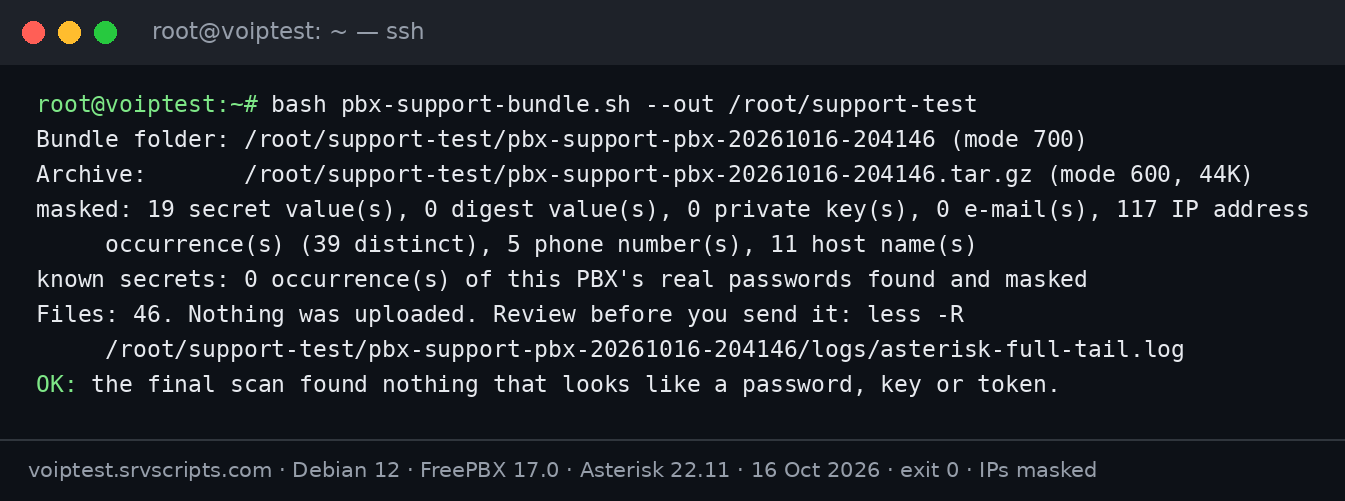
| Full run on FreePBX 17 | 46 files, 44 KB archive in 3.3 s; folder 700, archive 600; final scan clean |
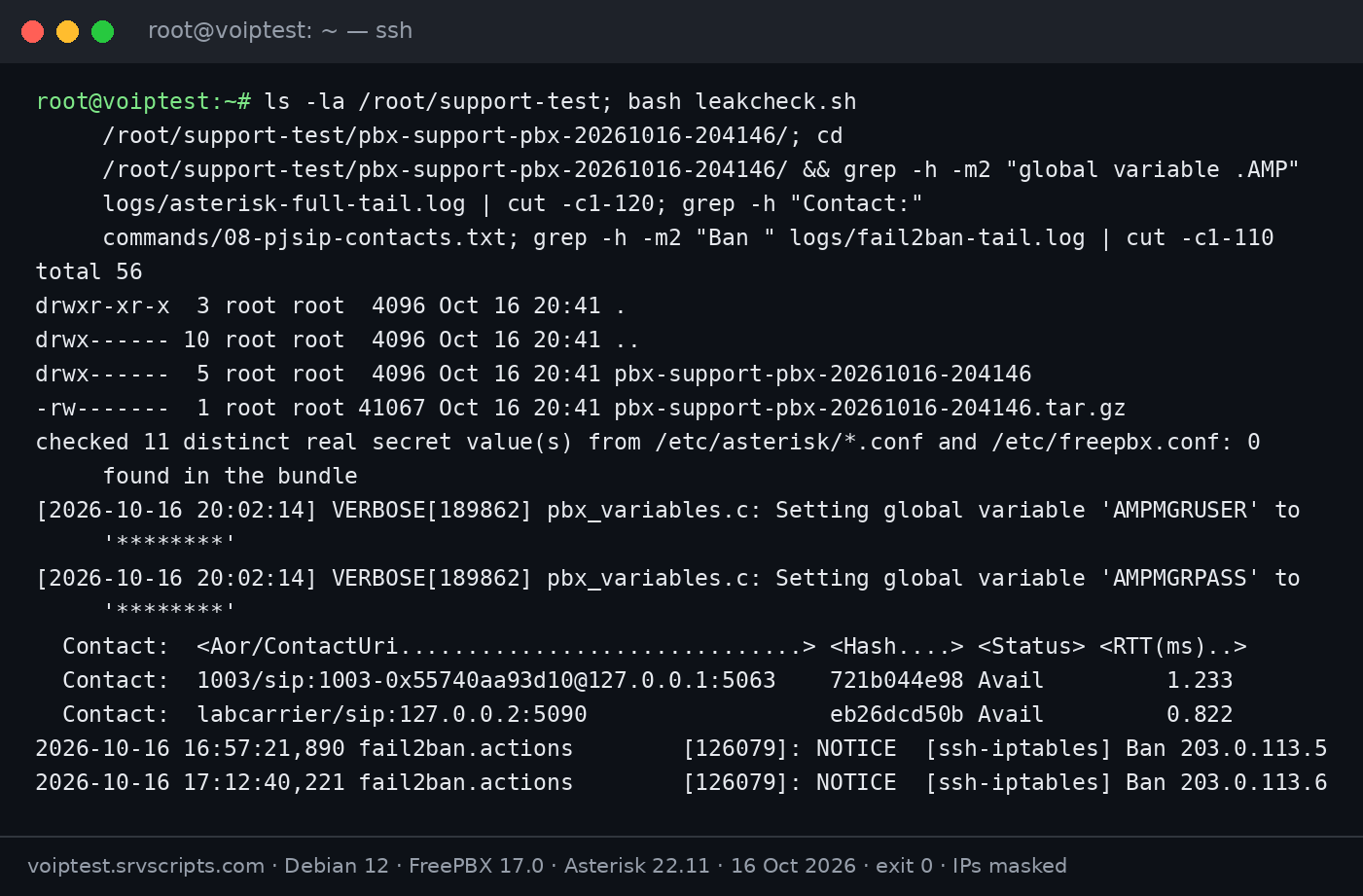
| Independent check against the real passwords | 11 distinct password values from /etc/asterisk and /etc/freepbx.conf: none found in the bundle |
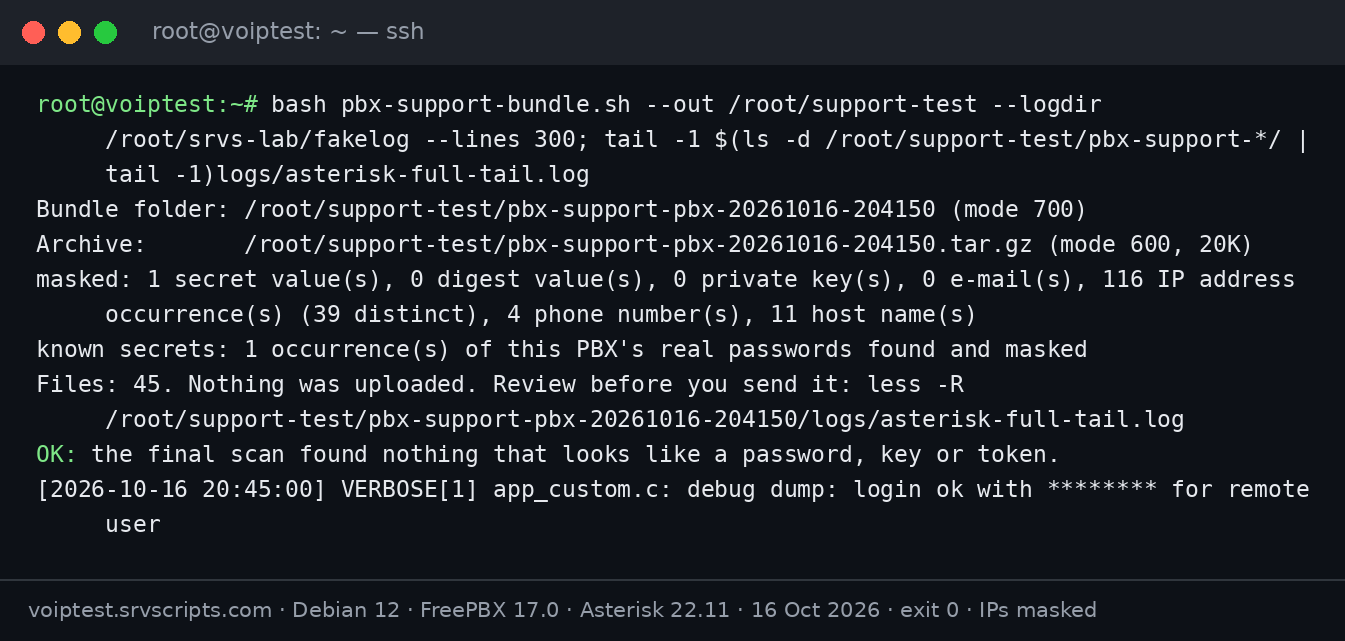
| Manager password planted in the log on purpose | Found by the known-secret check and masked; final scan clean |
--dry-run | Lists 15 command groups and 26 config files present on the server; writes nothing |
| Version 1.0.1 on the rebuilt lab | 46 files, 40 KB archive in 3.2 s, final scan clean; independent check: 0 of 11 real password values in the folder or the archive |
| 1.0.1 with a spaced Digest header, a Bearer token and the manager password planted in a log copy | All masked (the Digest username kept), exit 0 |
| Automated checks for 1.0.3, 5 more (40 in all, as a normal user) | A single 4-digit password: no file named known and no unexpected member in the folder or the archive, warning printed. Two known passwords, one with a space, in a password= log line: no part of either survives. --pack with an extra file: exit 2. 1.0.2 fails 4 of them |
| Version 1.0.2 on the lab | Full run: 47 files, 36 KB, scan clean, 0 of 11 real passwords in the folder or the archive. With an SDES key, an ICE password, a spaced Digest header and the real manager password planted in a log copy: all masked, exit 0 |
| Automated fixtures for 1.0.2, 14 more | A full SIP INVITE with two SDES keys, an FEC key, MIKEY, a k= line and an ICE password: none in the folder or the archive, a=ice-ufrag kept. A spaced manager password in a FreePBX variable line: masked whole. --pack: scan.txt that is a folder, a secret in README.txt, an unreadable file (as a normal user), an archive name that is a folder or a link: exit 1 or 2 and no archive. 1.0.1 fails 10 of them |
| Automated fixtures (CI), 20 | Trunk password (also with spaces and a comment), AMI and database passwords, Digest values with spaces or on folded lines, Proxy-Authorization, Authentication-Info, Basic and Bearer credentials, a private key, e-mail, public IPv4 and IPv6, phone numbers: none reach the bundle; private IPs, times, channel names and the Digest username stay. An unknown token: exit 1, no archive, scan.txt without the value, archive created by --pack after the line is removed. A failing tar: exit 2, no archive left |
We tested on our FreePBX 17 lab server (Debian 12, Asterisk 22.11, 4 vCPU) on 16 and 17 October 2026. The first draft of the script leaked the FreePBX manager password: FreePBX prints it as a global variable in the Asterisk log on every reload, and none of our masks covered that line. Our check against the real passwords caught it before release, which is why the version you download masks FreePBX global variables and runs the known-secret check on every bundle.
An independent review of version 1.0.0 then found three more gaps, all fixed in 1.0.1 (17 October 2026): Digest values written with spaces around = were not masked and the final scan did not look for them; the known-secret check cut a password that contains a space at the space, so the rest of it stayed visible; and the scan list printed the matching line, so it could repeat the secret it warned about, inside an archive that was already made. If you shared a bundle made with 1.0.0, check its Authorization lines and scan.txt for passwords, nonces and tokens, and change any password you find.
A third review then found two faults in 1.0.2 itself, fixed in 1.0.3 (17 October 2026). 1.0.2 put its internal list of this PBX’s passwords into the bundle as a file named known: the values in it were masked, except passwords shorter than 4 characters (letters and symbols too) or of up to 5 digits, which stayed readable. And with two or more known passwords, the first masking pass read the list as one value, so a password with a space could keep its second word in a password= line. 1.0.3 keeps its own files outside the bundle, checks that the folder and the archive hold only the bundle’s files, and warns about passwords too short to search for. If you made a bundle with 1.0.2 (available for about an hour on 17 October), delete the whole bundle, the folder and its .tar.gz archive, and make a new one with 1.0.3. Deleting known from the folder is not enough: it stays in the archive and in any copy you already sent. If you sent a 1.0.2 bundle to anyone, ask them to delete it too, and change two kinds of passwords: any password shorter than 4 characters, whether letters, digits or symbols, and any password made only of digits with 5 digits or fewer.
A second review of 1.0.1 found more, fixed in 1.0.2 (17 October 2026): SIP traces of encrypted calls kept their SRTP keys and ICE passwords; a manager password with a space was masked only up to the space in the FreePBX variable line; and --pack treated a scan that could not run as clean and skipped README.txt. If you shared a bundle made with 1.0.0 or 1.0.1 that contains SIP traces of encrypted (SRTP or WebRTC) calls, treat it as sensitive: the keys of those calls are in it. Also check the FreePBX “Setting global variable” lines for the end of a password. The screenshots are the real terminal output of 1.0.0, whose normal run looks the same; only IP addresses are masked.
Options
| Option | Meaning |
|---|---|
--out DIR | Where to write the bundle (default /root) |
--lines N | Last N lines of the Asterisk full log (default 2000, 0 for none) |
--conf DIR, --logdir DIR | Asterisk config and log folders (defaults /etc/asterisk and /var/log/asterisk) |
--mask-private-ips | Mask private addresses too |
--keep-ips | Do not mask any IP address |
--keep-host | Keep this server’s host and domain name |
--keep-numbers | Do not mask phone numbers |
--dry-run | Show what would be collected, collect nothing |
--pack DIR | Scan a bundle folder again after you edited it, and create its archive if the scan is clean, the scan itself worked and the folder holds only the bundle’s own files |
Notes and limits
- Masking works on patterns. It cannot know every place a custom script prints a secret; the known-secret check covers the passwords Asterisk and FreePBX store, and the final scan catches common token formats. Read the bundle before you send it.
- Extension (SIP user) names are kept: without their passwords they are not secrets, and they are needed to read the logs.
- Call details in the log tail (who called which number) are personal data. Numbers are masked, but if you share the bundle outside your company, check your data protection rules first.
- For a SIP trace of one problem call, enable
pjsip set logger on, make the call, then run the bundle with a small--linesvalue. See our call drop decision tree for what to look for, or analyse a trace yourself with the SIP trace analyzer.
Related: PJSIP health check, Asterisk security audit, troubleshoot SIP with sngrep, Asterisk CLI cheat sheet.
Background: the Asterisk logging documentation explains the full log and its verbosity levels.
The script
#!/usr/bin/env bash
# PBX Support Bundle for Asterisk and FreePBX: Redacted Diagnostics, Preview, No Upload (v1.0.4) - from srvScripts.com
# Source, docs and updates: https://srvscripts.com/scripts/pbx-support-bundle/
# Copyright (c) 2026 srvScripts.com. MIT licence: if you copy, share or adapt this script, keep this notice and credit srvScripts.com.
#
# Collects what a VoIP consultant, your provider or a forum usually asks for (versions, PJSIP transports, endpoints,
# registrations and contacts, selected config files, the last lines of the Asterisk log) into one archive, with
# passwords, digest values, SRTP/ICE keys from SIP traces, private keys, e-mail addresses, public IP addresses and
# phone numbers masked.
# Only files on a fixed list are copied: never pjsip.auth.conf, manager.conf, voicemail.conf or the FreePBX database
# config. Those are only read to check that none of their passwords ended up in the bundle (any match is masked).
# Nothing is uploaded or sent anywhere. The result is a private folder (700) and archive (600) for you to review.
#
#   bash pbx-support-bundle.sh                    # bundle in /root, last 2000 log lines
#   bash pbx-support-bundle.sh --dry-run          # show what would be collected, collect nothing
#   bash pbx-support-bundle.sh --lines 5000 --out /root/support --keep-private-ips
#
# Changes nothing on the PBX: it runs read-only Asterisk CLI commands and writes only the bundle.
# Exit codes: 0 archive created and the final scan found nothing, 1 the scan found something that may be sensitive
# (no archive; fix the listed lines and run --pack), 2 nothing collected or the archive could not be written,
# 3 bad option or missing tool.
# Version 1.0.4 (2026-10-18): comment correction only, no change in behaviour: the 1.0.3 note below now also names
#   passwords shorter than 4 characters, which the 1.0.2 "known" file left readable as well.
# Version 1.0.3 (2026-10-17): fixes from a third review: 1.0.2 copied its internal list of this PBX's passwords
#   into the bundle as a file named "known" (masked, except passwords shorter than 4 characters, of any kind, and
#   passwords of up to 5 digits); the list now lives outside
#   the bundle, and folder and archive are checked against the fixed layout. With two or more known passwords the
#   first masking pass read the list as one value, so a password with a space could keep its second word; fixed.
#   Known passwords too short or too numeric to search for safely are counted in a warning.
# Version 1.0.2 (2026-10-17): fixes from a second independent review: SDP keying material in SIP traces (SDES
#   inline: keys incl. FEC keys, a=key-mgmt, k= lines, ICE passwords) is masked and checked by the final scan; this
#   PBX's known passwords are masked before any pattern rule, and quoted FreePBX variable values are masked whole
#   (1.0.1 masked only the first word of a password with a space); a scan that fails (unreadable file, report not
#   writable) stops with exit 2 instead of counting as clean; the scan now covers every file, README.txt included;
#   the archive name must not be an existing folder or link.
# Version 1.0.1 (2026-10-17): fixes from an independent review: Digest values written with spaces around "=", other
#   Authorization/Authentication-Info parameters and Bearer tokens are masked; known passwords with spaces are no
#   longer cut short; scan.txt lists file, line and rule only (it printed the value in 1.0.0); no archive is created
#   while the scan finds something (new --pack); a failed archive is an error instead of OK.
# Version 1.0.0 (2026-10-17): first release. Tested on FreePBX 17.0.33 / Asterisk 22.11 (Debian 12).
set -uo pipefail
export LC_ALL=C
umask 077
OUT=/root; LINES=2000; DRY=0; KEEP_PRIV=1; MASK_HOST=1; MASK_NUM=1; AST=${ASTERISK_BIN:-asterisk}; CONF=/etc/asterisk
LOGDIR=/var/log/asterisk
usage() {
  cat <<'EOF'
Usage: pbx-support-bundle.sh [options]
  --out DIR            where to write the bundle (default /root)
  --lines N            last N lines of the Asterisk "full" log (default 2000, 0 = none)
  --conf DIR           Asterisk config folder (default /etc/asterisk)
  --logdir DIR         Asterisk log folder (default /var/log/asterisk)
  --mask-private-ips   also mask private (RFC 1918) addresses; by default they are kept, they help with NAT problems
  --keep-ips           do not mask any IP address (public addresses are masked by default)
  --keep-host          keep this server's host and domain name (masked as pbx.example.com by default)
  --keep-numbers       keep phone numbers (7 to 15 digits are masked by default, last 2 digits kept)
  --dry-run            list what would be collected and exit
  --pack DIR           after you edited a bundle folder: scan it again and create the archive if it is clean
  -h, --help           this help
EOF
}
die() { echo "ERROR: $*" >&2; exit 3; }
KEEP_IPS=0; PACK=""
while [ $# -gt 0 ]; do
  case "$1" in
    --out) OUT="${2:-}"; [ -d "$OUT" ] || die "--out: no such folder"; shift 2 ;;
    --lines) [[ "${2:-}" =~ ^[0-9]+$ ]] || die "--lines needs a number"; LINES=$2; shift 2 ;;
    --conf) CONF="${2:-}"; [ -d "$CONF" ] || die "--conf: no such folder"; shift 2 ;;
    --logdir) LOGDIR="${2:-}"; shift 2 ;;
    --mask-private-ips) KEEP_PRIV=0; shift ;;
    --keep-ips) KEEP_IPS=1; shift ;;
    --keep-host) MASK_HOST=0; shift ;;
    --keep-numbers) MASK_NUM=0; shift ;;
    --dry-run) DRY=1; shift ;;
    --pack) PACK="${2:-}"; [ -d "$PACK" ] || die "--pack needs an existing bundle folder"; shift 2 ;;
    -h|--help) usage; exit 0 ;;
    *) usage >&2; die "unknown option: $1" ;;
  esac
done
command -v perl >/dev/null 2>&1 || die "perl is required (it is part of every Debian/RHEL base system)"
command -v tar >/dev/null 2>&1 || die "tar is required"
scan_bundle() { # dir report-file -> writes the report (file:line:rule, never values), prints the number of hits;
  # returns non-zero if any file cannot be read or the report cannot be written (a failed scan is never "clean")
  ( cd "$1" && find . \( -type f -o -type l \) -print0 ) | perl -0 -e '
    use strict; use warnings; my ($dir, $rep) = @ARGV; my $n = 0; open my $o, ">", $rep or die "scan report: $!\n";
    my $K = qr/(?:password|secret|passwd|md5_cred|apikey|api_key|token|auth_?pass)/i;
    sub masked { my $v = shift; return 1 if $v =~ /^(["\x27])\*{4,}\1/; return 1 if $v =~ /^\*{4,}(?:$|[\s,;&)}\]])/; 0 }
    my @R = (
      [ "assignment", sub { $_[0] =~ /\b$K\s*(?:=>|=|:)\s*([^\n]*)/ && length($1) && !masked($1) } ],
      [ "freepbx-variable", sub { $_[0] =~ /(?:PASS|SECRET|TOKEN)[A-Z_]*["\x27]?\s+to\s+(["\x27][^\n]*)/ && !masked($1) } ],
      [ "private-key", sub { $_[0] =~ /BEGIN [A-Z ]*PRIVATE KEY/ } ],
      [ "auth-header", sub { $_[0] =~ /\b(?:Proxy-)?Authorization\s*:\s*(?:Basic|Bearer)\s+(?!\*{4})\S/i } ],
      [ "digest-value", sub { $_[0] =~ /\b(?:response|nonce|cnonce|opaque|nextnonce|rspauth|auts)\s*=\s*"?(?!\*{4})[^\s",;*]/i } ],
      [ "sdp-key", sub { $_[0] =~ /inline:(?!\*{4})[A-Za-z0-9+\/]{8,}|ice-pwd:(?!\*{4})\S{4,}|a=key-mgmt:\s*\S+\s+(?!\*{4})\S|(?:^|\s)k=(?:clear|base64|uri|prompt):(?!\*{4})\S/i } ],
      [ "long-token", sub { $_[0] =~ m{[A-Za-z0-9+/]{60,}={0,2}} } ] );
    my $err = 0; local $/ = "\0";
    while (my $f = <STDIN>) { chomp $f; $f =~ s{^\./}{}; (my $safe = $f) =~ s/[^\w.\/-]/?/g;
      if (-l "$dir/$f") { print $o "$safe:0: symbolic-link\n"; $n++; next }
      my $i; unless (open $i, "<", "$dir/$f") { warn "cannot read $safe: $!\n"; $err++; next }
      local $/ = "\n"; my $ln = 0;
      while (my $l = <$i>) { $ln++; for my $r (@R) { if ($r->[1]->($l)) { print $o "$safe:$ln: $r->[0]\n"; $n++; last } } }
      close $i or $err++; }
    close $o or die "scan report: $!\n"; die "$err file(s) could not be scanned\n" if $err; print $n;' "$1" "$2"
}
scan_or_stop() { # dir -> sets HITS and leaves dir/scan.txt only when something was found; exits 2 if the scan fails
  local dir=$1 rep rc
  if [ -e "$dir/scan.txt" ] || [ -L "$dir/scan.txt" ]; then
    if [ -f "$dir/scan.txt" ] && [ ! -L "$dir/scan.txt" ]; then rm -f "$dir/scan.txt"
    else echo "ERROR: $dir/scan.txt is not a plain file (folder or link); remove it and try again. No archive was created." >&2; exit 2; fi
  fi
  rep=$(mktemp) || { echo "ERROR: cannot create a temporary scan report. No archive was created." >&2; exit 2; }
  HITS=$(scan_bundle "$dir" "$rep"); rc=$?
  if [ "$rc" -ne 0 ] || ! [[ "$HITS" =~ ^[0-9]+$ ]]; then rm -f "$rep"; echo "ERROR: the final scan failed (see above), so the bundle cannot be called clean. No archive was created." >&2; exit 2; fi
  if [ "$HITS" -gt 0 ]; then cp "$rep" "$dir/scan.txt" && chmod 600 "$dir/scan.txt" || { rm -f "$rep"; echo "ERROR: cannot write $dir/scan.txt. No archive was created." >&2; exit 2; }; fi
  rm -f "$rep"
}
pack_bundle() { # dir -> creates dir.tar.gz atomically, mode 600, verified; returns 0 or 2
  local dir=${1%/} base parent tmp members; base=$(basename "$dir"); parent=$(dirname "$dir")
  if [ -L "$dir.tar.gz" ] || { [ -e "$dir.tar.gz" ] && [ ! -f "$dir.tar.gz" ]; }; then
    echo "ERROR: $dir.tar.gz already exists and is not a plain file (folder or link); move it away first. No archive was created." >&2; return 2; fi
  tmp=$(mktemp "$parent/.${base}.XXXXXX") || { echo "ERROR: cannot create a temporary archive in $parent" >&2; return 2; }
  if tar -C "$parent" -czf "$tmp" "$base" && gzip -t "$tmp" && chmod 600 "$tmp" && [ -s "$tmp" ] \
     && members=$(tar -tzf "$tmp") && ! grep -qvE "^$(printf '%s' "$base" | sed 's/[.[\*^$]/\\&/g')/((README|scan)\.txt|(commands|config|logs)/([^/]+)?)?\$" <<<"$members" \
     && mv -fT "$tmp" "$dir.tar.gz" && [ -f "$dir.tar.gz" ] && [ ! -L "$dir.tar.gz" ]; then return 0; fi
  rm -f "$tmp"; echo "ERROR: the archive could not be created (disk full or not writable?) or did not hold exactly the bundle files; the reviewed folder $dir is kept" >&2; return 2
}

layout_ok() { # dir -> 0 if the folder holds only what the bundle writes: README.txt, scan.txt, commands/ config/ logs/ files
  local dir=$1 bad
  bad=$(cd "$dir" && find . -mindepth 1 ! -path ./README.txt ! -path ./scan.txt ! -path ./commands ! -path ./config ! -path ./logs \
        ! -regex '\./\(commands\|config\|logs\)/[^/]*' -print | head -3)
  [ -z "$bad" ] && return 0
  echo "ERROR: $dir contains something the bundle does not write ($(echo $bad | tr '\n' ' ')); move it out and run --pack again. No archive was created." >&2; return 1
}
# ---- --pack: re-scan a bundle folder you edited and create the archive if nothing sensitive is left ----
if [ -n "$PACK" ]; then
  PACK=${PACK%/}; layout_ok "$PACK" || exit 2; scan_or_stop "$PACK"
  if [ "$HITS" -gt 0 ]; then echo "WARNING: $HITS line(s) still look sensitive; see $PACK/scan.txt (file, line, rule; no values). No archive was created."; exit 1; fi
  pack_bundle "$PACK" || exit 2
  echo "OK: nothing that looks like a password, key or token is left. Archive: $PACK.tar.gz (mode 600, $(du -h "$PACK.tar.gz" | cut -f1))"; exit 0
fi

# ---- what is collected: fixed lists, nothing else is read ----
CONFS=(asterisk.conf modules.conf pjsip.conf pjsip.transports.conf pjsip.transports_custom.conf pjsip_custom.conf
  pjsip.endpoint.conf pjsip.endpoint_custom.conf pjsip.endpoint_custom_post.conf pjsip.aor.conf pjsip.aor_custom_post.conf
  pjsip.registration.conf pjsip.registration_custom_post.conf pjsip.identify.conf pjsip.identify_custom_post.conf
  rtp.conf rtp_additional.conf rtp_custom.conf logger.conf logger_general_custom.conf logger_logfiles_custom.conf
  http.conf http_additional.conf http_custom.conf extensions_custom.conf features_general_custom.conf)
NEVER="pjsip.auth.conf manager.conf manager_custom.conf manager_additional.conf voicemail.conf res_odbc.conf cdr_mysql.conf freepbx.conf amportal.conf"
CMDS=(
  "system|cat /etc/os-release; echo; uname -a; echo; uptime; echo; df -h -x tmpfs -x devtmpfs; echo; free -m; echo; date; timedatectl 2>/dev/null | head -8"
  "network|ip -br addr 2>/dev/null; echo; ip route 2>/dev/null; echo; ss -lntup 2>/dev/null | grep -Ei 'asterisk|httpd|apache|nginx|5060|5061|8089' "
  "asterisk-version|$AST -rx 'core show version'; $AST -rx 'core show uptime'"
  "asterisk-settings|$AST -rx 'core show settings'"
  "pjsip-transports|$AST -rx 'pjsip show transports'"
  "pjsip-endpoints|$AST -rx 'pjsip show endpoints'"
  "pjsip-registrations|$AST -rx 'pjsip show registrations'"
  "pjsip-contacts|$AST -rx 'pjsip show contacts'"
  "pjsip-identifies|$AST -rx 'pjsip show identifies'"
  "channels|$AST -rx 'core show channels count'; $AST -rx 'core show channels concise' | wc -l"
  "rtp|$AST -rx 'rtp show settings' 2>/dev/null"
  "modules|$AST -rx 'module show like res_pjsip' ; $AST -rx 'module show like chan_'"
  "freepbx|command -v fwconsole >/dev/null && { fwconsole -V; fwconsole ma list 2>/dev/null | head -150; }"
  "fail2ban|command -v fail2ban-client >/dev/null && { fail2ban-client status; for j in \$(fail2ban-client status 2>/dev/null | sed -n 's/.*Jail list:[[:space:]]*//p' | tr ',' ' '); do fail2ban-client status \$j; done; }"
  "services|systemctl --no-pager --plain list-units --type=service --state=failed 2>/dev/null; systemctl --no-pager status asterisk freepbx 2>/dev/null | head -30"
)
if [ "$DRY" = 1 ]; then
  echo "Would run (read-only):"; for c in "${CMDS[@]}"; do echo "  ${c%%|*}: ${c#*|}" | cut -c1-150; done
  echo "Would copy from $CONF (only if present):"; for f in "${CONFS[@]}"; do [ -f "$CONF/$f" ] && echo "  $f"; done
  echo "Never copied (only read to check that their passwords do not appear in the bundle): $NEVER"
  echo "Logs: last $LINES lines of $LOGDIR/full; last 300 lines of $LOGDIR/freepbx.log and /var/log/fail2ban.log"
  echo "Masking: passwords and secrets, digest values, private keys, e-mail addresses, $( [ $KEEP_IPS = 1 ] && echo "no IPs" || { [ $KEEP_PRIV = 1 ] && echo "public IPs" || echo "all IPs"; }), $( [ $MASK_NUM = 1 ] && echo "phone numbers" || echo "numbers kept"), $( [ $MASK_HOST = 1 ] && echo "host name" || echo "host name kept")"
  exit 0
fi

host=$(hostname -f 2>/dev/null || hostname); dom=$(hostname -d 2>/dev/null || true)
stamp=$(date +%Y%m%d-%H%M%S); name="pbx-support-$( [ $MASK_HOST = 1 ] && echo pbx || echo "${host%%.*}")-$stamp"
# RAW holds only the collected payload; WORK holds this script's own files (the password list, counters) and is
# never read into the bundle
RAW=$(mktemp -d) && WORK=$(mktemp -d) || die "mktemp failed"; trap 'rm -rf "$RAW" "$WORK"' EXIT
mkdir -p "$RAW/commands" "$RAW/config" "$RAW/logs"
n=0; got=0
"$AST" -rx "core show version" >/dev/null 2>&1 || echo "WARNING: the Asterisk CLI did not answer (not running, or not root?): only system information and files are collected" >&2
for c in "${CMDS[@]}"; do
  n=$((n+1)); lab=${c%%|*}; f=$(printf '%s/commands/%02d-%s.txt' "$RAW" "$n" "$lab")
  { echo "# ${c#*|}"; timeout 60 bash -c "${c#*|}" 2>&1; } > "$f"; [ "$(wc -l < "$f")" -gt 1 ] && got=$((got+1))
done
for f in "${CONFS[@]}"; do [ -f "$CONF/$f" ] && cp "$CONF/$f" "$RAW/config/" && got=$((got+1)); done
if [ "$LINES" -gt 0 ] && [ -r "$LOGDIR/full" ]; then tail -n "$LINES" "$LOGDIR/full" > "$RAW/logs/asterisk-full-tail.log"; got=$((got+1)); fi
[ -r "$LOGDIR/freepbx.log" ] && tail -n 300 "$LOGDIR/freepbx.log" > "$RAW/logs/freepbx-tail.log"
[ -r /var/log/fail2ban.log ] && tail -n 300 /var/log/fail2ban.log > "$RAW/logs/fail2ban-tail.log"
[ "$got" -gt 0 ] || { echo "ERROR: nothing could be collected (is this an Asterisk server? run as root)" >&2; exit 2; }

# Real passwords of this PBX, read (never copied) from the files the bundle leaves out; masked before any other rule.
perl -ne '
  if (/^\s*(?:password|secret|md5_cred)\s*=>?\s*(.*?)\s*$/i) { my $v = $1; $v =~ s/(?<!\\);.*$//; $v =~ s/\;/;/g; $v =~ s/^\s+|\s+$//g; $v =~ s/^"(.*)"$/$1/; print "$v\n" if length $v; }
  if (/\b(?:AMPDBPASS|AMPMGRPASS)["\x27]?\]?\s*=>?\s*["\x27]?([^"\x27;]+?)["\x27]?\s*;?\s*$/) { print "$1\n"; }
' "$CONF/pjsip.auth.conf" "$CONF"/manager*.conf "$CONF/voicemail.conf" "$CONF/res_odbc.conf" /etc/freepbx.conf /etc/amportal.conf > "$WORK/known" 2>/dev/null
# ---- redaction: one pass over every file, the same address always gets the same replacement ----
DEST="$OUT/$name"; mkdir -m 700 "$DEST" || die "cannot create $DEST"; mkdir "$DEST/commands" "$DEST/config" "$DEST/logs"
KNOWN="$WORK/known"; export KEEP_IPS KEEP_PRIV MASK_HOST MASK_NUM host dom KNOWN
( cd "$RAW" && find . -type f -print0 ) | perl -0 -e '
  use strict; use warnings;
  my ($raw, $dest) = @ARGV; my (%map, %cnt); my ($n4, $n6) = (0, 0);
  my ($host, $dom) = ($ENV{host} // "", $ENV{dom} // "");
  my $kre; if (open my $k, "<", $ENV{KNOWN}) { local $/ = "\n"; my %s; my @v = grep { length >= 4 && !/^\d{1,5}$/ && !$s{$_}++ } map { chomp; $_ } <$k>; close $k;
    $kre = join "|", map { quotemeta } sort { length $b <=> length $a } @v if @v; }
  sub priv4 { my @o = split /\./, $_[0]; return 1 if $o[0]==10 || $o[0]==127 || ($o[0]==172 && $o[1]>=16 && $o[1]<=31) || ($o[0]==192 && $o[1]==168) || ($o[0]==100 && $o[1]>=64 && $o[1]<=127) || $o[0]==0 || $o[0]>=224 || ($o[0]==169 && $o[1]==254); 0 }
  sub doc4 { $_[0] =~ /^(192\.0\.2|198\.51\.100|203\.0\.113)\./ }
  sub ip4 { my $ip = shift; my @o = split /\./, $ip; return $ip if grep { $_ > 255 } @o; return $ip if $ENV{KEEP_IPS};
    return $ip if doc4($ip) || $ip eq "0.0.0.0" || $ip =~ /^127\./ || $ip eq "255.255.255.255" || $ip =~ /^255\./;
    return $ip if priv4($ip) && $ENV{KEEP_PRIV};
    $map{$ip} //= do { $n4++; $n4 <= 250 ? "203.0.113." . ($n4 + 4) : "198.51.100." . ($n4 - 246) }; $cnt{ip}++; $map{$ip} }
  sub ip6 { my $a = shift; my $c = ($a =~ tr/://); return $a unless $a =~ /::/ || $c == 7; return $a if $a =~ /:::/ || $a !~ /[0-9a-f]{2}/i; return $a if $a =~ m{^(fe80|fc|fd|2001:db8)}i || $a !~ m{^[23]}; $map{lc $a} //= "2001:db8::" . (++$n6); $cnt{ip}++; $map{lc $a} }
  my %KEEP = map { $_ => 1 } qw(username realm uri algorithm qop nc stale domain);
  sub authparams { my $p = shift; $p =~ s{([A-Za-z][\w-]*)(\s*=\s*)("(?:[^"\\]|\\.)*"|[^\s,]+)}{my ($k, $e, $v) = ($1, $2, $3); $KEEP{lc $k} ? "$k$e$v" : do { $cnt{digest}++; $v =~ /^"/ ? "$k$e\"****\"" : "$k$e****" }}ge; return $p; }
  sub authval { my ($h, $v) = @_;
    return authparams($v) if $h =~ /^Authentication-Info$/i;
    if ($v =~ /^(\s*)(Digest)(\s+)(.*)$/is) { return $1 . $2 . $3 . authparams($4); }
    if ($v =~ /^(\s*)([A-Za-z][\w-]*)(\s+)\S/) { $cnt{digest}++; return "$1$2$3****"; }
    return $v; }
  local $/ = "\0";
  while (my $f = <STDIN>) { chomp $f; $f =~ s{^\./}{};
    open my $in, "<", "$raw/$f" or next; local $/; my $t = <$in>; close $in;
    if (defined $kre) { $cnt{known} += ($t =~ s/$kre/********/g); }
    $cnt{key} += ($t =~ s/-----BEGIN [A-Z ]*PRIVATE KEY-----.*?-----END [A-Z ]*PRIVATE KEY-----/[private key removed]/gs);
    $cnt{secret} += ($t =~ s/^(\s*[;#]?\s*(?:password|secret|md5_cred|passwd|pass|apikey|api_key|token|auth_?pass|pin|community|key_?pass(?:word)?)\s*(?:=>|=|:)\s*)\S.*$/$1********/gmi);
    $cnt{secret} += ($t =~ s/\b(password|secret|passwd|token|apikey|api_key)(\s*[=:]\s*"?|":\s*")(?!\*{8})[^\s"&;,]+/$1$2********/gi);
    # FreePBX logs its manager and database credentials on every reload ("Setting global variable AMPDBPASS to ...")
    my $VAR = qr/\b[A-Za-z0-9_-]*(?:PASS|SECRET|TOKEN|APIKEY|API_KEY|PIN|CRED|DBUSER|MGRUSER)[A-Za-z0-9_-]*[\x27"]?\s*(?:to|=|=>)\s*/i;
    $cnt{secret} += ($t =~ s/($VAR)([\x27"])(?!\*{8}\2)[^\n]*?\2/$1$2********$2/g);
    $cnt{secret} += ($t =~ s/($VAR)(?![\x27"*])[^\s)]+/$1********/g);
    # SDP keying material in SIP traces: SDES keys (all of them, FEC keys too), MIKEY, k= lines, ICE passwords
    $cnt{sdp} += ($t =~ s{(\binline:)(?!\*{8})[A-Za-z0-9+/]+=*}{$1********}gi);
    $cnt{sdp} += ($t =~ s{(a=key-mgmt:\s*\S+\s+)(?!\*{8})\S+}{$1********}gi);
    $cnt{sdp} += ($t =~ s{((?:^|\s)k=(?:clear|base64|uri|prompt):)(?!\*{8})\S+}{$1********}gim);
    $cnt{sdp} += ($t =~ s{(\bice-pwd[:=]\s*"?)(?!\*{8})[^\s",;]+}{$1********}gi);
    # SIP / HTTP authentication headers: keep username, realm, uri, algorithm, qop, nc; mask everything else
    # (RFC 3261 allows spaces around "=" and folded continuation lines)
    $t =~ s{\b((?:Proxy-)?Authorization|(?:WWW|Proxy)-Authenticate|Authentication-Info)(\s*:)([^\n]*(?:\n[ \t]+[^\n]*)*)}{$1 . $2 . authval($1, $3)}gie;
    $cnt{digest} += ($t =~ s{\b(response|nonce|cnonce|opaque|nextnonce|rspauth|auts)(\s*=\s*)("[^"]*"|[^\s,;"]+)}{my ($k, $e, $v) = ($1, $2, $3); $v =~ /^"?\*+"?$/ ? "$k$e$v" : ($v =~ /^"/ ? "$k$e\"****\"" : "$k$e****")}gie);
    $cnt{email} += ($t =~ s/[\w.+-]+@(?!example\.)[A-Za-z0-9-]+(?:\.[A-Za-z0-9-]+)*\.[A-Za-z]{2,}/user\@example.com/g);
    if ($ENV{MASK_HOST} && length $host > 3) { $cnt{host} += ($t =~ s/\Q$host\E/pbx.example.com/gi); }
    if ($ENV{MASK_HOST} && length $dom > 3) { $cnt{host} += ($t =~ s/\b[\w-]+\.\Q$dom\E\b/pbx.example.com/gi); $cnt{host} += ($t =~ s/\b\Q$dom\E\b/example.com/gi); }
    $t =~ s/(?<![\w.])((?:\d{1,3}\.){3}\d{1,3})(?![\w.])/ip4($1)/ge;
    unless ($ENV{KEEP_IPS}) { $t =~ s{(?<![\w:.])([0-9a-f]{0,4}(?::[0-9a-f]{0,4}){2,7})(?![\w:.])}{ip6($1)}gie; }
    if ($ENV{MASK_NUM}) { $cnt{number} += ($t =~ s/(?<![\w.\/\-\$])(\+?)(\d{5,13})(\d{2})(?![\w.:])/$1 . ("*" x length $2) . $3/ge); }
    open my $out, ">", "$dest/$f" or die "cannot write $dest/$f: $!\n"; print $out $t; close $out;
  }
  printf "masked: %d secret value(s), %d digest value(s), %d SRTP/ICE key(s), %d private key(s), %d e-mail(s), %d IP address occurrence(s) (%d distinct), %d phone number(s), %d host name(s)\n",
    map({ $cnt{$_} // 0 } qw(secret digest sdp key email ip)), scalar(keys %map), map({ $cnt{$_} // 0 } qw(number host));
  printf "KNOWN1=%d\n", $cnt{known} // 0;
' "$RAW" "$DEST" > "$WORK/redaction.txt" 2>&1; prc=$?
if [ "$prc" -ne 0 ]; then echo "ERROR: redaction failed, the bundle was removed: $(tail -1 "$WORK/redaction.txt")" >&2; rm -rf "$DEST"; exit 2; fi
KNOWN1=$(sed -n 's/^KNOWN1=//p' "$WORK/redaction.txt"); sed -i '/^KNOWN1=/d' "$WORK/redaction.txt"
# ---- safety net: the real secrets of this PBX must not appear anywhere in the bundle ----
# The values were read (never copied) before redaction and masked first; this second pass catches any occurrence
# the pattern rules may have changed around them. Short or purely numeric values under 6 digits are skipped.
known=$(find "$DEST" -type f -print0 | perl -0 -e '
  open my $k, "<", shift or exit 0; my @v; { local $/ = "\n"; @v = grep { length >= 4 && !/^\d{1,5}$/ && !/^\*+$/ } map { chomp; $_ } <$k>; } my %s; @v = grep { !$s{$_}++ } @v;
  exit 0 unless @v; my $re = join "|", map { quotemeta } sort { length $b <=> length $a } @v; my $n = 0;
  local $/ = "\0"; while (my $f = <STDIN>) { chomp $f; local $/; open my $i, "<", $f or next; my $t = <$i>; close $i;
    my $c = ($t =~ s/$re/********/g); if ($c) { $n += $c; open my $o, ">", $f or die; print $o $t; close $o } }
  print $n;' "$WORK/known")
echo "known secrets: ${KNOWN1:-0} occurrence(s) of this PBX's real passwords found and masked first, ${known:-0} more after the other rules" >> "$WORK/redaction.txt"
{
  echo "PBX support bundle created by https://srvscripts.com/scripts/pbx-support-bundle/ (v1.0.4) on $(date -u '+%F %T UTC')"
  echo "Options: lines=$LINES keep_ips=$KEEP_IPS keep_private_ips=$KEEP_PRIV mask_host=$MASK_HOST mask_numbers=$MASK_NUM"
  cat "$WORK/redaction.txt"
  echo "Not collected on purpose: $NEVER, CDR and call recordings, the FreePBX database."
  echo "Masked IP addresses use documentation ranges (203.0.113.x, 198.51.100.x, 2001:db8::); the same address always gets the same replacement."
} > "$DEST/README.txt"

# ---- final scan: anything that still looks secret? The list shows file, line number and rule, never the text ----
layout_ok "$DEST" || { rm -rf "$DEST"; exit 2; }
weak=$(perl -ne 'chomp; $n++ if length($_) && (length($_) < 4 || /^\d{1,5}$/); END { print $n // 0 }' "$WORK/known")
[ "${weak:-0}" -gt 0 ] && echo "WARNING: $weak of this PBX's passwords are too short or only digits (up to 5) to be searched for safely; they are masked only where they appear as password=... Change them: they are weak."
scan_or_stop "$DEST"; hits=$HITS
echo "Bundle folder: $DEST (mode 700)"
sed -n 3,4p "$DEST/README.txt"
echo "Files: $(find "$DEST" -type f | wc -l). Nothing was uploaded."
if [ "$hits" -gt 0 ]; then
  echo "WARNING: the final scan found $hits line(s) that may still be sensitive. No archive was created."
  echo "  The list (file, line, rule; no values) is in $DEST/scan.txt. Edit or remove those lines, then run:"
  echo "  bash $0 --pack $DEST"
  exit 1
fi
pack_bundle "$DEST" || exit 2
echo "Archive:       $DEST.tar.gz (mode 600, $(du -h "$DEST.tar.gz" | cut -f1))"
echo "Review before you send it: less -R $DEST/logs/asterisk-full-tail.log"
echo "OK: the final scan found nothing that looks like a password, key or token."
exit 0
d2826eaac8d48d62411854f781e56bf1a1027e2f3a231ffb9135dd16c8d95092curl -fsSL -o pbx-support-bundle.sh https://scr.srvscripts.com/pbx-support-bundle/pbx-support-bundle.sh && curl -fsSL https://scr.srvscripts.com/pbx-support-bundle/pbx-support-bundle.sh.sha256 | sha256sum -cInvoke-WebRequest -Uri 'https://scr.srvscripts.com/pbx-support-bundle/pbx-support-bundle.sh' -OutFile 'pbx-support-bundle.sh'; if ((Get-FileHash 'pbx-support-bundle.sh' -Algorithm SHA256).Hash -eq 'D2826EAAC8D48D62411854F781E56BF1A1027E2F3A231FFB9135DD16C8D95092') { 'OK: the file is intact' } else { 'MISMATCH: do not run this file' }curl and sha256sum are not the Linux tools, so use the PowerShell line there.Also on GitHub: github.com/srvscripts/scripts
Frequently asked questions
What should I send when a VoIP consultant asks for logs?
Usually the Asterisk version, the PJSIP transports, endpoints, registrations and contacts, the relevant config files and the Asterisk full log around the problem. This script collects exactly that and masks passwords, digest values, public IPs and phone numbers.
Does the script upload my data anywhere?
No. It has no network code at all. It writes a private folder (mode 700) and archive (mode 600) on the PBX, and you decide what to send.
Does FreePBX really write passwords into the Asterisk log?
Yes, on our FreePBX 17 server every reload logged the manager and database passwords as global variables (AMPMGRPASS, AMPDBPASS) at verbose level. The script masks those lines.
Can I keep the IP addresses?
Yes, use --keep-ips. By default only public addresses are masked, and each one gets a consistent replacement, so you can still follow a call through the trace.
Is it safe to post the bundle on a public forum?
Read it first. The masks and the two checks remove passwords, keys, public IPs and phone numbers, but extension names, host details you chose to keep and anything a custom script printed in an unusual format may remain.