Buying too few SIP channels means busy signals in your busiest hour; buying too many means paying for capacity that sits idle. This Erlang calculator answers both sizing questions telephony engineers ask: how many SIP channels or trunk lines you need for a given grade of service (Erlang B), and how many agents a call centre queue needs to answer a share of calls within a target time (Erlang C). It also shows the bandwidth those channels need.
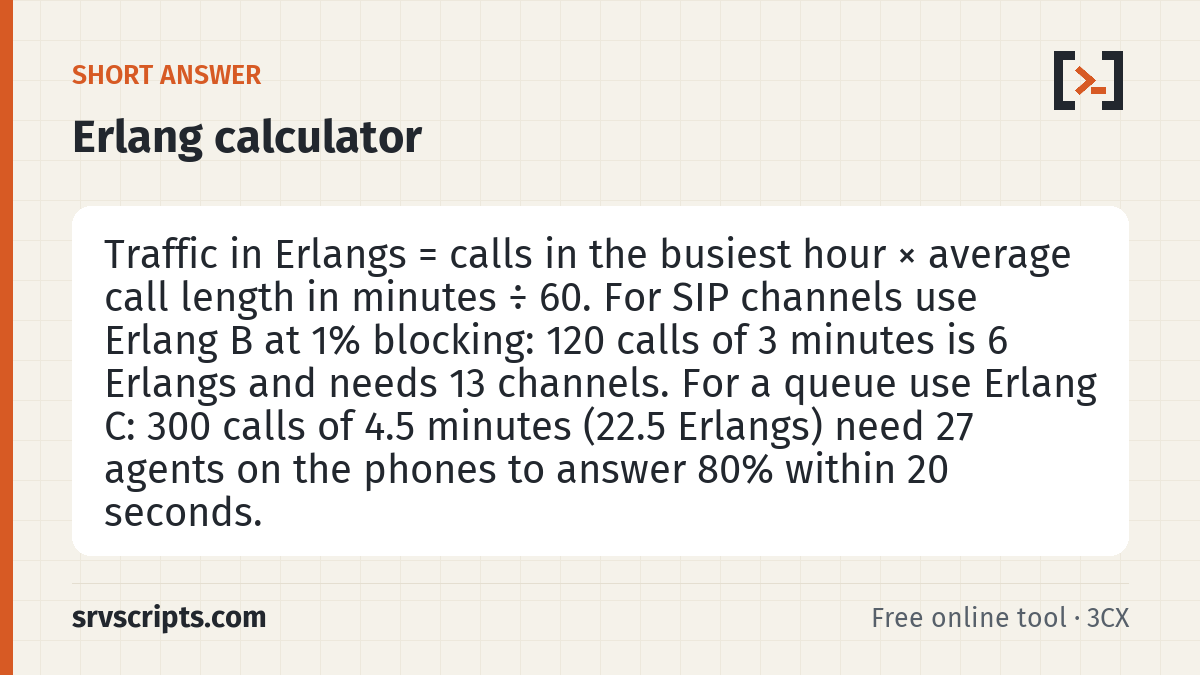
Short answer: Traffic in Erlangs = calls in the busiest hour × average call length in minutes ÷ 60. For SIP channels use Erlang B at 1% blocking: 120 calls of 3 minutes is 6 Erlangs and needs 13 channels. For a queue use Erlang C: 300 calls of 4.5 minutes (22.5 Erlangs) need 27 agents on the phones to answer 80% within 20 seconds.
Table of Contents
What an Erlang is
An Erlang is one line kept busy for one hour. Ten calls of 6 minutes in an hour are 60 minutes of talk, so 1 Erlang; 120 calls of 3 minutes are 360 minutes, so 6 Erlangs. Always size for the busiest hour of a normal busy day, not the daily average: busy-hour traffic is often 10 to 15 percent of a whole day’s calls. Your PBX CDR tells you exactly; count calls and total duration per hour over a few weeks and take a high but not freak hour.
-- busy-hour calls and minutes from the FreePBX CDR (last 30 days)
SELECT DATE_FORMAT(calldate, '%Y-%m-%d %H:00') AS hour, COUNT(*) AS calls, ROUND(SUM(billsec)/60) AS minutes
FROM asteriskcdrdb.cdr
WHERE calldate > NOW() - INTERVAL 30 DAY AND disposition = 'ANSWERED'
GROUP BY hour ORDER BY minutes DESC LIMIT 10;
How many SIP channels: Erlang B
Erlang B assumes a call that finds every channel busy is lost: the caller hears busy and goes away. That fits SIP trunks, gateways and channel licences. The result is the number of channels that keeps blocking at or below your target. 1 percent (one call in a hundred blocked in the busy hour) is the usual business grade of service; use 0.1 to 0.5 percent for emergency or revenue lines.
Blocking falls quickly as you add channels, then flattens, which is why the table under the result shows a few sizes either side. Add headroom for calls that hold a channel without talk time: ringing, queues, voicemail, conferences and transfers that hairpin through the trunk.
How many agents: Erlang C
Erlang C assumes callers wait in a queue until an agent is free. It gives the share of calls answered within your target time (the service level, classically 80 percent in 20 seconds), the average speed of answer and agent occupancy. Occupancy above about 85 to 90 percent burns agents out, so the cheapest staffing on paper is rarely the right one. The number is agents on the phones: divide by one minus shrinkage (breaks, training, absence, often 25 to 35 percent) for agents on the schedule. The queue also needs SIP channels for the agents plus the callers waiting, which the result estimates.
Worked example
| Busy-hour calls | Average length | Erlangs | SIP channels (1% blocking) | G.711 bandwidth each way |
|---|---|---|---|---|
| 30 | 3 min | 1.5 | 6 | 0.52 Mbps |
| 60 | 3 min | 3 | 8 | 0.70 Mbps |
| 120 | 3 min | 6 | 13 | 1.13 Mbps |
| 300 | 4 min | 20 | 30 | 2.62 Mbps |
Bandwidth is G.711 at 20 ms packets on Ethernet, 87.2 kbps per call in each direction. Use the VoIP bandwidth calculator for other codecs, SRTP or a VPN.
Erlang calculator at a glance
Official documentation: ITU-T E.500: traffic intensity measurement, ITU-T E.520: number of circuits in automatic groups.
Related: VoIP bandwidth calculator · VoIP codec bandwidth · Migrate a PBX to the cloud.
Frequently asked questions
How many SIP channels do I need per user?
There is no fixed ratio; it depends on how much your users phone. Office users often average 0.1 to 0.2 Erlang each in the busy hour, which works out to roughly one channel per 2 users in a small office and one per 4 users at around 100 users, because larger groups share channels more efficiently. Measure your busy hour and use Erlang B.
What is the difference between Erlang B and Erlang C?
Erlang B assumes blocked calls are lost (busy signal) and sizes trunks and channels. Erlang C assumes callers wait in a queue and sizes agents for a service level. Use B for SIP channels and C for call centre staffing.
What blocking percentage should I use?
1 percent in the busy hour is the usual business grade of service. Use a lower target such as 0.1 percent for lines where a busy signal is costly, and remember the rest of the day sees much less blocking.
Does Erlang C overstate the agents needed?
It assumes callers never hang up while waiting, so real queues do a little better than it predicts. It is still the standard planning model; add shrinkage on top for breaks and absence.