Most hacked PBXs are not broken into with clever exploits. They are found by scanners that try common SIP passwords, reach a manager interface that was left on a public address, or use an international route with no PIN. The bill arrives a weekend later. This Asterisk security audit checks a FreePBX or plain Asterisk server for exactly those openings and prints a FAIL, WARN, INFO or PASS line for each, with a one-line fix.
It changes nothing and never prints a password: weak secrets are reported by the name of the endpoint or AMI user only.
Version 1.0.1 (17 October 2026): An independent review found that some checks in 1.0.0 printed PASS when their query had failed and returned nothing (anonymous endpoint, IP-trusted endpoints, international routes), and that an unreadable FreePBX database made the route checks disappear silently. 1.0.1 reports those as UNKNOWN (exit 3) and says which check did not run. If you use 1.0.0, update.
Table of Contents
What the Asterisk security audit checks
- Asterisk version against the end-of-life table (an unsupported version gets no security fixes), and whether the deprecated chan_sip is still loaded.
- Run user: Asterisk running as root turns any bug into a full server compromise.
- Public listeners: IAX2 (4569), DUNDi (4520), H.323 (1720), UNISTIM (5000) and other ports Asterisk opens on public addresses that most systems never use.
- AMI and ARI/HTTP: bound to 127.0.0.1 or exposed; AMI users with short or guessable secrets.
- PJSIP passwords: shorter than 12 characters, all digits or equal to the user name.
- Anonymous SIP and trusted IPs: a guest endpoint, or an IP-authenticated trunk that lands in an internal context (anyone who can spoof or share that IP can dial out).
- fail2ban: whether an Asterisk jail exists and whether Asterisk actually writes security events to the log file that jail watches. A jail reading an empty file is the most common silent failure, and FreePBX installs often have it.
- Firewall: a default-deny policy in nftables, iptables, firewalld or ufw.
- International routes without a PIN or time condition, the default admin user name, readable recordings and voicemail, and a GUI open to the world.
Install and first run
curl -fsSLO https://scr.srvscripts.com/asterisk-security-audit/asterisk-security-audit.sh
bash asterisk-security-audit.sh
bash asterisk-security-audit.sh --fails-only
bash asterisk-security-audit.sh --json > audit.json
Run it as root. Exit codes: 0 no warnings, 1 warnings only, 2 at least one FAIL, 3 a check could not run (UNKNOWN) and nothing failed. That makes it usable as a weekly cron job or a monitoring check.
Tested on a real server
| Run | Server state | Result |
|---|---|---|
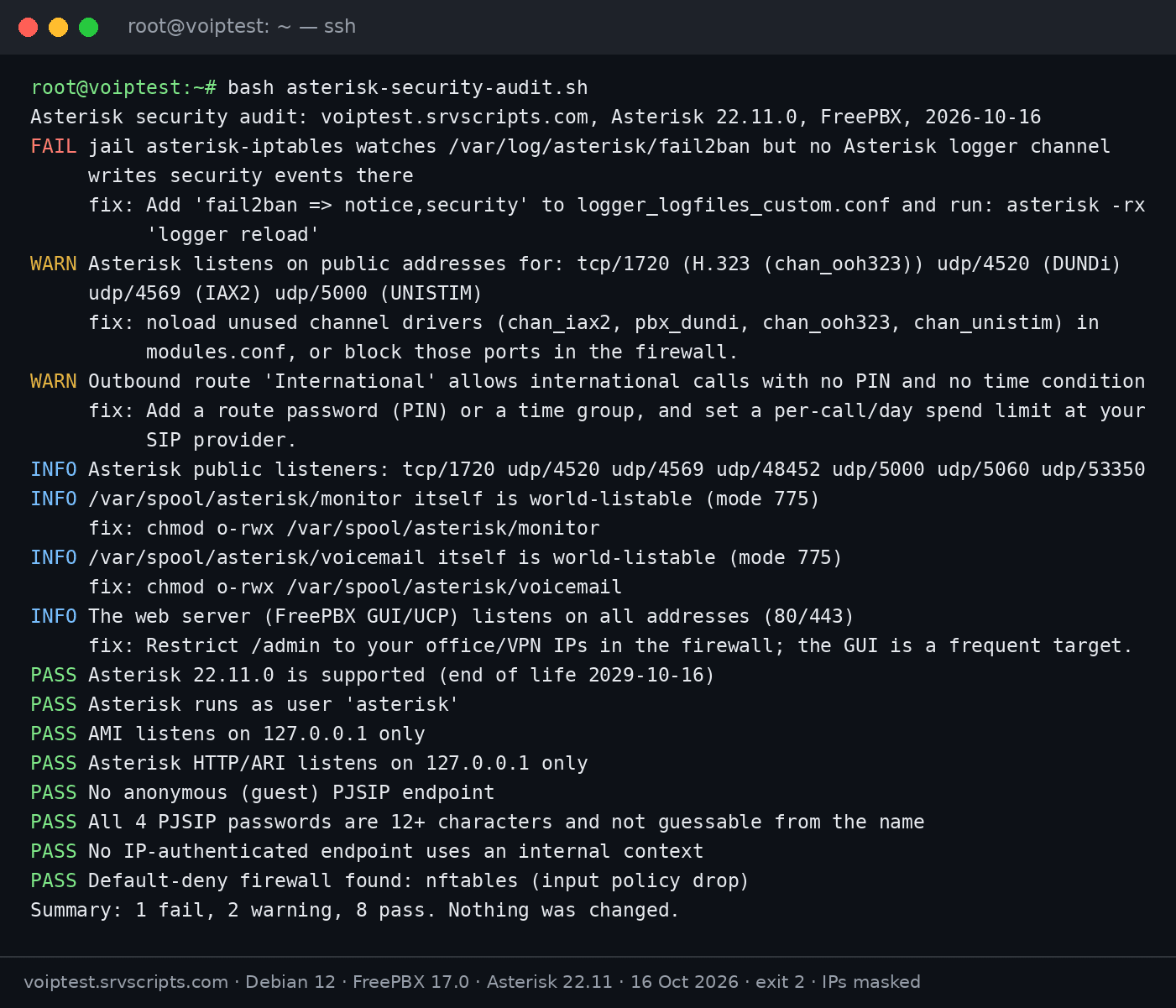
| Before | Fresh FreePBX 17 open-source install with a trunk, three extensions and an international route | 1 FAIL (fail2ban jail could not see Asterisk security events), 2 WARN (public IAX2, DUNDi, H.323 and UNISTIM listeners; international route without a PIN), 8 PASS |
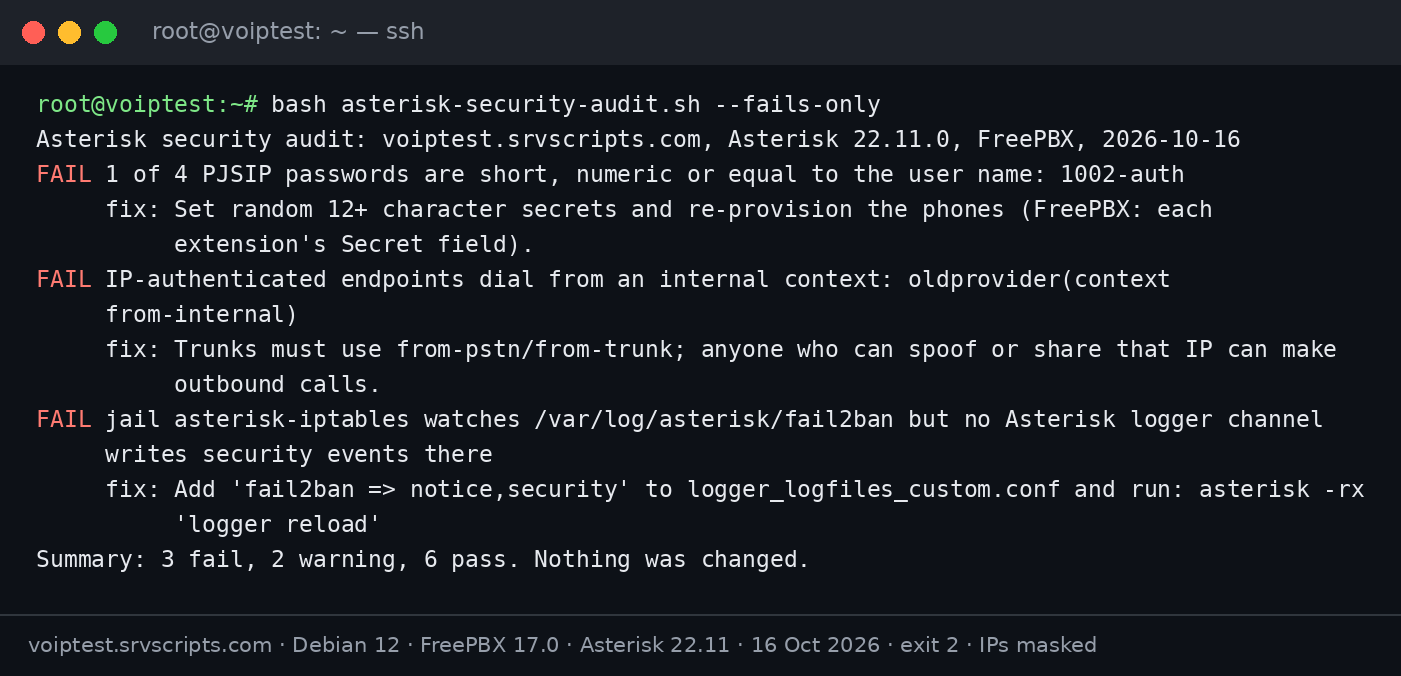
| Problems added on purpose | Extension 1002 given a weak password and an IP-trusted “oldprovider” endpoint pointed at from-internal | 3 FAIL, each with the right object name and no password shown |
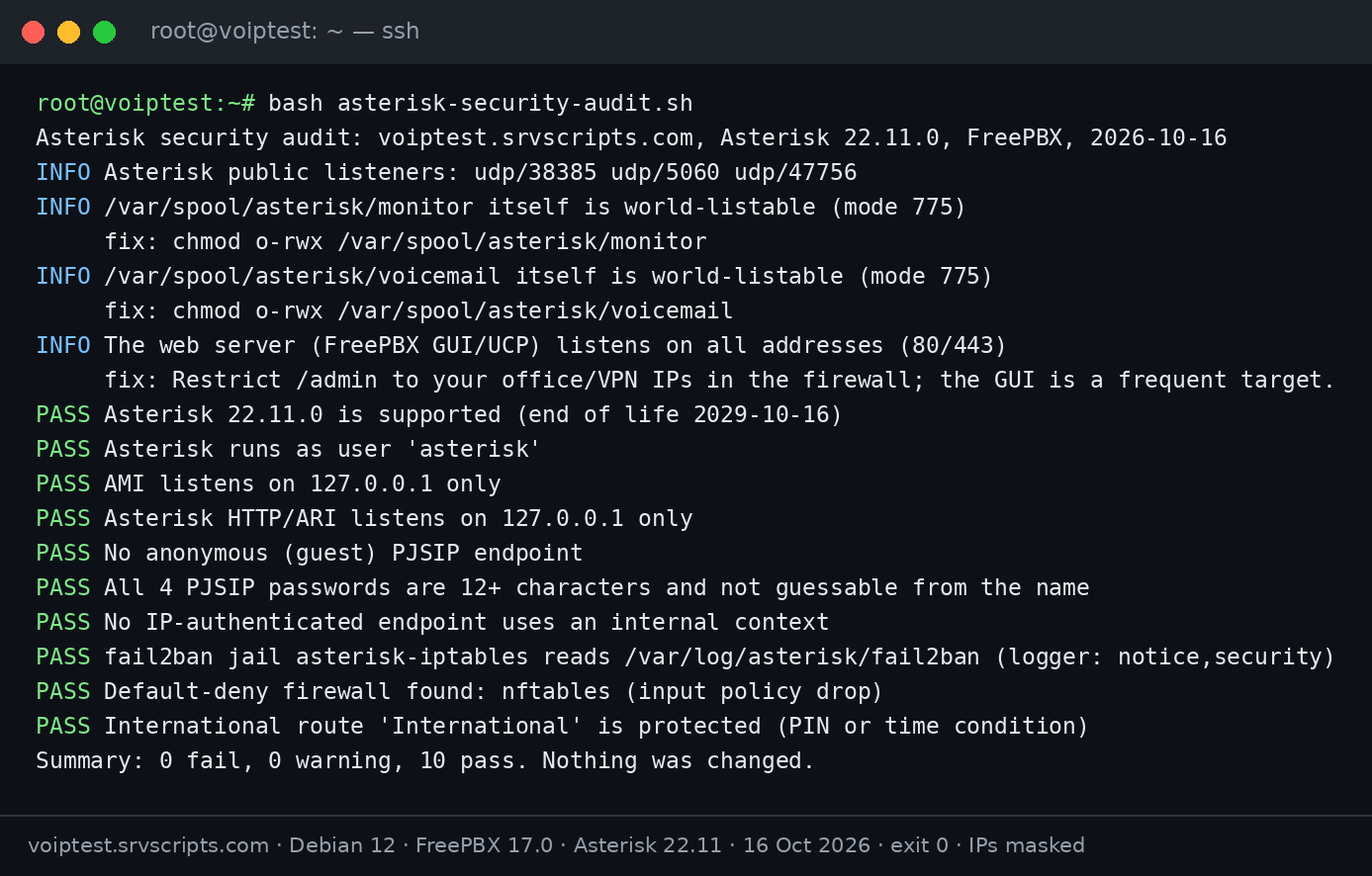
| After fixing | Logger channel for fail2ban added, unused channel drivers set to noload, a PIN on the international route, the test problems removed | 0 FAIL, 0 WARN, 10 PASS |
1.0.1: wrong database credentials (MYSQL_ARGS) | FreePBX installed but its database not readable | UNKNOWN “the route and admin-user checks were NOT run”, exit 3 |
| Regression test (fake Asterisk CLI) | The identify list query fails | 1.0.1: UNKNOWN, no PASS line. 1.0.0: “PASS No IP-authenticated endpoint” (the bug) |
We ran it on our FreePBX 17 lab server (Debian 12, Asterisk 22.11, 4 vCPU) on 16 October 2026. The fresh install really did ship with a fail2ban jail watching /var/log/asterisk/fail2ban while no Asterisk logger channel wrote to it, so password-guessing attacks would never have been banned. The screenshots are the real terminal output; only IP addresses are masked.
Fixing the common findings
Back up the files before you change them, and keep the copies until the PBX has run normally for a day:
mkdir -p /root/asterisk-bak-$(date +%F) && cp -a /etc/asterisk /root/asterisk-bak-$(date +%F)/
mysqldump asterisk | gzip > /root/asterisk-bak-$(date +%F)/asterisk.sql.gz- fail2ban cannot see attacks: add
fail2ban => notice,securityto/etc/asterisk/logger_logfiles_custom.conf, thenasterisk -rx "logger reload". See fail2ban for Asterisk and FreePBX. - Unused public listeners: in FreePBX, Admin > Asterisk Modules, or add
noload => chan_iax2.so(and pbx_dundi, chan_ooh323, chan_unistim) tomodules.conf, then restart Asterisk. Or block the ports with the SIP firewall rules generator. - International route without a PIN: Connectivity > Outbound Routes > the route > Route Password, or a time group. Also set a daily spend limit at your provider.
- Weak SIP password: set a random 16+ character secret on the extension and re-provision the phone.
Revert: copy the saved /etc/asterisk back (cp -a /root/asterisk-bak-DATE/asterisk/. /etc/asterisk/), restore the database dump if you changed routes in the GUI (zcat … | mysql asterisk), then fwconsole reload.
Options
| Option | Meaning |
|---|---|
--json | Print the findings as JSON (severity, id, message, fix) |
--fails-only | Print only FAIL lines plus the summary |
--min-secret N | Minimum SIP and AMI password length (default 12) |
--conf DIR | Asterisk configuration folder (default /etc/asterisk) |
MYSQL_ARGS (environment) | Extra mysql client arguments for the FreePBX database; root on FreePBX needs none |
Notes
- Read-only: it reads configuration files, runs Asterisk “show” commands and queries the FreePBX database. Nothing is changed, so there is nothing to revert.
- A clean report is not a guarantee. It checks the settings behind most real incidents, but it cannot see your provider account, phones or network.
- Pair it with the toll fraud watch, which watches the calls themselves, and the 10-point toll fraud checklist.
Related: FreePBX Responsive Firewall vs Intrusion Detection, Asterisk versions and EOL dates, SIP ports firewall rules.
Official reference for the settings checked here: the Asterisk documentation (security, AMI and res_pjsip pages).
The script
#!/usr/bin/env bash
# Asterisk and FreePBX Security Audit: Toll Fraud, Exposed Ports, Weak Secrets, Fail2ban (v1.0.1) - from srvScripts.com
# Source, docs and updates: https://srvscripts.com/scripts/asterisk-security-audit/
# Copyright (c) 2026 srvScripts.com. MIT licence: if you copy, share or adapt this script, keep this notice and credit srvScripts.com.
#
# Read-only security audit for an Asterisk PBX (FreePBX 15-17, plain Asterisk 18+, VitalPBX, Issabel). It checks the
# things that lead to toll fraud and hijacked PBXs: unsupported Asterisk versions, services listening on public
# addresses (IAX2, H.323, AMI, ARI...), weak or guessable SIP passwords, guest/anonymous SIP, trunks trusted by IP
# into internal contexts, a fail2ban jail that cannot see Asterisk's security log, missing firewall rules,
# international dialling without a PIN, and readable call recordings. Every finding has a one-line fix.
# Nothing is changed and no password is ever printed: weak secrets are reported by object name only.
#
#   bash asterisk-security-audit.sh            # full report
#   bash asterisk-security-audit.sh --json     # JSON for monitoring
#   bash asterisk-security-audit.sh --fails-only
#
# Exit codes: 0 no warnings, 1 warnings only, 2 at least one FAIL, 3 could not run or a check could not run (UNKNOWN,
# e.g. Asterisk or the FreePBX database not readable) and nothing failed.
# Run as root (it reads /etc/asterisk, the FreePBX database and the firewall).
# Version 1.0.1 (2026-10-17): a CLI or database query that fails is reported as UNKNOWN (exit 3) instead of a PASS
#   built on empty data (anonymous endpoint, IP trust, international routes, FreePBX database). Found in an
#   independent review.
# Version 1.0.0 (2026-10-17): first release. Tested on FreePBX 17.0.33 / Asterisk 22.11 on Debian 12 (fresh
#   --opensourceonly install with a trunk, 3 extensions and international routes).
set -uo pipefail
export LC_ALL=C

JSON=0; FAILS_ONLY=0; CONF=/etc/asterisk; AST=${ASTERISK_BIN:-asterisk}; read -ra _MA <<<"${MYSQL_ARGS:-}"; MYSQL=(mysql "${_MA[@]}" -N -B)
MINLEN=12; TODAY=$(date +%F)

usage() {
  cat <<'EOF'
Usage: asterisk-security-audit.sh [options]
  --json            print findings as JSON
  --fails-only      print FAIL lines only (plus the summary)
  --min-secret N    minimum SIP/AMI password length (default 12)
  --conf DIR        Asterisk config folder (default /etc/asterisk)
  -h, --help        this help
Environment: ASTERISK_BIN (default asterisk), MYSQL_ARGS extra mysql client arguments for the FreePBX database
EOF
}
die() { echo "UNKNOWN: $*" >&2; exit 3; }
while [ $# -gt 0 ]; do
  case "$1" in
    --json) JSON=1; shift ;;
    --fails-only) FAILS_ONLY=1; shift ;;
    --min-secret) [[ "${2:-}" =~ ^[0-9]+$ ]] || die "--min-secret needs a number"; MINLEN=$2; shift 2 ;;
    --conf) CONF="${2:-}"; [ -d "$CONF" ] || die "--conf: no such folder"; shift 2 ;;
    -h|--help) usage; exit 0 ;;
    *) usage >&2; die "unknown option: $1" ;;
  esac
done
[ "$EUID" -eq 0 ] || die "run as root (reads /etc/asterisk, the firewall and the FreePBX database)"
command -v "$AST" >/dev/null 2>&1 || die "asterisk binary not found"
ax() { timeout 10 "$AST" -rx "$1" 2>/dev/null; }
# axc VAR CMD REGEX: checked CLI query; VAR is set only when the command succeeded and its output has the expected
# shape. Returns 1 otherwise, so the caller reports UNKNOWN instead of a PASS built on empty data.
axc() { local out rc; out=$(timeout 10 "$AST" -rx "$2" 2>&1); rc=$?; printf -v "$1" '%s' "$out"
  [ "$rc" -eq 0 ] && grep -Eq -- "$3" <<<"$out" && ! grep -Eqi 'No such command|Unable to connect' <<<"$out"; }
VER=$(ax "core show version" | awk '/^Asterisk/{print $2; exit}')
[ -n "$VER" ] || die "cannot talk to Asterisk (is it running?)"

declare -a SEV=() ID=() MSG=() FIX=()
f() { SEV+=("$1"); ID+=("$2"); MSG+=("$3"); FIX+=("${4:-}"); }   # severity id message fix
FREEPBX=0; FPBX_FILE=0; [ -r /etc/freepbx.conf ] && FPBX_FILE=1
if [ "$FPBX_FILE" = 1 ]; then
  if "${MYSQL[@]}" asterisk -e "SELECT 1" >/dev/null 2>&1; then FREEPBX=1
  else f UNKNOWN freepbx_db "FreePBX is installed but its database cannot be queried: the route and admin-user checks were NOT run" "Check that MariaDB runs, or pass credentials in MYSQL_ARGS, then run the audit again."; fi
fi

# 1. Asterisk version support (dates from docs.asterisk.org/About-the-Project/Asterisk-Versions/, checked 2026-10-17)
major=${VER%%.*}; major=${major//[^0-9]/}
eol=""; secfix=""
case "$major" in
  16) eol=2023-10-09 ;; 17) eol=2020-09-30 ;; 18) eol=2025-10-20 ;; 19) eol=2022-11-02 ;;
  20) secfix=2026-10-19; eol=2027-10-19 ;; 21) secfix=2025-10-18; eol=2026-10-18 ;;
  22) secfix=2028-10-16; eol=2029-10-16 ;; 23) secfix=2026-10-15; eol=2027-10-15 ;; 24) secfix=2030-10-15; eol=2031-10-15 ;;
esac
if [ -z "$eol" ]; then
  if [ -n "$major" ] && [ "$major" -lt 16 ]; then f FAIL version "Asterisk $VER is long out of support" "Upgrade to Asterisk 22 LTS (FreePBX 17)."
  else f INFO version "Asterisk $VER: support dates not in this script's table" "Check docs.asterisk.org/About-the-Project/Asterisk-Versions/"; fi
elif [[ "$TODAY" > "$eol" ]]; then f FAIL version "Asterisk $VER reached end of life on $eol: no more security fixes" "Upgrade to Asterisk 22 LTS (FreePBX 17) or newer."
elif [ -n "$secfix" ] && [[ "$TODAY" > "$secfix" ]]; then f WARN version "Asterisk $VER gets security fixes only until $eol" "Plan the move to a current LTS (22) before $eol."
else f PASS version "Asterisk $VER is supported (end of life $eol)"; fi
grep -q 'chan_sip.so' <<<"$(ax "module show like chan_sip.so")" && f WARN chan_sip "chan_sip is loaded (deprecated, removed in Asterisk 21)" "Move extensions and trunks to PJSIP, then noload => chan_sip.so"

# 2. Process user
au=$(ps -o user= -C asterisk 2>/dev/null | head -1)
if [ "$au" = root ]; then f WARN runuser "Asterisk runs as root" "Run it as the asterisk user (AST_USER/AST_GROUP or the FreePBX default)."
elif [ -n "$au" ]; then f PASS runuser "Asterisk runs as user '$au'"; fi

# 3. What Asterisk listens on (public addresses)
pub=()
while read -r proto addr; do
  port=${addr##*:}; ip=${addr%:*}; ip=${ip#[}; ip=${ip%]}
  case "$ip" in 127.*|::1|localhost) continue ;; esac
  pub+=("$proto/$port")
done < <(ss -H -lntup 2>/dev/null | awk '/"asterisk"/{print $1, $5}' | sort -u)
odd=(); for p in "${pub[@]}"; do
  case "$p" in udp/5060|tcp/5060|tcp/5061|udp/5061) ;; *) odd+=("$p") ;; esac
done
declare -A PNAME=([udp/4569]="IAX2" [udp/4520]="DUNDi" [tcp/1720]="H.323 (chan_ooh323)" [udp/5000]="UNISTIM" [udp/2727]="MGCP" [tcp/2000]="Skinny" [tcp/5038]="AMI" [tcp/8088]="HTTP/ARI" [tcp/8089]="HTTPS/ARI")
if [ "${#odd[@]}" -gt 0 ]; then
  list=""; for p in "${odd[@]}"; do [[ "$p" == udp/[1-9][0-9][0-9][0-9][0-9] && -z "${PNAME[$p]:-}" ]] && continue; list+="$p${PNAME[$p]:+ (${PNAME[$p]})} "; done
  [ -n "$list" ] && f WARN listeners "Asterisk listens on public addresses for: $list" "noload unused channel drivers (chan_iax2, pbx_dundi, chan_ooh323, chan_unistim) in modules.conf, or block those ports in the firewall."
fi
[ "${#pub[@]}" -gt 0 ] && f INFO sip_ports "Asterisk public listeners: ${pub[*]}"

# 4. AMI
ami_bind=$(awk -F= '/^\[general\]/{g=1;next} /^\[/{g=0} g && $1 ~ /^[ \t]*bindaddr/ {gsub(/[ \t]/,"",$2); print $2}' "$CONF/manager.conf" 2>/dev/null | tail -1)
ami_on=$(awk -F= '/^\[general\]/{g=1;next} /^\[/{g=0} g && $1 ~ /^[ \t]*enabled/ {gsub(/[ \t]/,"",$2); print $2}' "$CONF/manager.conf" 2>/dev/null | tail -1)
if [ "${ami_on:-no}" = yes ]; then
  case "${ami_bind:-0.0.0.0}" in 127.*|::1) f PASS ami "AMI listens on $ami_bind only" ;;
    *) f FAIL ami "AMI (port 5038) listens on ${ami_bind:-0.0.0.0}" "Set bindaddr = 127.0.0.1 in manager.conf (FreePBX: Advanced Settings > Asterisk Manager)." ;; esac
  weak=""
  for fcf in "$CONF"/manager.conf "$CONF"/manager_additional.conf "$CONF"/manager_custom.conf; do
    [ -r "$fcf" ] || continue
    weak+=$(awk -v min="$MINLEN" -F= '/^\[/{u=$0; gsub(/[\[\]]/,"",u)} $1 ~ /^[ \t]*secret[ \t]*$/ {s=$2; gsub(/^[ \t]+|[ \t]+$/,"",s); if(length(s)<min || s ~ /^[0-9]+$/ || s==u) printf "%s ", u}' "$fcf")
  done
  [ -n "$weak" ] && f WARN ami_secret "AMI users with short or guessable secrets: $weak" "Use random secrets of $MINLEN+ characters (secrets not shown)."
fi

# 5. HTTP / ARI
hb=$(cat "$CONF"/http.conf "$CONF"/http_additional.conf "$CONF"/http_custom.conf 2>/dev/null | awk -F= '$1 ~ /^[ \t]*bindaddr/ {gsub(/[ \t]/,"",$2); b=$2} $1 ~ /^[ \t]*enabled/ {gsub(/[ \t]/,"",$2); e=$2} END{print e, b}')
read -r h_en h_bind <<<"$hb"
if [ "${h_en:-no}" = yes ]; then
  case "${h_bind:-0.0.0.0}" in 127.*|::1) f PASS http "Asterisk HTTP/ARI listens on $h_bind only" ;;
    *) f WARN http "Asterisk HTTP/ARI server listens on ${h_bind:-0.0.0.0}" "Bind it to 127.0.0.1 unless WebRTC phones need it; then firewall it." ;; esac
fi

# 6. Anonymous / guest SIP
anon=""
if ! axc anon "pjsip show endpoint anonymous" 'Endpoint:|Unable to find object'; then
  f UNKNOWN anonymous "Could not check for an anonymous PJSIP endpoint (CLI query failed)" "Run: asterisk -rx 'pjsip show endpoint anonymous'"
elif grep -q 'Endpoint:' <<<"$anon"; then
  ctx=$(awk '$1=="context"{print $3; exit}' <<<"$anon")
  f WARN anonymous "PJSIP 'anonymous' endpoint exists (context ${ctx:-?}): unauthenticated calls are accepted" "FreePBX: Settings > Asterisk SIP Settings > Allow Anonymous Inbound SIP Calls = No, unless you need it."
else f PASS anonymous "No anonymous (guest) PJSIP endpoint"; fi

# 7. PJSIP passwords (names only)
weak=(); total=0
while IFS='|' read -r sec user pass; do
  total=$((total + 1))
  if [ "${#pass}" -lt "$MINLEN" ] || [[ "$pass" =~ ^[0-9]+$ ]] || [ "$pass" = "$user" ] || [ "$pass" = "$sec" ]; then weak+=("$sec"); fi
done < <(cat "$CONF"/pjsip*.conf 2>/dev/null | awk '
  /^\[/{ if(t=="auth") print n "|" u "|" p; n=$0; gsub(/[\[\]]|\(.*$/,"",n); t=""; u=""; p=""; next }
  { line=$0; sub(/;.*/,"",line); split(line,kv,"="); k=kv[1]; gsub(/[ \t]/,"",k); v=substr(line,index(line,"=")+1); gsub(/^[ \t]+|[ \t]+$/,"",v) }
  k=="type"{t=v} k=="username"{u=v} k=="password"{p=v}
  END{ if(t=="auth") print n "|" u "|" p }')
if [ "$total" -eq 0 ]; then f INFO pjsip_secret "No PJSIP auth sections found in $CONF/pjsip*.conf"
elif [ "${#weak[@]}" -gt 0 ]; then f FAIL pjsip_secret "${#weak[@]} of $total PJSIP passwords are short, numeric or equal to the user name: $(printf '%s ' "${weak[@]:0:20}")" "Set random $MINLEN+ character secrets and re-provision the phones (FreePBX: each extension's Secret field)."
else f PASS pjsip_secret "All $total PJSIP passwords are $MINLEN+ characters and not guessable from the name"; fi

# 8. Endpoints trusted by IP that land in an internal context
bad=(); unk=(); idents=""
if axc idents "pjsip show identifies" 'No objects found|Identify:'; then
  while read -r ep; do
    [ -n "$ep" ] || continue
    epout=""; c=""
    if axc epout "pjsip show endpoint $ep" 'Endpoint:'; then c=$(awk '$1=="context"{print $3; exit}' <<<"$epout"); fi
    [ -n "$c" ] || { unk+=("$ep"); continue; }
    case "$c" in from-internal*|default|internal|from-users) bad+=("$ep(context $c)") ;; esac
  done < <(awk '$1=="Identify:" && $2 !~ /^</ {split($2,a,"/"); print a[2]}' <<<"$idents" | sort -u)
else unk+=("(identify list)"); fi
[ "${#unk[@]}" -gt 0 ] && f UNKNOWN ip_trust "Could not read the context of: ${unk[*]}" "Run: asterisk -rx 'pjsip show identifies' and 'pjsip show endpoint NAME'"
if [ "${#bad[@]}" -gt 0 ]; then f FAIL ip_trust "IP-authenticated endpoints dial from an internal context: ${bad[*]}" "Trunks must use from-pstn/from-trunk; anyone who can spoof or share that IP can make outbound calls."
elif [ "${#unk[@]}" -eq 0 ]; then f PASS ip_trust "No IP-authenticated endpoint uses an internal context"; fi

# 9. fail2ban sees Asterisk security events?
if command -v fail2ban-client >/dev/null 2>&1 && fail2ban-client ping >/dev/null 2>&1; then
  jails=$(fail2ban-client status 2>/dev/null | sed -n 's/.*Jail list:[[:space:]]*//p' | tr ',' ' ')
  ajail=""; for j in $jails; do case "$j" in *asterisk*|*sip*) ajail=$j ;; esac; done
  if [ -z "$ajail" ]; then f FAIL fail2ban "fail2ban runs but has no Asterisk/SIP jail" "Enable the asterisk jail (filter asterisk, logpath = the file your logger writes security events to)."
  else
    lp=$(fail2ban-client get "$ajail" logpath 2>/dev/null | awk '/\//{print $NF}' | head -1)
    # fail2ban drops a logpath that does not exist, so read the configured one from the jail files
    [ -n "$lp" ] || lp=$(cat /etc/fail2ban/jail.conf /etc/fail2ban/jail.local /etc/fail2ban/jail.d/*.conf /etc/fail2ban/jail.d/*.local 2>/dev/null | awk -v j="[$ajail]" '$0==j{f=1;next} /^\[/{f=0} f && $1=="logpath" {sub(/^[^=]*=[ \t]*/,""); print; exit}')
    lpb=$(basename "${lp:-none}")
    chan=$(cat "$CONF"/logger*.conf 2>/dev/null | grep -vE '^[[:space:]]*;' | awk -F'=>' -v b="$lpb" '{k=$1; gsub(/[ \t]/,"",k)} k==b {print $2}')
    if [ -z "$lp" ] || [ ! -e "$lp" ]; then f FAIL fail2ban "jail $ajail watches ${lp:-nothing}, which does not exist: SIP attacks are never banned" "Add '$lpb => notice,security' to logger_logfiles_custom.conf and run: asterisk -rx 'logger reload'"
    elif ! grep -qiE 'security|notice' <<<"$chan"; then f FAIL fail2ban "jail $ajail watches $lp but no Asterisk logger channel writes security events there" "Add '$lpb => notice,security' to logger_logfiles_custom.conf and run: asterisk -rx 'logger reload'"
    else f PASS fail2ban "fail2ban jail $ajail reads $lp (logger:$chan)"; fi
  fi
else f WARN fail2ban "fail2ban is not running" "Install fail2ban and enable an asterisk jail; SIP scanners try thousands of passwords a day."; fi

# 10. Firewall present?
fw=""
nftr=$(nft list ruleset 2>/dev/null); iptr=$(iptables -S INPUT 2>/dev/null)
if grep -qE 'hook input.*policy drop' <<<"$nftr"; then fw="nftables (input policy drop)"; fi
if [ -z "$fw" ] && grep -qE '^-P INPUT (DROP|REJECT)' <<<"$iptr"; then fw="iptables (INPUT policy DROP)"; fi
if [ -z "$fw" ] && command -v firewall-cmd >/dev/null 2>&1 && firewall-cmd --state >/dev/null 2>&1; then fw="firewalld"; fi
if [ -z "$fw" ] && command -v ufw >/dev/null 2>&1 && ufw status 2>/dev/null | grep -q 'Status: active'; then fw="ufw"; fi
if [ -n "$fw" ]; then f PASS firewall "Default-deny firewall found: $fw" "Allow SIP/RTP only from your phones and provider."
else f WARN firewall "No default-deny host firewall found (nftables/iptables/firewalld/ufw)" "Allow 5060/5061 and RTP only from your provider and office IPs; drop the rest."; fi

# 11. International dialling (FreePBX routes)
if [ "$FREEPBX" = 1 ]; then
  intl_ok=1
  intl=$("${MYSQL[@]}" asterisk -e "SELECT DISTINCT CONCAT_WS('|', r.name, IFNULL(r.password,''), IFNULL(r.time_group_id,0)) FROM outbound_routes r JOIN outbound_route_patterns p USING(route_id) WHERE CONCAT(p.match_pattern_prefix,p.match_pattern_pass) REGEXP '^(9?011|9?00|\\\\+|_?011|_?00)'" 2>/dev/null) || intl_ok=0
  if [ "$intl_ok" = 0 ]; then f UNKNOWN intl_route "Could not read the FreePBX outbound routes (query failed)" "Check the asterisk database; the international-route check was NOT run."
  elif [ -n "$intl" ]; then
    while IFS='|' read -r rn pw tg; do
      if [ -z "$pw" ] && [ "${tg:-0}" = 0 ]; then f WARN intl_route "Outbound route '$rn' allows international calls with no PIN and no time condition" "Add a route password (PIN) or a time group, and set a per-call/day spend limit at your SIP provider."
      else f PASS intl_route "International route '$rn' is protected (PIN or time condition)"; fi
    done <<<"$intl"
  else f PASS intl_route "No outbound route matches international prefixes (011/00/+)"; fi
  adm=$("${MYSQL[@]}" asterisk -e "SELECT COUNT(*) FROM ampusers WHERE username='admin'" 2>/dev/null)
  [ "${adm:-0}" -gt 0 ] && f INFO gui_admin "FreePBX GUI user 'admin' exists (the first name attackers try)" "Use a non-default admin name and 2FA (or restrict the GUI to your IPs)."
else
  grep -hqE '^[[:space:]]*exten[[:space:]]*=>[[:space:]]*_(9?011|9?00|\+)' "$CONF"/extensions*.conf 2>/dev/null && \
    f INFO intl_route "Dialplan has international patterns (_011/_00/_+)" "Protect them with a PIN (Authenticate/VMAuthenticate) and provider spend limits."
fi

# 12. Recordings / voicemail readable by everyone
for d in /var/spool/asterisk/monitor /var/spool/asterisk/voicemail; do
  [ -d "$d" ] || continue
  n=$(find "$d" -maxdepth 4 -type f -perm -o+r 2>/dev/null | head -1000 | wc -l)
  if [ "$n" -gt 0 ]; then f WARN files "$n file(s) under $d are readable by every local user" "chmod -R o-rwx $d (calls and voicemail are personal data)."
  elif [ "$(stat -c %a "$d" 2>/dev/null | cut -c3)" != 0 ] && [ -n "$(stat -c %a "$d" 2>/dev/null)" ]; then f INFO files "$d itself is world-listable (mode $(stat -c %a "$d"))" "chmod o-rwx $d"; fi
done

# 13. Web GUI exposure
if ss -H -lnt 2>/dev/null | awk '{print $4}' | grep -qE '(^0\.0\.0\.0|^\*|^\[::\]):(80|443)$'; then
  f INFO gui "The web server (FreePBX GUI/UCP) listens on all addresses (80/443)" "Restrict /admin to your office/VPN IPs in the firewall; the GUI is a frequent target."
fi

# ---------- report ----------
nf=0; nw=0; np=0; nu=0
for s in "${SEV[@]}"; do case "$s" in FAIL) nf=$((nf+1)) ;; WARN) nw=$((nw+1)) ;; PASS) np=$((np+1)) ;; UNKNOWN) nu=$((nu+1)) ;; esac; done
host=$(hostname -f 2>/dev/null || hostname)
rc=0; [ "$nw" -gt 0 ] && rc=1; [ "$nu" -gt 0 ] && rc=3; [ "$nf" -gt 0 ] && rc=2
if [ "$JSON" = 1 ]; then
  js() { local s=${1//\\/\\\\}; s=${s//\"/\\\"}; printf '"%s"' "${s//$'\t'/ }"; }
  printf '{"host":%s,"asterisk":%s,"freepbx":%s,"date":%s,"fail":%s,"warn":%s,"unknown":%s,"pass":%s,"findings":[' "$(js "$host")" "$(js "$VER")" "$([ $FREEPBX = 1 ] && echo true || echo false)" "$(js "$TODAY")" "$nf" "$nw" "$nu" "$np"
  for i in "${!SEV[@]}"; do [ "$i" -gt 0 ] && printf ','; printf '{"severity":%s,"id":%s,"message":%s,"fix":%s}' "$(js "${SEV[$i]}")" "$(js "${ID[$i]}")" "$(js "${MSG[$i]}")" "$(js "${FIX[$i]}")"; done
  printf ']}\n'
else
  echo "Asterisk security audit: $host, Asterisk $VER$([ $FREEPBX = 1 ] && echo ', FreePBX'), $TODAY"
  for sev in FAIL UNKNOWN WARN INFO PASS; do
    [ "$FAILS_ONLY" = 1 ] && [ "$sev" != FAIL ] && continue
    for i in "${!SEV[@]}"; do
      [ "${SEV[$i]}" = "$sev" ] || continue
      printf '%-4s %s\n' "$sev" "${MSG[$i]}"
      [ -n "${FIX[$i]}" ] && [ "$sev" != PASS ] && printf '     fix: %s\n' "${FIX[$i]}"
    done
  done
  echo "Summary: $nf fail, $nw warning$([ "$nu" -gt 0 ] && echo ", $nu check(s) could not run"), $np pass. Nothing was changed."
fi
exit "$rc"
bc8db9db8c183e3aa9897f9c1011f9301afa19072fb1e800f753a16752d1ab40curl -fsSL -o asterisk-security-audit.sh https://scr.srvscripts.com/asterisk-security-audit/asterisk-security-audit.sh && curl -fsSL https://scr.srvscripts.com/asterisk-security-audit/asterisk-security-audit.sh.sha256 | sha256sum -cInvoke-WebRequest -Uri 'https://scr.srvscripts.com/asterisk-security-audit/asterisk-security-audit.sh' -OutFile 'asterisk-security-audit.sh'; if ((Get-FileHash 'asterisk-security-audit.sh' -Algorithm SHA256).Hash -eq 'BC8DB9DB8C183E3AA9897F9C1011F9301AFA19072FB1E800F753A16752D1AB40') { 'OK: the file is intact' } else { 'MISMATCH: do not run this file' }curl and sha256sum are not the Linux tools, so use the PowerShell line there.Also on GitHub: github.com/srvscripts/scripts
Frequently asked questions
How do I know if my FreePBX has been hacked?
Look for calls you did not make: international or premium numbers in the CDR, especially at night or at weekends, and unknown IP addresses in pjsip show contacts. This audit finds the weaknesses attackers use; the toll fraud watch script finds the suspicious calls.
Does the audit show my SIP passwords?
No. Weak passwords are reported by endpoint or AMI user name only. The script never prints a secret.
Why does it say fail2ban cannot see Asterisk security events?
The jail reads a log file, but Asterisk only writes security events to it if a logger channel is configured. Without one, password-guessing attacks are never banned even though fail2ban is running.
Is it safe to run on a production PBX?
Yes. It is read-only and takes about a second. It does not reload Asterisk or change any file.
Does it work on VitalPBX or Issabel?
The Asterisk checks work on any Asterisk 18 or newer. The route and admin-user checks read the FreePBX database; without FreePBX the script instead looks for international patterns in the dialplan files and reports them as INFO.