AlmaLinux tracks Red Hat Enterprise Linux: three majors are supported at once, each gets a point release roughly every six months, and each major lives ten years. For a hosting server the practical questions are which major to install today, how long the one you have will be patched, and whether your control panel supports the newest one. This page answers those with live numbers from our tracker.
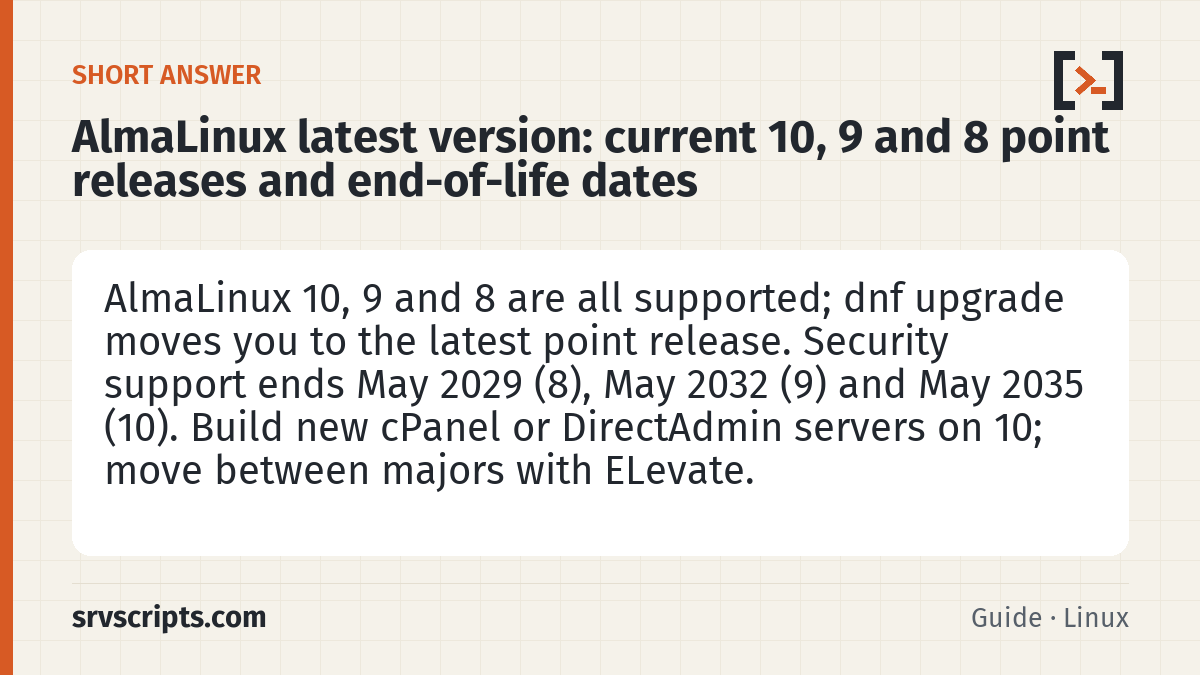
Short answer: The latest AlmaLinux releases are 10.3 (AlmaLinux 10), 9.9 (9) and 8.10 (8). Security support ends 31 May 2029 for AlmaLinux 8, 31 May 2032 for 9 and 31 May 2035 for 10. New cPanel and DirectAdmin servers should go on AlmaLinux 10 or 9; do not build new servers on 8. (Reviewed October 2026.)
Table of Contents
Current versions (live)
The table below comes from endoflife.date, refreshed twice a day. AlmaLinux point releases follow the matching RHEL point release by a few days; the “Support ends” date is the end of the major, not of the point release.
AlmaLinux — current versions
| Release line | Latest | Released | Support ends |
|---|---|---|---|
| 10 | 10.3 | 2026-11-16 | 2035-05-31 |
| 9 | 9.9 | 2026-11-16 | 2032-05-31 |
| 8 | 8.10 | 2024-05-28 | 2029-05-31 |
Last change in the tracker: 20 Nov 2026, 11:17 UTC · All tracked products · Vendor release notes
How AlmaLinux releases and support work
Each major has a ten-year life split into full support and maintenance support, mirroring RHEL; AlmaLinux ships security updates for the whole period. Point releases (10.1, 10.2…) are not separate branches: dnf upgrade moves a server to the latest point release automatically, and only the latest point release of a major receives updates.
AlmaLinux 8 is in its last years and still receives security fixes until May 2029, but new application versions (PHP, MariaDB, Node.js) increasingly require 9 or 10, and cPanel’s and DirectAdmin’s newest features target the newer majors. AlmaLinux 10 has been the recommended base for new servers since control-panel support arrived in 2025–2026.
Moving between majors is an in-place ELevate upgrade (Leapp-based) or a migration to a fresh server. Control panels support ELevate with their own wrappers; see cPanel ELevate 8 → 9 → 10. Firewalls are the usual casualty: CSF on AlmaLinux 10 (nftables and ipset).
Check which version you run
Check the release, the kernel and whether the server is actually on the latest point release:
cat /etc/almalinux-release
uname -r
dnf check-update | head          # pending updates
dnf --showduplicates list almalinux-release | tail -3   # newest point release in the repo
rpm -q kernel | sort -V | tail -1
Update safely
Within a major, updating is routine and includes point releases:
dnf upgrade --refresh, then reboot if the kernel changed (or use KernelCare to avoid reboots).- On cPanel,
upcpruns the OS update nightly when RPM updates are enabled; on DirectAdmin,dnfis yours to run. - If
dnfstops with “required file not found” after an upgrade, see the fix.
Between majors, plan a maintenance window and a full backup. Panel support for AlmaLinux 10: cPanel on AlmaLinux 10, DirectAdmin on AlmaLinux 10 and Debian 13, Plesk on AlmaLinux 10, and OpenLiteSpeed without a panel.
AlmaLinux versions at a glance
Official documentation: AlmaLinux release notes, AlmaLinux OS, endoflife.date: AlmaLinux.
Related guides: Is AlmaLinux 10 good for cPanel? Install guide and checklist · cPanel ELevate AlmaLinux 8 to 9 to 10: safe upgrade steps · Ubuntu vs AlmaLinux for cPanel: best OS for a new server.
Frequently asked questions
What is the latest AlmaLinux version?
AlmaLinux 10 is the newest major; its current point release, and the current 9.x and 8.x releases, are in the table at the top of this page, refreshed twice a day from endoflife.date.
When does AlmaLinux 8 reach end of life?
31 May 2029, the same date as RHEL 8. AlmaLinux 9 is supported until 31 May 2032 and AlmaLinux 10 until 31 May 2035. Each major gets ten years from its first release.
Should a new cPanel or DirectAdmin server use AlmaLinux 9 or 10?
AlmaLinux 10 for a new server in 2026: both panels support it for new installs and it has the longest support window. Choose 9 only if a required add-on (an older CloudLinux or KernelCare component, a monitoring agent) has not been released for 10 yet.