Call recordings are the fastest-growing thing on a PBX: at about 1 MB per minute of WAV, a ten-person office fills a small VPS disk in months, and a full disk stops Asterisk writing voicemail, logs and the database. Many businesses also have a legal or contractual limit on how long recordings may be kept. This call recording retention cleaner removes recordings older than the period you set, or moves them into an archive first.
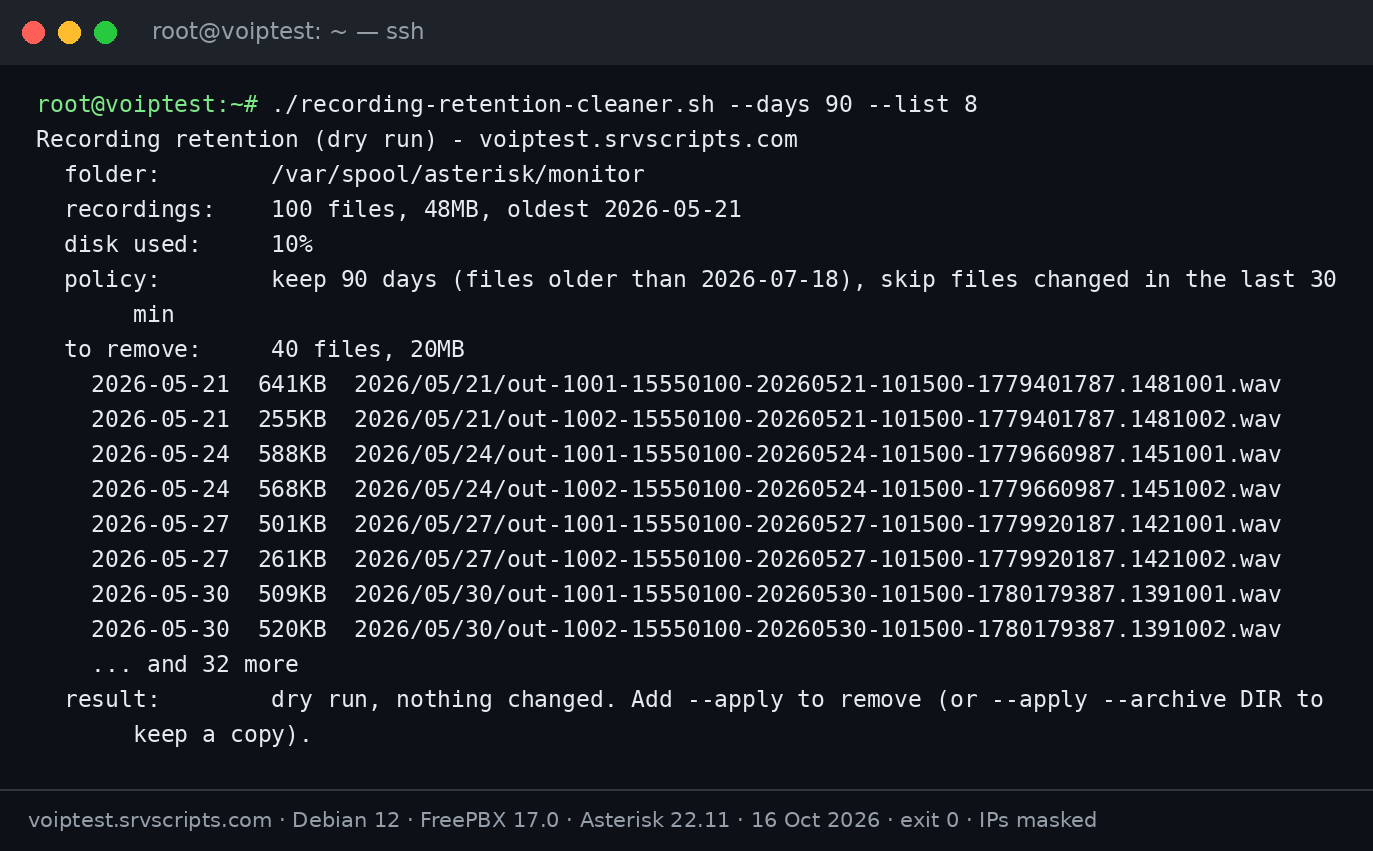
It is a dry run unless you add --apply, so the first run only shows what it would remove and how much space that frees.
Version 1.0.1 (17 October 2026): An independent review found that when every old recording was still open by a process, 1.0.0 kept its full list and could remove them, and our own retest found that the fuser check it relied on could fail silently. 1.0.1 finds open files directly in /proc, re-checks every file (age, link, open) immediately before removing it, and handles any file name safely. If you run 1.0.0 with --apply, update.
Table of Contents
What the recording retention cleaner does
- Finds recordings older than
--days(default 90) under/var/spool/asterisk/monitor, in the FreePBXYYYY/MM/DDlayout or any other, by file type (WAV, MP3, GSM, OGG, Opus and others). - Skips files changed in the last 30 minutes and files any process still holds open (read from /proc), and checks each file again right before removing it, so a call being recorded is not touched.
- With
--archive DIR, packs the old files into a dated.tar.gz(readable by root only), checks that every file is in the archive, and deletes the originals only after that check. - With
--update-cdr, clearsrecordingfilein the FreePBX call log for removed files, so the web player stops offering recordings that no longer exist. - With
--only-if-disk 85, does nothing unless the disk is at least 85% full, which suits a disk-pressure safety net. - Removes empty date folders, logs every run that removes files to syslog, and refuses dangerous folders such as
/or/etc.
Before you run it with --apply: backup and revert
Deleted recordings cannot be brought back by the script. Check your legal retention period first (rules differ by country and industry), then either use --archive or take a backup:
tar -czf /root/recordings-backup-$(date +%F).tar.gz -C /var/spool/asterisk monitor
mysqldump asteriskcdrdb cdr | gzip > /root/cdr-backup-$(date +%F).sql.gz   # only if you use --update-cdr
Revert: restore the files from the archive or backup (archives store paths without the leading slash), and the call log links from the dump:
tar -xzpf /root/rec-archive/recordings-YYYYmmdd-HHMMSS.tar.gz -C /
zcat /root/cdr-backup-DATE.sql.gz | mysql asteriskcdrdb
Install and first run
curl -fsSLO https://scr.srvscripts.com/recording-retention-cleaner/recording-retention-cleaner.sh
bash recording-retention-cleaner.sh --days 90                     # dry run: list only
bash recording-retention-cleaner.sh --days 90 --apply --archive /root/rec-archive
bash recording-retention-cleaner.sh --days 365 --apply --update-cdr
Exit codes: 0 done or nothing to do, 1 the disk is still above --only-if-disk after cleaning, 2 error (nothing is deleted when the archive cannot be written or read back; a failed call log update is also exit 2).
Tested on a real server
| Test | Result |
|---|---|
| Dry run, 90 days, on 100 recordings dated from 21 May to 17 Oct | 40 files (20 MB) listed, nothing changed |
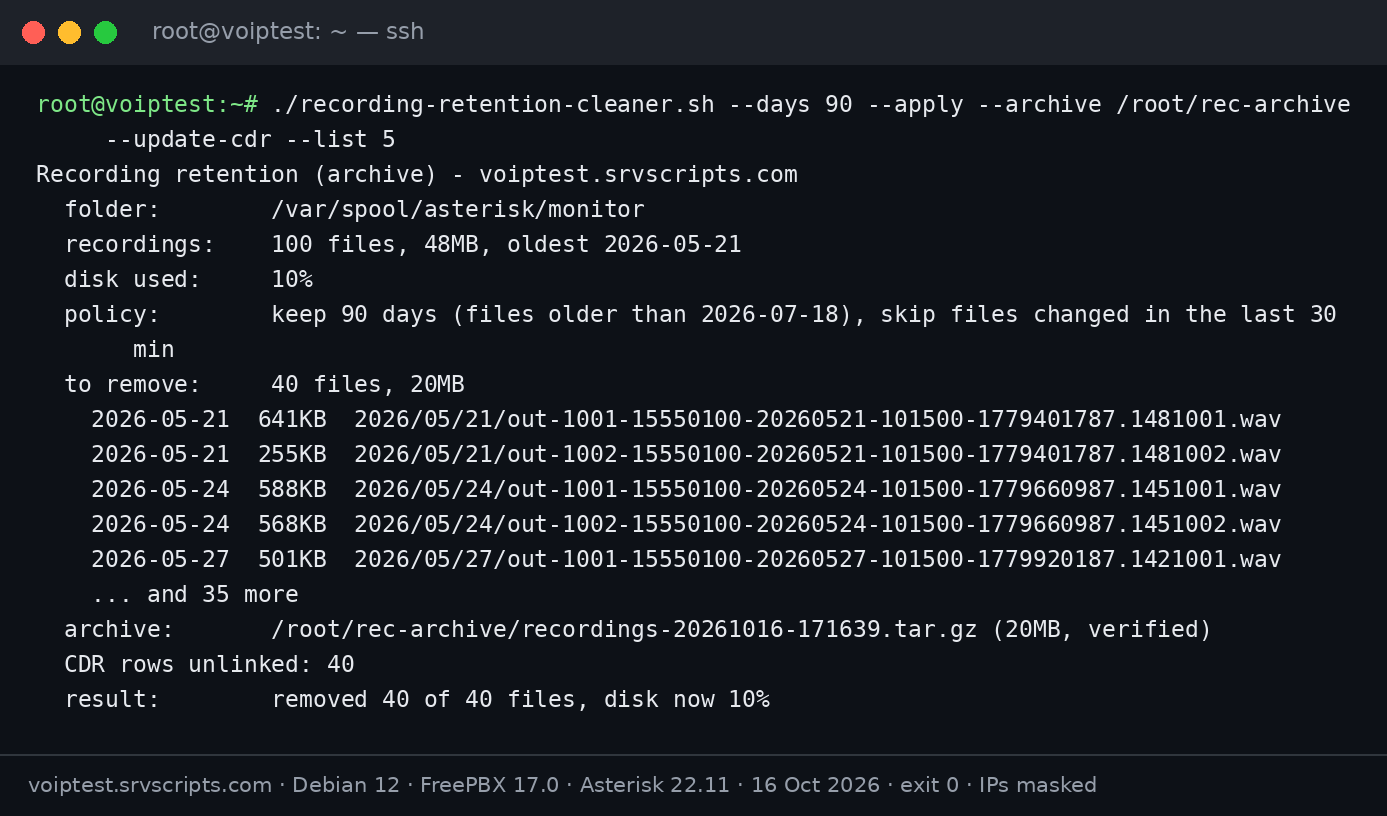
--apply --archive --update-cdr, 90 days | Archive written and checked (20 MB), 40 files removed, 40 call log rows unlinked, empty folders removed, syslog entry written |
| Revert: extract that archive | All 100 recordings back with their original dates |
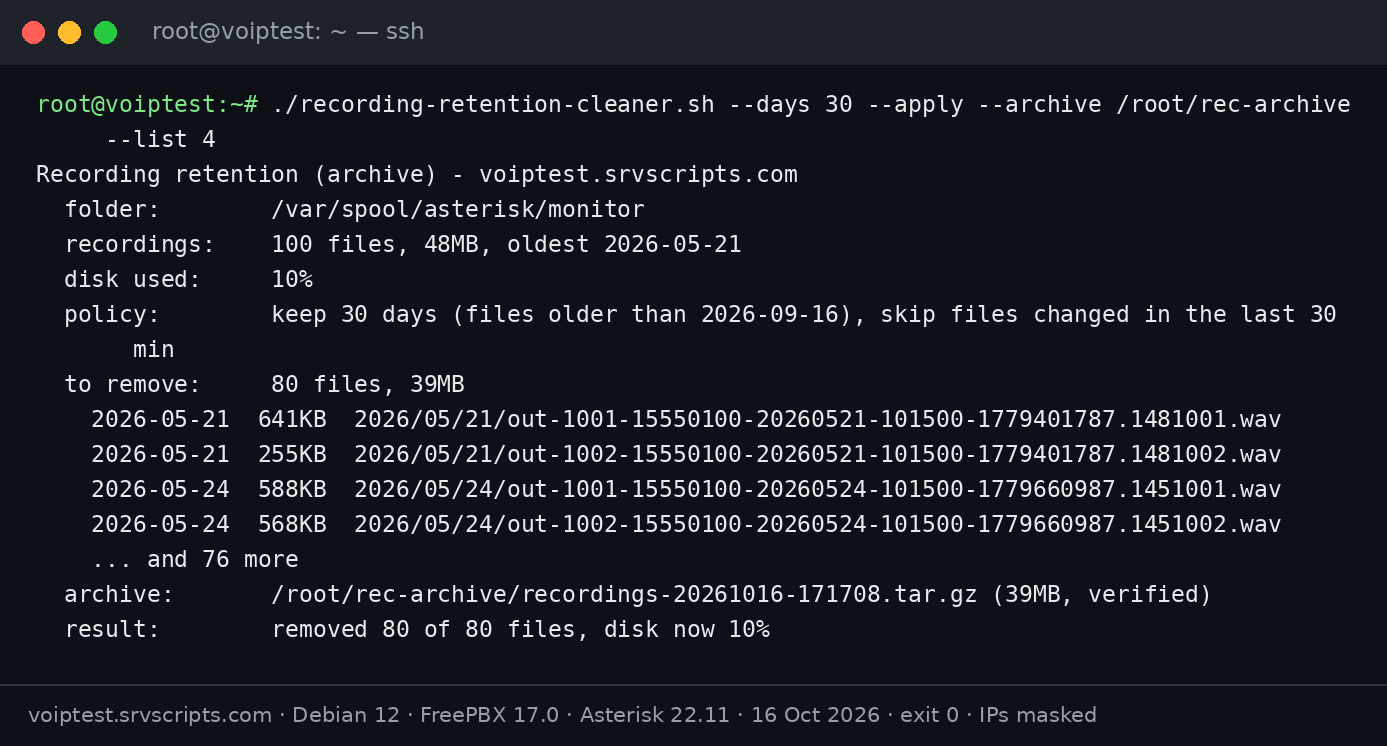
--apply --archive, 30 days | 80 files archived and removed; archive saved as mode 600 in a 700 folder |
| Guards | --days 0 and --dir /etc refused with exit 2; --only-if-disk 99 on a 10% full disk did nothing |
| 1.0.1: all 40 old recordings held open by a process | Nothing removed, “skipped: 40 old file(s) still open” |
1.0.1: 2 of 40 held open, with --archive | 38 archived and removed; the 2 open files kept |
| Regression test: names with a newline, a tab and a quote | Archived (4 of 4 files) and removed correctly |
We ran these tests on our FreePBX 17 lab server (Debian 12, Asterisk 22.11, 4 vCPU) on 16 October 2026. The recordings were test files with back-dated timestamps and matching rows in the FreePBX call log, so no real calls were involved. Our test also caught one problem before release: the first build saved the archive readable by every local user, and version 1.0.0 now creates it for root only. The screenshots are the real terminal output; only IP addresses are masked.
Run it from cron
Weekly, keeping 180 days and archiving to a mounted backup disk:
# /etc/cron.d/recording-retention
30 3 * * 0 root /usr/local/bin/recording-retention-cleaner.sh --days 180 --apply --archive /mnt/backup/recordings --quiet
Or as a safety net that only acts when the disk is filling up:
15 * * * * root /usr/local/bin/recording-retention-cleaner.sh --days 60 --apply --only-if-disk 85 --quietOptions
| Option | Meaning |
|---|---|
--days N | Keep recordings newer than N days (default 90, minimum 1) |
--dir PATH | Recordings folder (default /var/spool/asterisk/monitor) |
--apply | Actually delete or archive; without it the run is a dry run |
--archive DIR | Move old files into DIR/recordings-DATE.tar.gz first, checked, then delete the originals |
--only-if-disk P | Do nothing unless the filesystem is at least P% full |
--update-cdr | Clear cdr.recordingfile for removed files (FreePBX) |
--min-age-min M | Never touch files changed in the last M minutes (default 30) |
--list N | Show up to N file names (default 20) |
--quiet, --json | One summary line, or a JSON summary for monitoring |
Notes
- Want smaller files instead of fewer? Convert them first with Asterisk recordings to MP3, which makes WAV recordings several times smaller.
- Archives contain personal data. Keep them on encrypted or access-controlled storage and delete them when the retention period ends.
- FreePBX also has per-extension recording settings; recording less is the cheapest retention policy. See call recording with MixMonitor.
Related: call recording converter, FreePBX off-site backup, transcribe Asterisk recordings.
For the EU storage-limitation rule behind many retention periods, see GDPR Article 5(1)(e). Your own legal obligations may differ.
The script
#!/usr/bin/env bash
# Asterisk Call Recording Retention Cleaner: Delete or Archive Old FreePBX Recordings (v1.0.1) - from srvScripts.com
# Source, docs and updates: https://srvscripts.com/scripts/recording-retention-cleaner/
# Copyright (c) 2026 srvScripts.com. MIT licence: if you copy, share or adapt this script, keep this notice and credit srvScripts.com.
#
# Default is a DRY RUN: it only lists what it would remove and how much space that frees.
# Nothing is deleted unless you pass --apply. With --archive DIR, old recordings are moved
# into a dated .tar.gz archive instead of being deleted.
#
# Version 1.0.1 (2026-10-17): open-file exclusion fixed (when every old file was open, 1.0.0 kept the full list
#   and could remove them); open files are now found in /proc instead of fuser; each file is re-checked (age,
#   link, open) right before removal; NUL-safe file names;
#   a failed CDR update is reported (exit 2). Found in an independent review.
# Version 1.0.0 (2026-10-17): first release. Tested on FreePBX 17.0.33 / Asterisk 22.11 (Debian 12) with 100 test
#   recordings spread over 150 days: dry run, archive + delete, CDR unlink, restore from the archive.
# Should work on any Asterisk box that stores recordings as files (FreePBX layout
# /var/spool/asterisk/monitor/YYYY/MM/DD/*.wav|*.mp3|*.gsm).
#
# BEFORE YOU RUN WITH --apply
#   1. Run it without --apply and read the list.
#   2. Check your legal / contract retention period first (call recording rules differ by country).
#   3. If you might need the files later, use --archive /path instead of plain delete, or back up:
#        tar -czf /root/recordings-backup-$(date +%F).tar.gz -C /var/spool/asterisk monitor
#   4. With --update-cdr, back up the CDR table too:
#        mysqldump asteriskcdrdb cdr | gzip > /root/cdr-backup-$(date +%F).sql.gz
# REVERT
#   Deleted files cannot be undone by this script. Restore from your backup or archive:
#        tar -xzpf ARCHIVE.tar.gz -C /          (archives store absolute paths without the leading /)
#   CDR links:  zcat /root/cdr-backup-DATE.sql.gz | mysql asteriskcdrdb
#
# Usage: recording-retention-cleaner.sh [options]
#   --days N           keep recordings newer than N days (default 90)
#   --dir PATH         recordings folder (default /var/spool/asterisk/monitor)
#   --apply            actually delete (or archive). Without it: dry run
#   --archive DIR      move old files into DIR/recordings-YYYYmmdd-HHMMSS.tar.gz, then delete originals
#   --only-if-disk P   do nothing unless the filesystem is at least P% full
#   --update-cdr       blank cdr.recordingfile for removed files (FreePBX CDR reports stop linking them)
#   --min-age-min M    never touch files modified in the last M minutes (default 30; protects live calls)
#   --list N           show up to N file names (default 20)
#   --quiet            print only the summary line
#   --json             machine-readable summary
#   -h | --help
# Exit codes: 0 ok / nothing to do, 1 disk still above --only-if-disk after cleaning, 2 error
set -euo pipefail
VERSION=1.0.1
DIR=/var/spool/asterisk/monitor
DAYS=90; APPLY=0; ARCHIVE=""; DISKP=""; UPDCDR=0; MINAGE=30; LIST=20; QUIET=0; JSON=0
EXTS='wav|WAV|mp3|gsm|ogg|opus|wav49|sln|g729'

die(){ echo "ERROR: $*" >&2; exit 2; }
say(){ [ "$QUIET" = 1 ] || [ "$JSON" = 1 ] || echo "$@"; }
human(){ numfmt --to=iec --suffix=B "${1:-0}" 2>/dev/null || echo "${1}B"; }

while [ $# -gt 0 ]; do
  case "$1" in
    --days) DAYS=${2:?}; shift ;;
    --dir) DIR=${2:?}; shift ;;
    --apply) APPLY=1 ;;
    --archive) ARCHIVE=${2:?}; shift ;;
    --only-if-disk) DISKP=${2:?}; shift ;;
    --update-cdr) UPDCDR=1 ;;
    --min-age-min) MINAGE=${2:?}; shift ;;
    --list) LIST=${2:?}; shift ;;
    --quiet) QUIET=1 ;;
    --json) JSON=1 ;;
    -h|--help) sed -n '2,42p' "$0"; exit 0 ;;
    --version) echo "$VERSION"; exit 0 ;;
    *) die "unknown option $1 (see --help)" ;;
  esac; shift
done

[[ "$DAYS" =~ ^[0-9]+$ ]] && [ "$DAYS" -ge 1 ] || die "--days must be a whole number of 1 or more"
[[ "$MINAGE" =~ ^[0-9]+$ ]] || die "--min-age-min must be a number"
[ -z "$DISKP" ] || [[ "$DISKP" =~ ^[0-9]+$ && "$DISKP" -le 100 ]] || die "--only-if-disk must be 0-100"
[ -d "$DIR" ] || die "$DIR does not exist"
case "$(readlink -f "$DIR")" in /|/etc|/etc/*|/usr|/usr/*|/var|/root|/home) die "refusing to clean $DIR";; esac
[ "$(id -u)" = 0 ] || [ -w "$DIR" ] || die "run as root (or as the asterisk user)"

exec 9>/run/lock/srvs-recording-cleaner.lock 2>/dev/null || exec 9>/tmp/srvs-recording-cleaner.lock
flock -n 9 || die "another run is in progress"

usedpct(){ df -P "$DIR" | awk 'NR==2{gsub("%","",$5);print $5}'; }
before_pct=$(usedpct)
if [ -n "$DISKP" ] && [ "$before_pct" -lt "$DISKP" ]; then
  say "Disk is ${before_pct}% full (threshold ${DISKP}%): nothing to do."
  [ "$JSON" = 1 ] && printf '{"version":"%s","action":"skipped","disk_used_pct":%s,"threshold_pct":%s}\n' "$VERSION" "$before_pct" "$DISKP"
  exit 0
fi

tmp=$(mktemp -d); trap 'rm -rf "$tmp"' EXIT
RDIR=$(readlink -f "$DIR")
# Open files are found by reading every process's open file descriptors in /proc (no fuser needed: its exit
# code cannot tell "not in use" from an error). Run as root so all processes are visible; Asterisk writes
# recordings as the asterisk user, so running as that user also sees them.
declare -A OPEN=()
open_scan() {
  OPEN=(); local l
  while IFS= read -r -d '' l; do OPEN[$l]=1; done < <(find /proc/[0-9]*/fd -maxdepth 1 -type l -lname "$RDIR/*" -printf '%l\0' 2>/dev/null)
}
is_open() { [ -n "${OPEN[$1]:-}" ]; }
open_scan
# still_eligible FILE: re-checked immediately before removal: regular file (not a link), still old enough by
# age AND by last change, and not open.
still_eligible() {
  [ -f "$1" ] && [ ! -L "$1" ] || return 1
  [ -n "$(find "$1" -maxdepth 0 -mtime +"$((DAYS-1))" -mmin +"$MINAGE" 2>/dev/null)" ] || return 1
  ! is_open "$1"
}
# Candidates (NUL-separated, so unusual file names are safe): old enough, not changed in the last MINAGE
# minutes, a recording extension, and not open by any process.
files=(); sizes=(); skipped_open=0
while IFS=$'\t' read -r -d '' sz f; do
  if is_open "$f"; then skipped_open=$((skipped_open+1)); continue; fi
  files+=("$f"); sizes+=("$sz")
done < <(find "$RDIR" -xdev -type f -mtime +"$((DAYS-1))" -mmin +"$MINAGE" -regextype posix-extended \
           -regex ".*\.($EXTS)$" -printf '%s\t%p\0' | sort -z -t$'\t' -k2)
count=${#files[@]}; bytes=0; for sz in "${sizes[@]}"; do bytes=$((bytes+sz)); done
total_count=$(find "$DIR" -xdev -type f -regextype posix-extended -regex ".*\.($EXTS)$" -printf x | wc -c)
total_bytes=$(du -sb "$DIR" | cut -f1)
oldest=$(find "$DIR" -xdev -type f -regextype posix-extended -regex ".*\.($EXTS)$" -printf '%TY-%Tm-%Td\n' | sort | head -1)

mode="dry run"; [ "$APPLY" = 1 ] && mode=$([ -n "$ARCHIVE" ] && echo "archive" || echo "delete")
say "Recording retention ($mode) - $(hostname -f 2>/dev/null || hostname)"
say "  folder:        $DIR"
say "  recordings:    $total_count files, $(human "$total_bytes"), oldest ${oldest:-none}"
say "  disk used:     ${before_pct}%"
say "  policy:        keep $DAYS days (files older than $(date -d "-$DAYS days" +%F)), skip files changed in the last $MINAGE min"
[ "$(id -u)" = 0 ] || say "  note:          not running as root: files held open by other users' processes are not visible"
[ "$skipped_open" -gt 0 ] && say "  skipped:       $skipped_open old file(s) still open by a process (call in progress?)"
say "  to remove:     $count files, $(human "$bytes")"
if [ "$count" -gt 0 ] && [ "$LIST" -gt 0 ]; then
  for ((i=0; i<count && i<LIST; i++)); do
    say "    $(date -r "${files[$i]}" +%F)  $(human "${sizes[$i]}")  $(printf '%q' "${files[$i]#"$DIR"/}" | sed "s/^'\(.*\)'$/\1/")"
  done
  [ "$count" -gt "$LIST" ] && say "    ... and $((count-LIST)) more"
fi

removed=0; changed=0; archived_to=""; cdr_rows=0; cdr_err=0
if [ "$APPLY" = 1 ] && [ "$count" -gt 0 ]; then
  if [ -n "$ARCHIVE" ]; then
    [ -d "$ARCHIVE" ] || { mkdir -p "$ARCHIVE" && chmod 700 "$ARCHIVE"; }; [ -w "$ARCHIVE" ] || die "cannot write to $ARCHIVE"
    archived_to="$ARCHIVE/recordings-$(date +%Y%m%d-%H%M%S).tar.gz"
    printf '%s\0' "${files[@]#/}" > "$tmp/names"
    ( umask 077; tar -C / --null -czf "$archived_to" -T "$tmp/names" ) || die "archive failed; nothing deleted"
    n_in=$(tar -tzf "$archived_to" | wc -l) || die "archive cannot be read back; nothing deleted ($archived_to kept)"
    [ "$n_in" -eq "$count" ] || die "archive holds $n_in of $count files; nothing deleted ($archived_to kept)"
    say "  archive:       $archived_to ($(human "$(stat -c %s "$archived_to")"), $n_in files, read back)"
  fi
  : > "$tmp/removed"
  open_scan   # fresh view of open files right before removal
  for f in "${files[@]}"; do
    if still_eligible "$f"; then
      if rm -f -- "$f" && [ ! -e "$f" ]; then removed=$((removed+1)); printf '%s\0' "${f##*/}" >> "$tmp/removed"; fi
    else changed=$((changed+1)); fi
  done
  [ "$changed" -gt 0 ] && say "  kept:          $changed file(s) changed, opened or vanished since the scan"
  find "$DIR" -xdev -mindepth 1 -type d -empty -delete 2>/dev/null || true
  if [ "$UPDCDR" = 1 ] && [ "$removed" -gt 0 ]; then
    if command -v mysql >/dev/null 2>&1; then
      in=$(while IFS= read -r -d '' b; do [[ "$b" == *$'\n'* ]] && continue; b=${b//\\/\\\\}; printf "'%s'," "${b//\'/\'\'}"; done < "$tmp/removed")
      if [ -n "$in" ] && cdr_rows=$(mysql -N asteriskcdrdb -e "UPDATE cdr SET recordingfile='' WHERE recordingfile IN (${in%,}); SELECT ROW_COUNT();" 2>>"$tmp/sqlerr"); then
        say "  CDR rows unlinked: $cdr_rows"
      else cdr_err=1; cdr_rows=0; say "  ERROR: the CDR update failed ($(head -1 "$tmp/sqlerr" 2>/dev/null)); recordings were removed but the call log still links them"; fi
    else cdr_err=1; say "  ERROR: mysql client not found; --update-cdr was not applied"; fi
  fi
  logger -t srvs-recording-cleaner "removed $removed recordings ($(human "$bytes")) older than $DAYS days from $DIR${archived_to:+, archived to $archived_to}" || true
fi

after_pct=$(usedpct); rc=0; [ "$cdr_err" = 1 ] && rc=2
if [ "$APPLY" = 1 ]; then
  say "  result:        removed $removed of $count files, disk now ${after_pct}%"
  [ -n "$DISKP" ] && [ "$after_pct" -ge "$DISKP" ] && { say "  WARN: disk is still at or above ${DISKP}%; lower --days or add storage"; rc=1; }
else
  say "  result:        dry run, nothing changed. Add --apply to remove (or --apply --archive DIR to keep a copy)."
fi
if [ "$QUIET" = 1 ] && [ "$JSON" = 0 ]; then
  echo "recordings: $mode, $count file(s) $(human "$bytes") older than $DAYS days, removed $removed, disk ${before_pct}%->${after_pct}%"
fi
if [ "$JSON" = 1 ]; then
  printf '{"version":"%s","mode":"%s","dir":"%s","keep_days":%s,"total_files":%s,"total_bytes":%s,"candidates":%s,"candidate_bytes":%s,"removed":%s,"archive":"%s","cdr_rows_unlinked":%s,"disk_used_pct_before":%s,"disk_used_pct_after":%s}\n' \
    "$VERSION" "$mode" "$DIR" "$DAYS" "$total_count" "$total_bytes" "$count" "$bytes" "$removed" "$archived_to" "${cdr_rows:-0}" "$before_pct" "$after_pct"
fi
exit $rc
25a23f2effd330e89c9d6f6f708fa6a1cda820f4d8e69b494863a59acf3d13accurl -fsSL -o recording-retention-cleaner.sh https://scr.srvscripts.com/recording-retention-cleaner/recording-retention-cleaner.sh && curl -fsSL https://scr.srvscripts.com/recording-retention-cleaner/recording-retention-cleaner.sh.sha256 | sha256sum -cInvoke-WebRequest -Uri 'https://scr.srvscripts.com/recording-retention-cleaner/recording-retention-cleaner.sh' -OutFile 'recording-retention-cleaner.sh'; if ((Get-FileHash 'recording-retention-cleaner.sh' -Algorithm SHA256).Hash -eq '25A23F2EFFD330E89C9D6F6F708FA6A1CDA820F4D8E69B494863A59ACF3D13AC') { 'OK: the file is intact' } else { 'MISMATCH: do not run this file' }curl and sha256sum are not the Linux tools, so use the PowerShell line there.Also on GitHub: github.com/srvscripts/scripts
Frequently asked questions
How long should we keep call recordings?
It depends on your country and industry. Some regulations require recordings to be kept for a set period, while data protection laws such as the GDPR require deleting them once they are no longer needed. Check with your legal adviser, then set --days to match.
Will it delete a call that is being recorded right now?
No. Files changed in the last 30 minutes, or held open by a process, are skipped.
Can I keep a copy instead of deleting?
Yes. --archive DIR packs the old recordings into a tar.gz, checks the archive contains every file, and only then deletes the originals.
Why do old calls still show a play button in FreePBX?
The call log still points at the deleted file. Run with --update-cdr to clear those links.
Does it work without FreePBX?
Yes. It works on any Asterisk server that stores recordings as files. Only --update-cdr needs the FreePBX call log database.